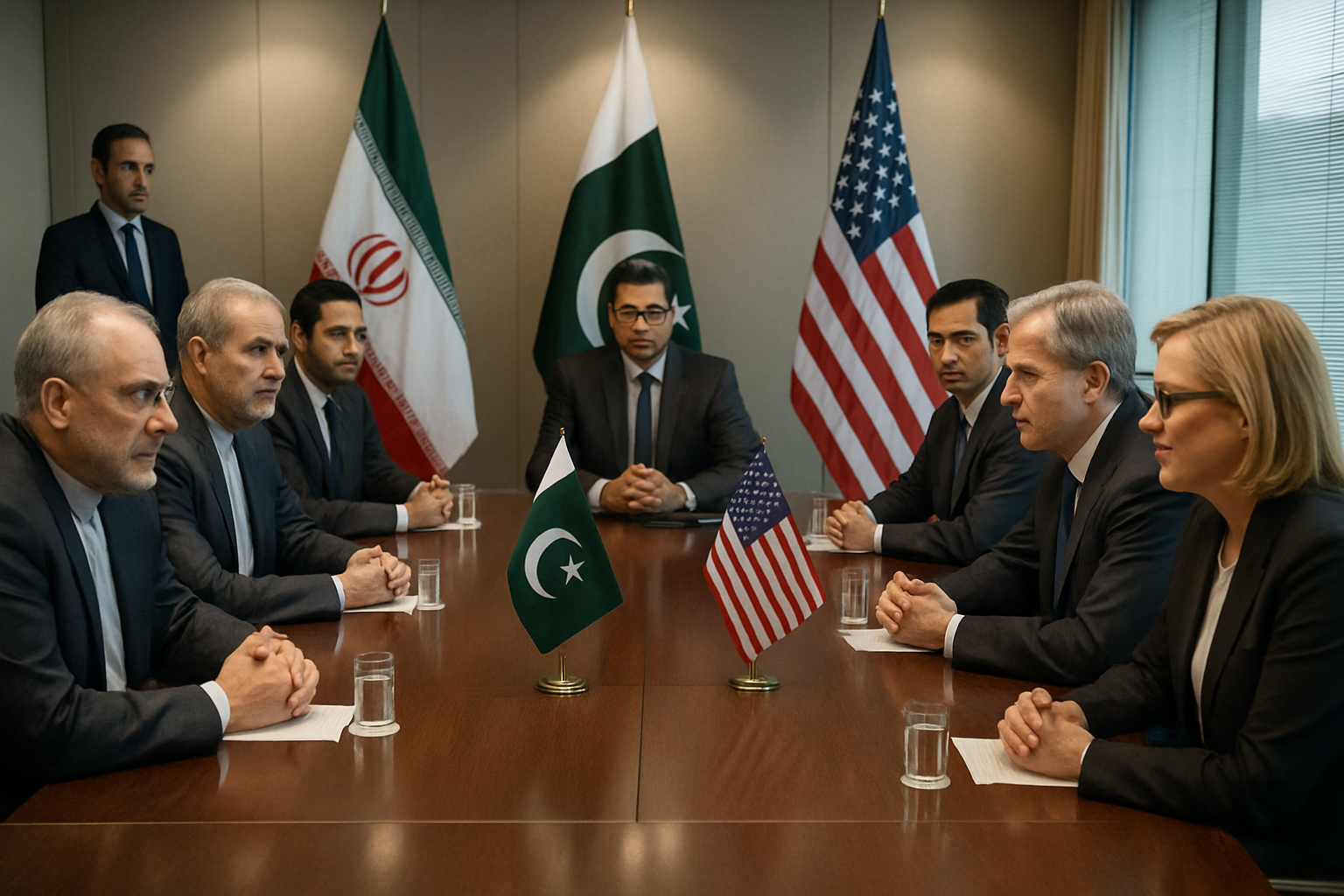
Historic diplomatic negotiations between Iran and the United States have officially commenced in Islamabad, Pakistan, representing the most direct engagement between the two adversaries in decades following a breakthrough ceasefire that ended the most dangerous international crisis since the Cold War.
Vice President J.D. Vance leads a high-level American delegation including Special Envoy Steve Witkoff and potentially former senior advisor Jared Kushner, while Iranian President Masoud Pezeshkian heads the Tehran delegation alongside Foreign Minister Abbas Araghchi and Parliament Speaker Mohammad-Bagher Ghalibaf. The talks, facilitated by Pakistan's Prime Minister Shehbaz Sharif and Field Marshal Asim Munir, follow the historic "Islamabad Accord" framework that prevented global catastrophe just 88 minutes before President Trump's "whole civilization will die tonight" deadline on April 8, 2026.
Pakistan's Diplomatic Triumph
Pakistan's emergence as the crucial mediator represents a watershed moment in 21st-century diplomacy. Through an innovative "message relay system," Prime Minister Sharif and Field Marshal Munir maintained round-the-clock contact with both Vice President Vance and Iranian officials, successfully bridging the communication gap between two nuclear-armed adversaries when traditional diplomatic channels had failed.
"Pakistan's mediation demonstrates that middle powers can successfully bridge major adversary divides when traditional mechanisms fail."
— UN Secretary-General António Guterres
The diplomatic breakthrough triggered immediate global relief, with oil prices crashing nearly 20% from their crisis peak of $119.50 per barrel for Brent crude to below $100 - the steepest decline in six years. Asian stock markets erupted in celebration, with Pakistan's KSE-100 index recording a historic 8.15% surge.
The Comprehensive Framework
Iran's 10-point proposal, accepted by the Trump administration as a "workable basis for negotiations," addresses the most complex issues in US-Iran relations. The framework encompasses Strait of Hormuz navigation protocols, sanctions relief mechanisms, regional conflict resolution, and comprehensive security guarantees - representing the most detailed US-Iran diplomatic framework since the 2015 nuclear deal.
The negotiations come at a critical juncture, with Iran maintaining 60% uranium enrichment levels and possessing over 400 kilograms of weapons-grade material sufficient for multiple nuclear devices. The diplomatic window is particularly significant given the February 2026 expiration of the New START treaty between the US and Russia, marking the first time in over 50 years without nuclear constraints between major powers.
Global Crisis Resolution
The ceasefire agreement ended a six-week conflict that had reached unprecedented global proportions. Operation Epic Fury, costing $11.3 billion in its first week alone, represented the largest Middle East military operation since the 2003 Iraq invasion. The crisis saw the effective closure of the Strait of Hormuz, through which 40% of global oil transit passes, leading to the stranding of over 150 tankers worth billions in cargo.
The aviation industry faced COVID-scale disruption with over 18,000 flights cancelled worldwide. Eight Middle Eastern countries simultaneously closed their airspaces, creating what analysts described as an "aviation black hole" affecting Asia-Europe travel corridors. Dubai International Airport, the world's busiest, remained shut due to missile damage.
Regional Coalition Dynamics
The Saudi-UAE-Qatar-Egypt coalition weathered its most severe test during the crisis, with Iran's "Operation True Promise 4" systematically targeting member territories. The UAE suffered one civilian death in Abu Dhabi, Kuwait reported 32 injuries from airport strikes, and Qatar had 8 wounded while intercepting Iranian missiles and drones. Despite these direct attacks, the coalition maintained its consensus supporting diplomatic solutions.
Egyptian President Abdel Fattah el-Sisi's warnings about "comprehensive chaos" spreading across "sisterly countries" proved prescient, but the diplomatic breakthrough prevented the regional war he feared. China's Foreign Minister Wang Yi expressed "full support" for Pakistan's initiative, while Germany noted "positive signs" for the direct talks.
The Lebanon Loophole
A critical challenge threatens the talks' success: Israeli Prime Minister Benjamin Netanyahu's explicit exclusion of Lebanon from the ceasefire framework. Israel conducted its deadliest bombardment of Lebanon, killing over 254 people in a single day and displacing 1.2 million Lebanese civilians - representing 25% of the population.
The humanitarian crisis in Lebanon has seen systematic targeting of medical personnel, with 26 paramedics killed and 51 wounded since March. The November 2024 US-French ceasefire between Israel and Hezbollah completely collapsed in March 2026 when Hezbollah chose "Iranian solidarity over Lebanese sovereignty" following the death of Supreme Leader Ali Khamenei.
Iran has threatened withdrawal from the Islamabad talks unless comprehensive ceasefire enforcement covers all fronts. Vice President Vance acknowledged Iran's "legitimate misunderstanding" about Lebanon's inclusion, but emphasized that the US never agreed to include Israeli-Hezbollah operations in the ceasefire framework.
Economic and Energy Implications
The crisis exposed catastrophic vulnerabilities in global energy architecture, with the 21-mile Strait of Hormuz proving a single-point failure for modern logistics. Iran's deployment of 2,000-6,000 naval mines effectively closed this critical waterway, forcing the International Energy Agency to implement the largest strategic petroleum reserve release in 50 years - 400 million barrels from 32 countries.
Consumer relief is beginning globally, with Bangladesh reviewing fuel rationing for 170 million people and Pakistan considering reversing wartime austerity measures. European households anticipate electricity and gasoline cost reductions, while Qatar resumes LNG production representing 20% of global exports.
Iran has implemented an innovative cryptocurrency payment system requiring $1 per barrel for oil tankers to circumvent sanctions tracking, representing a dramatic shift in maritime commerce. The first ships to successfully navigate this system included the Greek-owned NJ Earth and Liberian-flagged Daytona Beach.
Nuclear Diplomacy Window
The current crisis emerged from the complete collapse of Geneva nuclear talks despite achieving "broad agreement on guiding principles" - the most progress since the 2018 JCPOA breakdown. The fundamental disagreement persists over scope: Iran insisting on nuclear-only negotiations excluding ballistic missiles and regional proxies, while the US demands comprehensive talks including missiles, armed groups, and human rights.
The succession of Mojtaba Khamenei as Iran's first hereditary Supreme Leader in the Islamic Republic's 47-year history has shifted governance toward military control under the Revolutionary Guards. President Trump's rejection of this succession, claiming the right to personally choose Iran's next leader, represents the most explicit assertion of American control over Iranian affairs since 1979.
Congressional and Public Opinion
The conflict faced unprecedented domestic opposition, with only 25% American support - described as "almost unprecedented" unpopularity for early-stage military operations. Senator Richard Blumenthal expressed being "more concerned than ever" about the deployment of ground troops, while financial markets served as the "ultimate constraint" forcing diplomatic solutions.
Pentagon operations were projected to extend through September 2026, far beyond the initial 4-6 week timeline. The human toll included 3 US service members killed and 150 wounded, while Iran's Red Crescent reported over 787 civilian casualties from US-Israeli strikes.
Template-Setting Significance
UN Secretary-General António Guterres described the crisis as the "greatest test of multilateral cooperation in the modern era." The rapid transition from diplomatic breakthrough to military escalation demonstrated the fragility of crisis management in the multipolar era.
The success or failure of the Islamabad negotiations will establish precedents for 21st-century conflict resolution, affecting approaches to territorial sovereignty enforcement, nuclear governance credibility, and energy security paradigms for decades. The innovative Pakistani mediation provides a template for middle power diplomacy when traditional great power mechanisms fail.
Critical Two-Week Window
The success of converting this temporary pause into a lasting framework depends on the negotiations' ability to bridge fundamental disagreements that have prevented breakthroughs for over a decade. The talks represent the most comprehensive US-Iran diplomatic engagement since 2015, addressing issues far beyond nuclear concerns to encompass regional conflicts and security guarantees.
Security arrangements for the talks involve over 10,000 Pakistani military and police personnel, with the Serena Hotel in Islamabad's Red Zone exclusively reserved for the delegations. Two local holidays have been declared to ensure security during this historic diplomatic moment.
The stakes extend far beyond bilateral US-Iran relations, affecting regional war prevention, global energy security, nuclear governance credibility, and international law enforcement mechanisms. Success could provide a framework for future crisis management in an increasingly volatile interconnected world, while failure risks returning to the most dangerous international crisis since the Cold War's end.
As delegates gather in Islamabad, the world watches to see whether diplomatic innovation can triumph over military confrontation, setting the template for international conflict resolution in the 21st century. The outcome will determine whether the preference for diplomatic solutions over military escalation can be preserved in an era of growing global tensions.