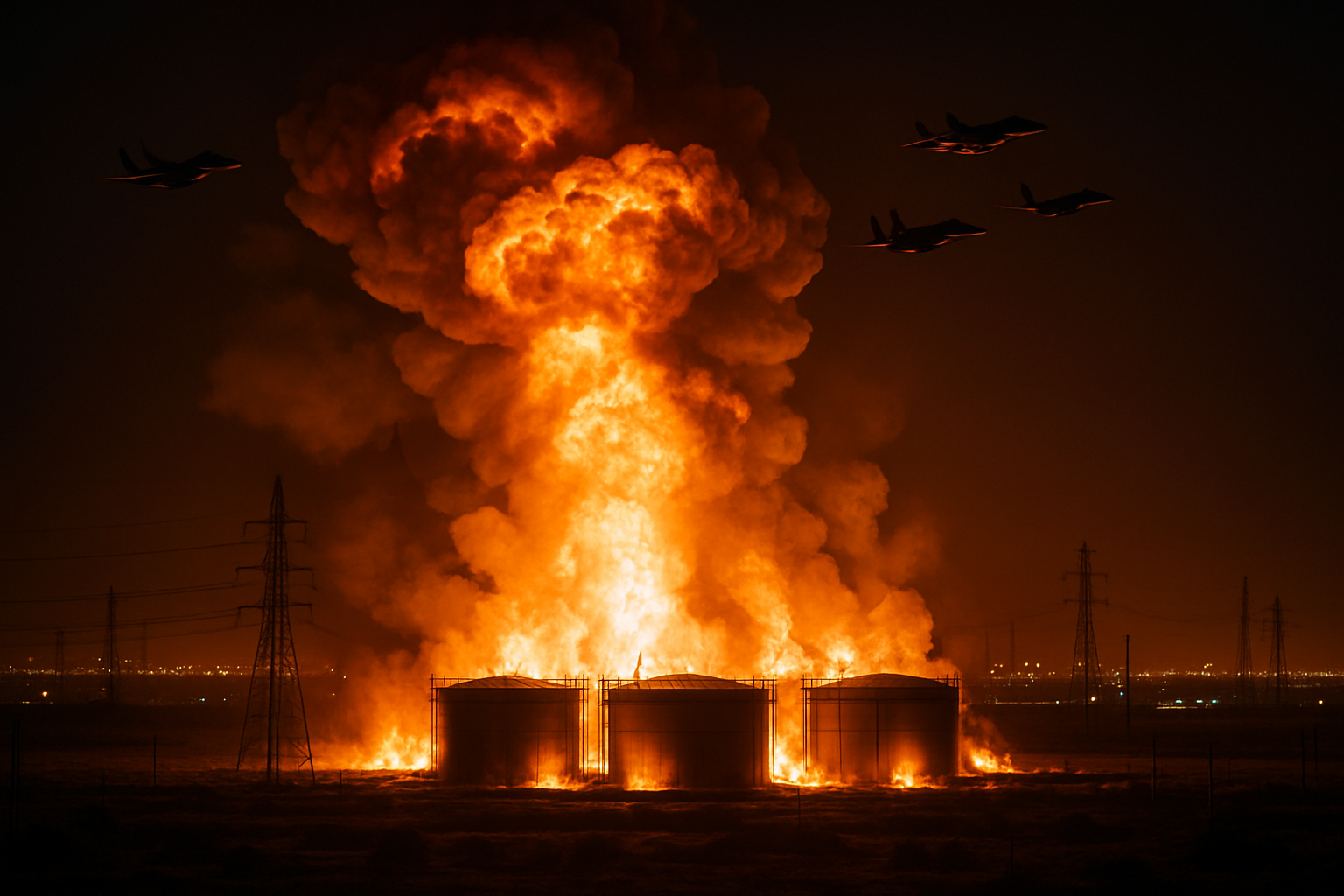
The month-long Middle East war reached a critical escalation point Tuesday as US forces launched strikes on Iranian nuclear facilities while Tehran retaliated with massive attacks on Gulf allies, creating the most dangerous international crisis since the Cold War end.
Powerful explosions rocked Iran's central city of Isfahan early Tuesday morning, marking the latest escalation in what has become the longest sustained military campaign in the region since the 2003 Iraq invasion. The strikes, part of the ongoing "Operation Epic Fury," targeted critical infrastructure including nuclear research facilities and weapons storage depots.
Nuclear Facilities Under Attack
US intelligence sources confirm that American forces hit Iranian nuclear sites with 2,000-pound bunker-buster bombs, targeting weapons storage facilities and missile production centers in coordinated strikes. The Isfahan attacks created massive secondary explosions and fires visible from space, according to satellite imagery.
International atomic watchdogs have raised urgent concerns about potential radiological disasters, as this marks the third time in ten days that nuclear facilities have been targeted. The strikes hit the Khondab heavy water reactor in Arak and uranium enrichment facilities at Ardakan, though no radiation leaks have been confirmed.
"We are seeing unprecedented targeting of nuclear infrastructure during an active conflict. This represents a extremely dangerous escalation that could have catastrophic consequences."
— Rafael Grossi, IAEA Director General
Iranian Retaliation Spreads Across Region
Iran responded with its most extensive regional strike campaign yet, launching ballistic missiles and drones against multiple targets across the Middle East. The attacks struck a fully loaded Kuwaiti oil tanker off the Dubai coast, setting it ablaze and creating a massive environmental disaster in the Persian Gulf.
The Iranian Revolutionary Guard confirmed strikes on US military bases in Saudi Arabia, wounding 12 American troops and damaging aircraft. Two US service members remain in critical condition following the Prince Sultan Air Base attack.
Meanwhile, a water desalination plant on Iran's Qeshm Island was knocked offline by airstrikes, cutting water supplies to thousands of civilians. Iranian media reports indicate the facility was hit during a coordinated bombing campaign that has now targeted over 11,000 sites across Iran.
Israeli Military Preparations Intensify
Israeli Defense Minister Katz announced plans to demolish "all residential buildings" in Lebanese border villages, "following the Gaza model," as Israel prepares for an extended military campaign. The announcement came as Israeli forces consolidated control over approximately 10% of Lebanese territory between the border and the Litani River.
More than 600,000 Lebanese residents who were forced to evacuate the southern region will be "absolutely prohibited" from returning until Israel's security is guaranteed, according to Israeli officials. The policy mirrors the systematic destruction carried out in Gaza's Rafah and Beit Hanoun neighborhoods.
Four Israeli soldiers were killed in combat operations in southern Lebanon Tuesday, bringing the total military casualties to levels not seen since the 2006 war. The deaths occurred as Israeli forces encountered heavier-than-expected resistance from Hezbollah fighters who have joined the conflict following the collapse of the November 2024 ceasefire.
Global Aviation and Energy Crisis
The conflict has triggered an unprecedented global transportation crisis, with over 18,000 flights cancelled worldwide—the most severe disruption since the COVID-19 pandemic. Eight Middle Eastern countries have simultaneously closed their airspace, creating a "black hole" in international aviation routes between Europe and Asia.
Dubai International Airport, the world's busiest for international passengers, remains completely shut down due to missile damage. Major carriers including Emirates, Air France-KLM, and Wizz Air have suspended Middle East operations indefinitely, stranding hundreds of thousands of passengers globally.
Oil markets have reached crisis levels, with Brent crude surging past $119.50 per barrel as Iran's naval mining operation has effectively closed the Strait of Hormuz to commercial shipping. The waterway, which carries 40% of global seaborne oil trade, now contains an estimated 2,000-6,000 naval mines deployed by Iranian forces.
Italy Blocks US Bomber Access
In a significant diplomatic development, Italy has refused to authorize US bombers to use its air bases for strikes against Iran, according to Italian press reports. The decision represents a crack in NATO solidarity as European allies express growing concern about the conflict's escalation.
The refusal to grant access to the Sigonella Air Base in Sicily forces US strategic bombers to use more distant bases, potentially limiting the scope and frequency of American operations against Iranian targets.
International Diplomatic Responses
European leaders have called for maximum restraint as the conflict threatens to engulf the entire region. France's foreign ministry warned that the targeting of nuclear facilities could trigger an "uncontrollable chain of events," while Germany has begun preparing contingency plans for a larger refugee crisis.
The United Nations Security Council scheduled emergency sessions for Wednesday as Secretary-General António Guterres declared the situation represents "the greatest test of multilateral cooperation in the modern era." Russia and China have condemned the strikes as violations of international law and sovereignty.
The crisis comes amid a broader breakdown of nuclear governance frameworks, with the New START treaty having expired in February—leaving the world without US-Russia nuclear constraints for the first time in over 50 years.
Humanitarian and Economic Impact
The Iranian Red Crescent reports over 787 civilian casualties from US-Israeli strikes, including a devastating school attack that killed between 53-85 students and staff. International human rights organizations are demanding Geneva Conventions investigations into potential war crimes.
The economic disruption has spread far beyond the Middle East, with Pakistan's stock exchange suffering its largest single-day decline in history (-8.97%) and emergency fuel rationing being implemented in Bangladesh, affecting 170 million people.
International evacuations are now the largest coordinated effort since the Arab Spring, with Australia reporting 115,000 trapped nationals and Germany evacuating 30,000 stranded tourists from the region.
Trump's Escalating Demands
President Trump has demanded Iran's "unconditional surrender" and claimed the right to personally choose Iran's next Supreme Leader, rejecting the hereditary succession of Mojtaba Khamenei following his father's death in early March. This represents the most direct assertion of American control over Iranian affairs since the 1979 revolution.
Congressional pressure is mounting, with only 25% of Americans supporting the military operations according to recent polling. Senator Richard Blumenthal expressed being "more concerned than ever" about potential ground troop deployment, while Pentagon sources indicate operations could continue through September—far beyond the initially projected 4-6 week timeline.
Template-Setting Crisis
Military analysts describe the current conflict as a template-setting moment for 21st-century international relations, demonstrating how rapidly diplomatic frameworks can collapse into military confrontation in an increasingly multipolar world.
The rapid transition from nuclear negotiations—which had achieved the most progress since the 2018 JCPOA collapse—to full-scale warfare within days illustrates the fragility of modern crisis management mechanisms.
"We are witnessing the most dangerous international crisis since the end of the Cold War, with implications that will reshape conflict resolution approaches for decades to come."
— UN Secretary-General António Guterres
Looking Ahead
As the conflict enters its second month, all diplomatic channels appear exhausted. Iran continues uranium enrichment at 60% purity with over 400kg of weapons-grade material, while Israel has announced plans for several more weeks of intensive military operations targeting Iranian defense infrastructure.
The deployment of thousands of US 82nd Airborne Division troops to the region has fueled speculation about potential ground operations, while Iran's expanding proxy network threatens to open new fronts across the Middle East.
Success in containing this crisis could provide a framework for future nuclear dispute resolution, but failure may accelerate the preference for military solutions over diplomacy—potentially encouraging nuclear proliferation globally while undermining the credibility of international institutions that have maintained relative stability since World War II.
The coming days will determine whether this remains a regional confrontation or evolves into a broader Middle Eastern war with global implications extending decades beyond the current crisis.