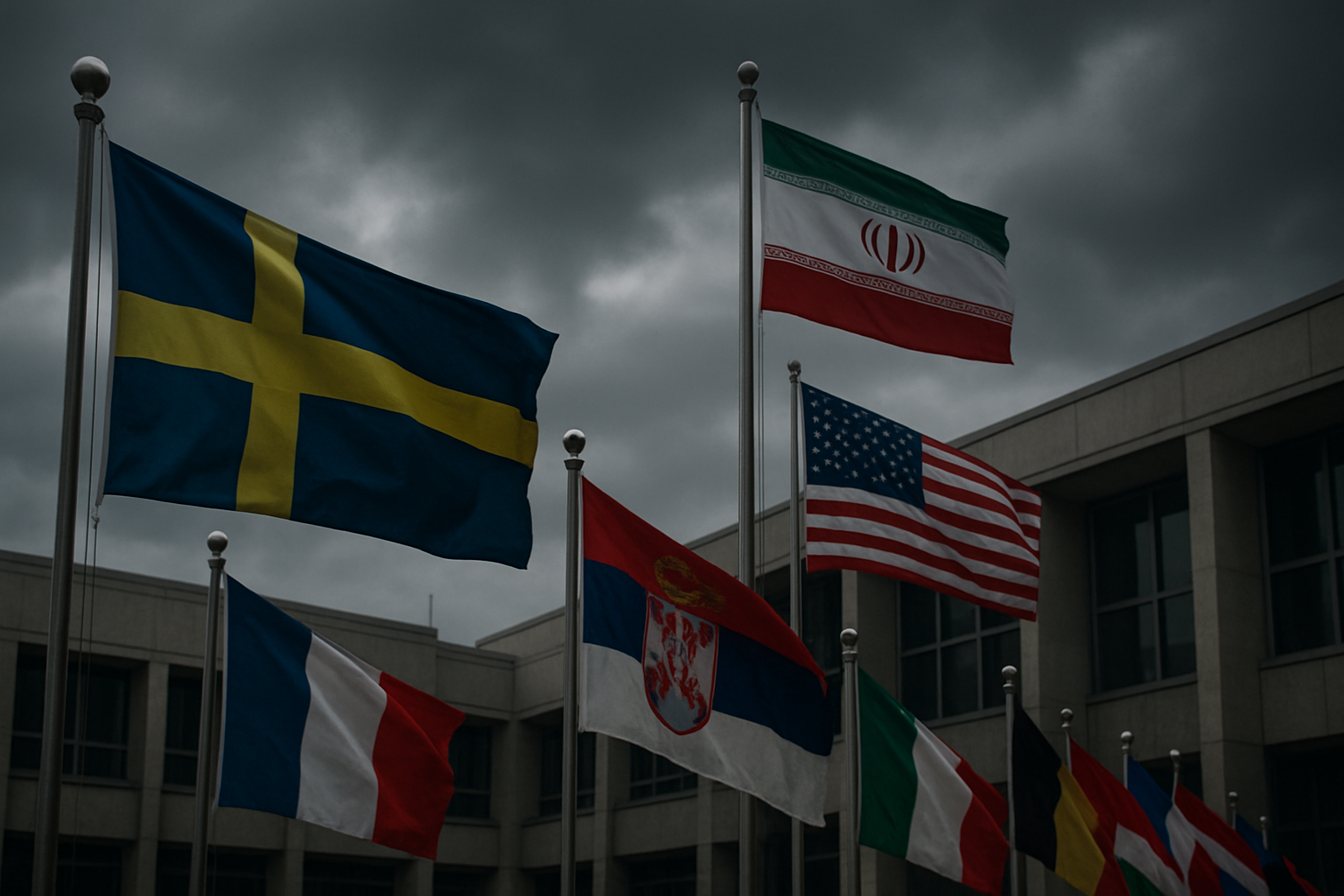
Multiple countries including Sweden and Serbia have issued urgent warnings for their citizens to evacuate Iran immediately, as tensions between Tehran and Washington reach a critical breaking point with the largest U.S. military buildup in the Middle East since the 2003 Iraq invasion.
Sweden's Ministry of Foreign Affairs announced Friday that the security situation in Iran and the surrounding region had become "extremely uncertain," strongly urging citizens to depart immediately. The warning comes amid an unprecedented escalation in U.S.-Iran tensions, with President Trump deploying dual aircraft carrier strike groups positioned just 800 kilometers from Iran's coast.
Unprecedented Military Escalation
The deployment of the USS Gerald R. Ford alongside the USS Abraham Lincoln represents approximately one-third of the active U.S. Navy fleet concentrated in the Persian Gulf region. Pentagon sources confirm military forces are prepared for potential strikes against Iran as early as this weekend, with operational scenarios ranging from targeted nuclear facility attacks to broader Revolutionary Guard infrastructure campaigns.
Albanian sources report that hundreds of American military personnel have been evacuated from bases across the Middle East, including Al Udeid Air Base in Qatar and facilities in Bahrain housing the Fifth Fleet. The withdrawal extends to U.S. troops stationed in Iraq, Syria, Kuwait, Saudi Arabia, Jordan, and the United Arab Emirates, according to Pentagon officials speaking anonymously to international media.
"The situation in Iran and the surrounding region is extremely uncertain. Citizens currently in Iran are strongly urged to depart immediately."
— Sweden's Ministry of Foreign Affairs
International Diplomatic Exodus
Serbia has joined Sweden in recommending that its citizens leave Iran "as soon as possible" due to the "risk of deteriorating security situation." Romania's G4Media reported that Serbian officials cited "growing tensions and the risk of deteriorating security situation" as justification for the evacuation advisory.
The evacuation warnings represent a stark escalation from recent diplomatic engagement efforts. Despite achieving what Iranian Foreign Minister Abbas Araghchi called "broad agreement on guiding principles" during Geneva talks mediated by Switzerland and Oman, fundamental disagreements persist over the scope of any potential nuclear agreement.
Nuclear Crisis at Critical Juncture
Iran continues enriching uranium at 60% purity, significantly above the 3.67% limit established in the 2015 nuclear deal and approaching the 90% threshold required for weapons-grade material. Intelligence assessments indicate Iran possesses sufficient enriched uranium for multiple nuclear weapons if weaponized.
The diplomatic impasse centers on scope disagreements that have plagued negotiations for over a decade. Iran maintains that ballistic missiles and regional proxy activities are "red lines" to be excluded from nuclear-only discussions, while U.S. Secretary of State Marco Rubio insists any comprehensive agreement must address missiles, armed groups, and human rights violations.
Trump Administration's Dual Approach
President Trump has issued increasingly explicit warnings, stating aboard Air Force One that Iran should understand "the consequences of not making a deal." Most significantly, Trump has made his most direct regime change comments to date, declaring that Iranian government overthrow would be "the best thing that could happen" — representing a policy evolution from nuclear-focused negotiations to comprehensive political transformation objectives.
The administration maintains a dual-track approach, combining maximum economic pressure through threats of 25% tariffs on Iran-trading countries with selective diplomatic engagement. This strategy reflects calculations about regional stability risks versus military confrontation that could reshape Middle Eastern geopolitics for decades.
Regional Powers Rally for Diplomacy
Despite the military escalation, an unprecedented regional coalition including Saudi Arabia, the UAE, Qatar, and Egypt continues backing diplomatic processes. This remarkable Middle Eastern consensus represents extraordinary unity in preventing military confrontation that could destabilize the Persian Gulf, through which 40% of global oil transit flows.
Oman has emerged as the critical mediator, leveraging its historical neutrality and successful role in facilitating the 2015 nuclear agreement. The Swiss decision to host talks in Geneva represents a venue evolution from Gulf-based negotiations to European neutral territory, signaling growing international investment in diplomatic resolution.
Military Incidents Escalate Tensions
The evacuation warnings come against a backdrop of escalating military incidents. An F-35C fighter jet from the USS Abraham Lincoln recently shot down an Iranian Shahed-139 drone after it aggressively approached the carrier group in the Arabian Sea. Simultaneously, Islamic Revolutionary Guard Corps vessels have harassed U.S.-flagged tankers in the strategically vital Strait of Hormuz.
These incidents have already impacted global energy markets, with oil prices rising over $1 per barrel on tensions. The potential for broader conflict threatens to disrupt worldwide supply chains far beyond the immediate Middle Eastern region.
International Nuclear Governance Crisis
The Iran crisis unfolds amid broader challenges to global nuclear governance. The New START Treaty between the United States and Russia expired February 5, marking the first time in over 50 years without nuclear arms control constraints between the world's largest nuclear powers. China's rapid nuclear expansion further complicates multilateral frameworks for preventing proliferation.
UN Secretary-General António Guterres has warned that nuclear risks are at their "highest in decades," making the Iran negotiations critical for establishing 21st-century precedents for nuclear crisis resolution.
Domestic Pressures Mount
Iran faces severe domestic challenges, with over 42,000 protest arrests documented since the 2022 uprising and continued civil society suppression. During the current diplomatic engagement, Nobel Peace Prize laureate Narges Mohammadi was sentenced to an additional 7.5 years imprisonment for "gathering and collusion," demonstrating the regime's prioritization of domestic control over international progress.
The Iranian government appears to calculate that nuclear capabilities provide more strategic value than economic relief through sanctions removal, despite the severe economic hardships facing ordinary Iranians.
Israeli Security Concerns
Israeli Prime Minister Benjamin Netanyahu has conducted extensive coordination meetings with Trump, emphasizing that any agreement must include "limiting ballistic missiles and ending support for the Iranian axis." Israel views nuclear-only frameworks as insufficient for addressing existential security threats from Iran's integrated missile and proxy network, including Hezbollah, Hamas, and the Houthis.
This coordination adds complexity to negotiations, as Israeli security red lines align with U.S. demands for comprehensive agreements while conflicting with Iran's insistence on nuclear-only discussions.
Critical Weekend Decision Point
Multiple international sources confirm that U.S. military forces could be ready for strikes against Iran by this weekend, pending final authorization from President Trump. The White House continues weighing escalation risks against the potential for diplomatic breakthrough, with stakes including regional war prevention, global energy stability, and nuclear governance credibility.
The current crisis represents a template-setting moment for 21st-century conflict resolution, with implications extending well beyond the current administration. Success in preventing regional war while addressing nuclear proliferation concerns could provide a diplomatic precedent for future crises. Conversely, failure may accelerate military solutions that reshape Middle Eastern geopolitics for decades while encouraging nuclear proliferation elsewhere.
Economic and Strategic Stakes
The potential for conflict carries massive economic implications beyond oil price volatility. The Persian Gulf region's role in global energy security means that regional warfare could disrupt supply chains worldwide, affecting everything from manufacturing to transportation costs.
For the countries issuing evacuation warnings, the decision reflects careful assessments of risks to their citizens against the backdrop of deteriorating diplomatic relations. Sweden's decision is particularly significant given its traditional role in international mediation and its diplomatic presence in Iran.
Looking Ahead
The coming days will prove decisive for determining whether innovative diplomatic solutions can bridge decade-old challenges or whether the international community faces its most serious Middle Eastern military confrontation in years. The evacuation warnings from multiple nations underscore the gravity of the current moment and the urgent need for de-escalation.
As more countries may follow Sweden and Serbia's lead in advising citizen evacuations, the window for diplomatic resolution appears increasingly narrow. The unprecedented nature of current tensions — combining nuclear proliferation concerns, regional proxy conflicts, and great power competition — makes the Iranian crisis a critical test of international conflict resolution mechanisms in an increasingly multipolar world.
The international community watches closely as military preparations continue alongside diplomatic efforts, hoping that dialogue can prevail over the gravitational pull toward confrontation in one of the world's most strategically vital regions.