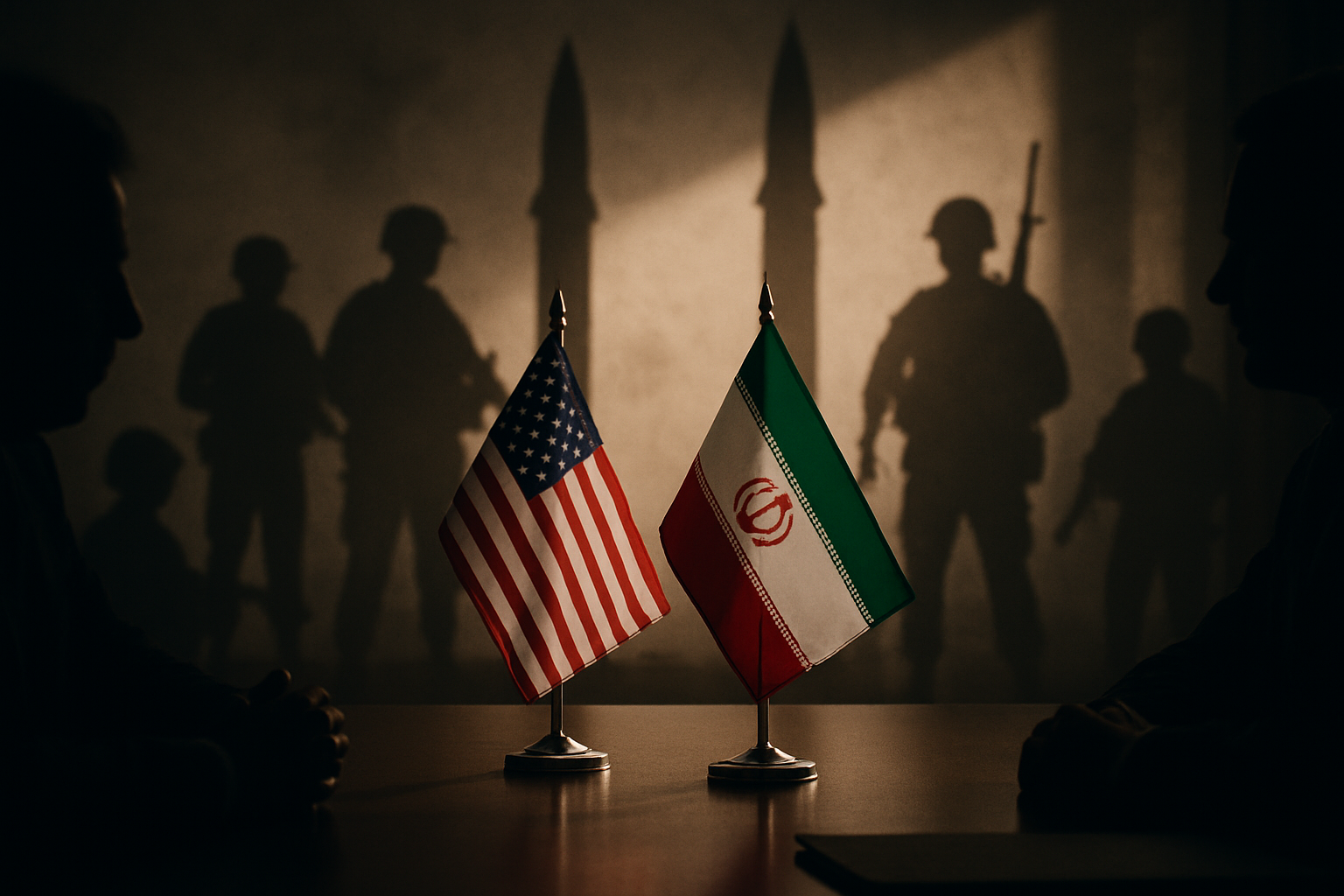
Military tensions between Iran and the United States have reached their most dangerous level in decades, as diplomatic efforts show both promise and peril amid escalating threats of armed conflict that could reshape the Middle East and global energy markets.
The crisis has intensified dramatically following reports of Iranian cluster munitions striking residential areas in Haifa, while diplomatic sources reveal that direct talks between the US and Iran could potentially take place in Islamabad as early as this week. The developments mark a critical juncture in a standoff that began with nuclear negotiations but has evolved into a comprehensive confrontation involving military strikes, economic sanctions, and regional proxy conflicts.
Diplomatic Breakthrough Amid Military Escalation
Pakistan has emerged as a crucial mediator in the crisis, with Foreign Office spokesperson Tahir Hussain Andrabi confirming that Islamabad has expressed its willingness to host potential negotiations between Iran and the United States. The offer comes with the caveat that both sides must reach mutual agreement to end the ongoing military escalation.
According to Pakistani officials, the government is positioning itself as a "net regional stabilizer" alongside Egypt and Turkey in coordinated diplomatic efforts. Prime Minister Shehbaz Sharif has reportedly spoken directly with Iranian President Pezeshkian, while Foreign Minister Ishaq Dar has been in contact with Iranian Foreign Minister Abbas Araghchi, keeping the White House informed of all diplomatic developments.
"Pakistan remains open to facilitating dialogue and could offer to host talks if the concerned parties consent."
— Tahir Hussain Andrabi, Pakistani Foreign Office Spokesperson
The diplomatic initiative has gained momentum after President Donald Trump announced a five-day postponement of planned strikes on Iran's energy infrastructure, citing "very good and productive conversations" with unidentified Iranian officials. However, Trump's characterization of the talks has been met with fierce denial from Tehran.
Iranian Denial and Counter-Narratives
Iran's Revolutionary Guard has dismissed Trump's claims of productive peace talks as "fake news," with officials accusing the US president of attempting to manipulate financial and oil markets. Parliamentary Speaker Mohammad Bagher Ghalibaf stated that "no negotiations have been held with the US, and fake news is used to manipulate the financial and oil markets and escape the quagmire in which the US and Israel are trapped."
The contradictory statements highlight the complex nature of the current diplomatic landscape, where back-channel communications may be occurring even as public officials maintain hardline positions. European diplomatic sources suggest that while direct negotiations between Iran and the US have not taken place, regional powers including Egypt, Pakistan, and Gulf states have been actively relaying messages between the two adversaries.
Iran's Supreme Leader Ayatollah Ali Khamenei's adviser, Mohsen Rezaei, has set demanding conditions for any potential ceasefire, insisting that Iran will not end hostilities until all sanctions are lifted and compensations are paid. This maximalist position underscores the vast gulf between Iranian expectations and likely US concessions.
Military Escalation and Humanitarian Concerns
The military dimension of the crisis continues to intensify despite diplomatic efforts. Recent strikes have resulted in significant civilian casualties, with Iranian cluster munitions reportedly hitting residential areas in Haifa's suburbs, though no injuries were immediately reported in that specific incident. The use of cluster munitions, widely banned by international treaty due to their indiscriminate nature, has drawn international condemnation.
US and Israeli forces have reportedly struck over 9,000 targets in Iran, including 140 naval vessels, according to American military sources. The scale of the military operation represents one of the most comprehensive campaigns against Iranian assets in recent memory, targeting both military infrastructure and economic installations.
Iran has responded with its own escalatory measures, with the Islamic Revolutionary Guard Corps (IRGC) confirming missile strikes on sensitive Israeli installations, including the Dimona nuclear facility and the port city of Eilat. The IRGC has also targeted US army bases in the region, though specific base names have not been disclosed for security reasons.
Regional Impact and Energy Security
The conflict has created ripple effects across the Middle East's energy infrastructure. Iran has threatened to close the Strait of Hormuz, through which approximately 40% of global oil passes daily, using it as economic leverage against what Iranian officials describe as Trump administration sensitivity to market pressures.
According to Nicholas Mulder, Assistant Professor at Cornell University and author of "The Economic Weapon: The Rise Of Sanctions As A Tool Of Modern War," Iran has strategically begun using the threat of Strait of Hormuz closure as "a form of economic pressure," recognizing that "the Trump administration is particularly sensitive to pressure from the markets."
Oil markets have already shown volatility in response to the crisis, with energy analysts warning that a full closure of the strategic waterway could trigger a global energy crisis. The threat has prompted emergency planning among major oil-importing nations and has led to increased diplomatic pressure on both sides to find a peaceful resolution.
Evolving Threat Matrix
Recent intelligence reports suggest Iran is preparing "surprises" and "special plans" for the United States, Israel, and their allies in the coming days. Swedish media sources indicate that multiple waves of missiles have been fired at Israeli targets overnight, with Iranian officials promising actions that will "crush the attackers' hopes for negotiations."
The escalating rhetoric from both sides has coincided with increased military deployments across the region. The US has maintained significant naval assets in the Persian Gulf, while Iran has positioned missile batteries and naval mines in strategic locations around the Strait of Hormuz.
Israel, meanwhile, has continued its operations against Hezbollah targets in Beirut, expanding the conflict's geographical scope and involving additional actors in what began as a bilateral US-Iran confrontation. The involvement of regional proxies threatens to transform the crisis into a wider Middle Eastern conflict.
International Response and Mediation Efforts
The international community has responded with a mixture of concern and diplomatic engagement. Norway has issued statements about the scale of US and Israeli operations, while Sweden has advised its citizens against travel to the region due to "extremely uncertain" security conditions.
France has offered analysis through academic experts, with French media highlighting the economic dimensions of the conflict and the role of market sensitivity in constraining military options. The European Union has largely maintained a position calling for de-escalation while supporting diplomatic initiatives.
Russia has positioned itself as a critic of Western actions in the region, while China has remained relatively quiet, focusing on protecting its own economic interests in Middle Eastern energy markets. Both powers represent potential mediators, though their relationships with Iran complicate their roles as neutral arbiters.
Economic and Humanitarian Consequences
Beyond the immediate military implications, the crisis has generated significant economic disruption across the region and globally. Gas pipeline infrastructure has been damaged in recent strikes, affecting both Iranian domestic distribution and regional export capabilities. Infrastructure damage has extended to neighboring residential buildings, raising concerns about civilian protection under international humanitarian law.
The humanitarian toll continues to mount, with civilian casualties reported on multiple sides of the conflict. International humanitarian organizations have called for the establishment of humanitarian corridors and the protection of civilian infrastructure, including schools and hospitals, which have come under threat during the escalating military operations.
Looking Ahead: Critical Juncture
As diplomatic efforts continue through Pakistani mediation and other back-channel communications, the window for peaceful resolution appears to be narrowing. Trump's temporary postponement of energy infrastructure strikes provides a brief opportunity for negotiations, but the fundamental disagreements between Washington and Tehran remain substantial.
The crisis represents more than a bilateral dispute between Iran and the United States. It encompasses broader questions of regional security architecture, nuclear proliferation, economic warfare through energy chokepoints, and the effectiveness of multilateral diplomatic solutions in an increasingly polarized international system.
The coming days will be crucial in determining whether diplomatic initiatives can gain sufficient momentum to prevent further military escalation, or whether the Middle East will face its most significant regional conflict in decades. The stakes extend far beyond the immediate region, with global energy security, international law, and the precedent for resolving similar future crises all hanging in the balance.
For now, the world watches as Pakistani diplomats work alongside their Egyptian and Turkish counterparts to broker conversations that could either defuse one of the most dangerous international crises in recent memory or fail to prevent a wider conflagration that would reshape Middle Eastern geopolitics for generations to come.