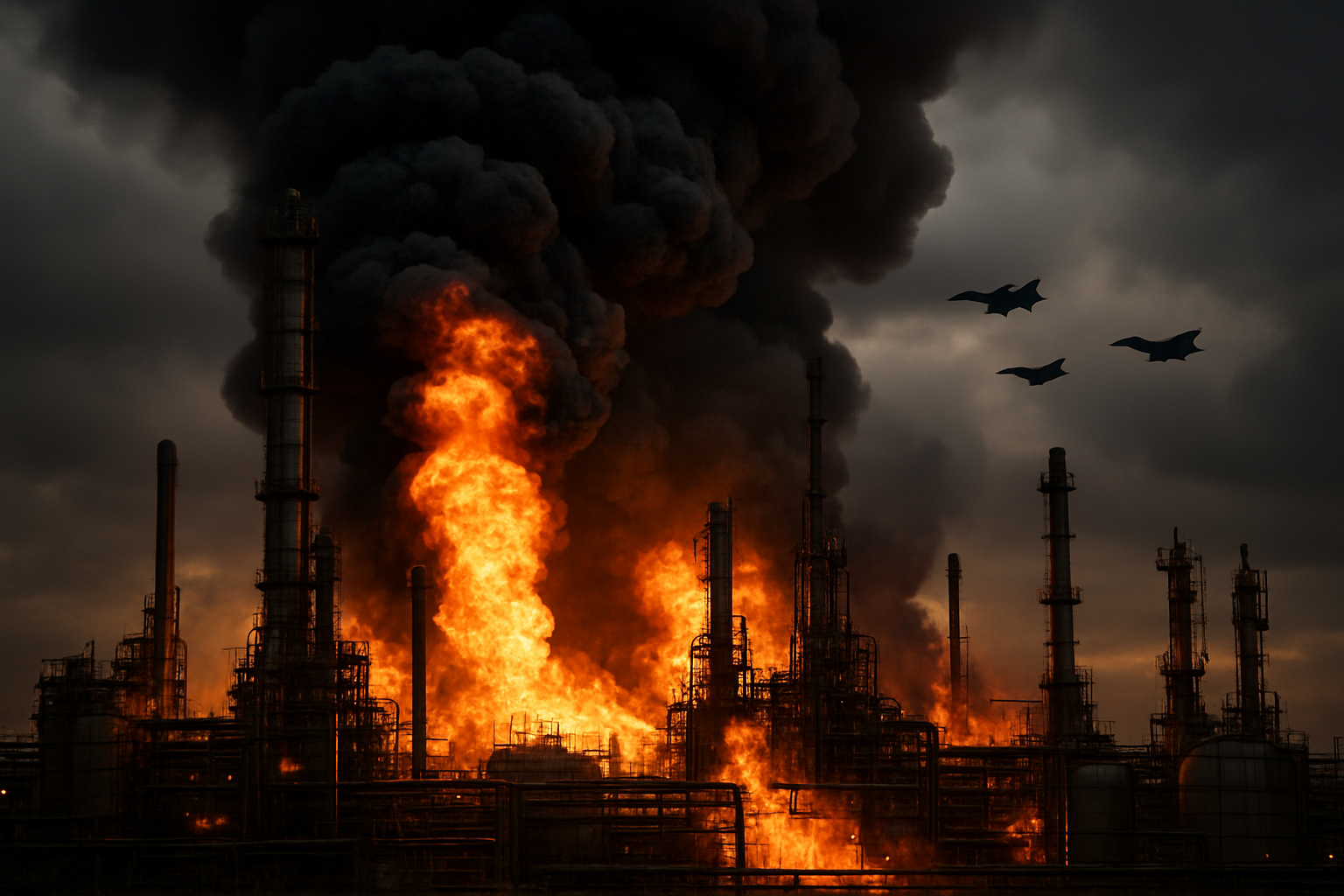
The Iran-US war has escalated dramatically with Iran's Revolutionary Guard launching their most extensive attacks yet on American and allied targets, including critical oil infrastructure, as President Trump threatens "consequences never seen before" while the conflict enters its most dangerous phase since beginning nearly two weeks ago.
Iranian forces struck multiple oil tankers near Iraq's coast, leaving at least one crew member dead and several missing, according to Iraqi authorities. The attacks on two foreign-flagged tankers in Iraqi territorial waters near the al-Faw port represent a significant escalation in Iran's systematic campaign against energy infrastructure across the region.
Global Energy Security Under Assault
Iran's mining of the Strait of Hormuz—the world's most critical oil chokepoint carrying 40% of global seaborne petroleum—has sent shockwaves through international markets. US intelligence reports confirm Iran has deployed dozens of naval mines using small vessels, prompting President Trump to destroy 28 Iranian mine-laying ships in response.
Oil prices have surged past $80 per barrel, representing a 10% increase as the conflict threatens the global energy supply chain. The International Energy Agency has recommended the largest-ever coordinated release of strategic petroleum reserves to combat what analysts describe as one of the worst oil shocks since the 1970s.
"The world should be prepared for oil to hit $200 a barrel," warned Iran's military command spokesperson, as Revolutionary Guard forces continued their "Operation True Promise 4" campaign.
— Iranian Military Command
The crisis has effectively halted exports through the Strait of Hormuz, with over 150 oil tankers stranded in the Persian Gulf carrying billions of dollars worth of cargo. Major shipping companies Maersk and MSC have suspended all operations in the region, while Qatar has halted LNG production, affecting approximately 20% of global liquefied natural gas exports.
School Attack Investigation Reveals US Responsibility
New revelations have emerged regarding the devastating February 28 attack on a girls' school in Minab, Iran, that killed between 165-185 students and staff. A Pentagon investigation has concluded that US forces were likely responsible for the strike using outdated targeting data, according to military sources.
The investigation found that the US military was attempting to target an adjacent Islamic Revolutionary Guards base but used incorrect intelligence, resulting in the Tomahawk missile striking the Shajareh Tayyebeh primary school during regular hours. Nearly every US Senate Democrat has signed a letter demanding a "swift investigation" of the incident, which has become a symbol of civilian casualties in the conflict.
"The results of this school attack are horrific. The majority of those killed in the strikes were girls between the ages of 7 and 12 years old," the letter signed by 46 senators stated.
— US Senate Democrats
President Trump has denied knowledge of the Pentagon report, stating he was unaware of the findings that attributed responsibility to US forces. The incident has drawn international condemnation and calls for investigation under Geneva Convention protocols governing civilian protection during wartime.
Iran Sets Conditions for Peace
Iranian President Masoud Pezeshkian has outlined Tehran's three conditions for ending the war: recognition of Iran's legitimate rights, payment of war reparations, and firm international guarantees against future aggression. The statement represents Iran's clearest public outline of ceasefire demands and appears to rule out any immediate resolution.
The conditions come as Iran's new Supreme Leader succession process continues following Ali Khamenei's death on March 1. CIA assessments suggest a Revolutionary Guards member will likely be selected, indicating a shift toward more hardline military governance of the Islamic Republic.
International Response Intensifies
The conflict has prompted the largest international evacuation since the Arab Spring of 2011, with Australia reporting 115,000 nationals trapped in the region and Germany attempting to extract 30,000 stranded tourists. The European Union has activated its ESTIA evacuation plan for Cyprus—the first time in the bloc's history—following Iranian drone attacks on RAF Akrotiri, marking the first attack on European territory since World War II.
A unprecedented naval coalition has formed in response, with HMS Dragon joining Spanish frigates and vessels from Italy, France, Netherlands, and Greece to protect Cyprus and European interests in the Eastern Mediterranean.
Congressional Scrutiny Mounts
Bipartisan pressure is growing in Congress for answers about the war's strategy, costs, and timeline. Senator Richard Blumenthal expressed being "more concerned than ever" about potential ground troop deployment, as Pentagon estimates show Operation Epic Fury has cost $5.6 billion in its first 48 hours alone.
The conflict's unpopularity is "almost unprecedented" for early-stage military operations, with only 25% of Americans supporting the strikes according to recent polling. Financial markets have emerged as an "ultimate constraint" on escalation, with Pakistan's KSE-100 index recording its largest single-day decline in history at -8.97%.
Nuclear Diplomacy Collapses
The current military confrontation emerged from the complete breakdown of Geneva nuclear negotiations despite achieving a "broad agreement on guiding principles"—the most promising diplomatic opening in years since the 2018 JCPOA collapse.
The fundamental scope disagreement proved insurmountable: Iran insisted on nuclear-only talks while excluding ballistic missiles and proxy relationships as "red lines," while the US demanded a comprehensive agreement including missiles, armed groups, and human rights concerns. Iran continues uranium enrichment at 60% purity with over 400 kilograms of weapons-grade material, sufficient for multiple nuclear weapons if weaponized.
Regional Allies Under Pressure
The unprecedented coalition of Saudi Arabia, UAE, Qatar, and Egypt that had supported diplomatic engagement is severely strained as Iranian retaliation has directly targeted their territories. Egyptian President Abdel Fattah el-Sisi condemned attacks on "sisterly Arab countries" while warning of "comprehensive chaos" spreading across the region.
Kuwait's government reported 32 foreign nationals injured in airport drone strikes, while Qatar intercepted 65 missiles and 12 drones using Patriot defense systems, with 8 people injured by falling debris. The UAE confirmed one civilian death in Abu Dhabi from missile fragments, while Dubai International Airport—the world's busiest—remains completely shut down from missile damage.
Global Aviation Crisis
Over 18,000 flights have been cancelled worldwide in what aviation authorities describe as the most extensive disruption since COVID-19. Eight Middle Eastern countries have simultaneously closed their airspace, forcing complex rerouting that has stranded hundreds of thousands of passengers globally.
Major carriers including Emirates, Air France-KLM, and Wizz Air have suspended all Middle Eastern operations indefinitely. The crisis exposes the vulnerability of global aviation networks to regional conflicts, particularly given the Middle East's role as a critical hub connecting Europe and Asia.
Historical Significance
UN Secretary-General António Guterres has called the crisis "the greatest test of multilateral cooperation and crisis management in the modern era." The rapid transition from diplomatic breakthrough to military confrontation demonstrates the fragility of crisis management mechanisms in the current multipolar international order.
The conflict represents a template-setting moment for 21st-century international relations, with its outcome likely to influence approaches to nuclear crises, territorial disputes, and the balance between diplomatic and military solutions for decades to come.
"This crisis will determine whether the international community can prevent regional wars through diplomacy or whether military solutions become the default response to complex international disputes."
— International Relations Expert
The stakes extend far beyond the Middle East, encompassing global energy security, nuclear governance credibility, international law enforcement, and the fundamental principles of post-WWII order. As the conflict enters its second week, the coming days will be crucial in determining whether escalation can be contained or whether the world faces a broader regional war with implications lasting decades.
With energy markets in turmoil, civilian casualties mounting, and nuclear diplomacy collapsed, the Iran-US war has become the most consequential international crisis since the end of the Cold War, testing every major international institution and alliance while reshaping the global order in real time.