The Iran-US military conflict has escalated into the most dangerous international crisis since the Cold War, with death tolls approaching 5,000 across the Middle East as President Trump seeks Arab nations to help fund the prolonged confrontation while Iran categorically rejects peace proposals and expands its retaliation campaign.
The month-long conflict, dubbed "Operation Epic Fury" by the Pentagon, represents the largest coordinated US-Israeli military operation since the 2003 Iraq invasion. With costs exceeding $27 billion and running at $1 billion daily, the White House has signaled Trump's interest in having Arab states shoulder the financial burden of what has become an extended regional war.
White House Press Secretary Karoline Leavitt confirmed Monday that Trump is "quite interested" in asking Arab countries to help pay for the war with Iran, though she declined to provide specific details about which nations have been approached or how much funding is being sought.
Mounting Casualties and Regional Impact
Nearly 5,000 people have been killed across the Middle East since the conflict began on February 28, when Israel launched preemptive strikes against Iran following the collapse of nuclear negotiations in Geneva. The human toll continues to mount as Iran's Revolutionary Guard maintains its "Operation True Promise 4" campaign, declaring that "no red lines remain" in its systematic targeting of US and Israeli assets.
The conflict has fundamentally altered the regional security landscape. Iranian forces have struck targets across multiple nations: the UAE has suffered one civilian death in Abu Dhabi, Kuwait has seen 32 people injured in airport drone strikes, and Qatar reported eight wounded despite successfully intercepting 65 missiles and 12 drones using Patriot defense systems.
In a historic escalation, Iranian drones struck RAF Akrotiri in Cyprus – marking the first attack on European territory since World War II. This unprecedented assault prompted the deployment of an international naval coalition, including HMS Dragon and Spanish, Italian, French, Dutch, and Greek vessels to protect European interests in the Eastern Mediterranean.
Nuclear Diplomacy Collapse
The current military crisis emerged from the complete breakdown of what initially appeared to be promising nuclear negotiations. In February, talks in Geneva achieved a "broad agreement on guiding principles" – the most significant diplomatic progress since the collapse of the Joint Comprehensive Plan of Action (JCPOA) in 2018.
However, fundamental disagreements proved insurmountable. Iran maintained that ballistic missiles and regional proxy groups were "red lines" that would be excluded from any nuclear-only agreement. Meanwhile, US Secretary of State Marco Rubio insisted on a comprehensive framework addressing Iran's missile program, support for armed groups, and human rights violations.
Iran continues enriching uranium to 60% purity, approaching the 90% threshold needed for weapons-grade material. Intelligence assessments suggest Iran possesses over 400 kilograms of enriched uranium – sufficient for multiple nuclear weapons if weaponized.
Trump's Strategy Evolution
President Trump's approach has evolved from nuclear-focused diplomacy to explicit regime change objectives. He has demanded Iran's "unconditional surrender" and claimed the right to personally choose Iran's next Supreme Leader, rejecting the succession of Mojtaba Khamenei following his father Ali Khamenei's death on March 1.
The Wall Street Journal reported that Trump has told aides he is willing to end the military campaign against Iran even if the Strait of Hormuz remains largely closed, signaling a potential shift from the initial goal of immediately reopening the critical waterway that handles 40% of global oil transit.
"We are quite interested in having various Arab countries that benefit from this help pay for what we're doing,"
— Karoline Leavitt, White House Press Secretary
Global Economic Crisis
The conflict has triggered unprecedented global economic disruption. Oil prices have surged past $100 per barrel for the first time since 2014, with warnings they could reach $200. Iran has deployed an estimated 2,000-6,000 naval mines in the Strait of Hormuz, effectively closing the waterway and stranding over 150 tankers carrying billions of dollars in cargo.
The International Energy Agency has released a record 400 million barrels from strategic petroleum reserves across 32 countries – the largest intervention in the agency's 50-year history. Natural gas prices have spiked 24% in Europe and 78% in the United States, while Qatar has halted LNG production, threatening global energy supplies.
Aviation has suffered COVID-scale disruptions, with over 18,000 flights cancelled worldwide as eight Middle Eastern countries maintain simultaneous airspace closures. Dubai International Airport, the world's busiest with 86 million passengers annually, remains shuttered due to missile damage.
Military Buildup and Casualties
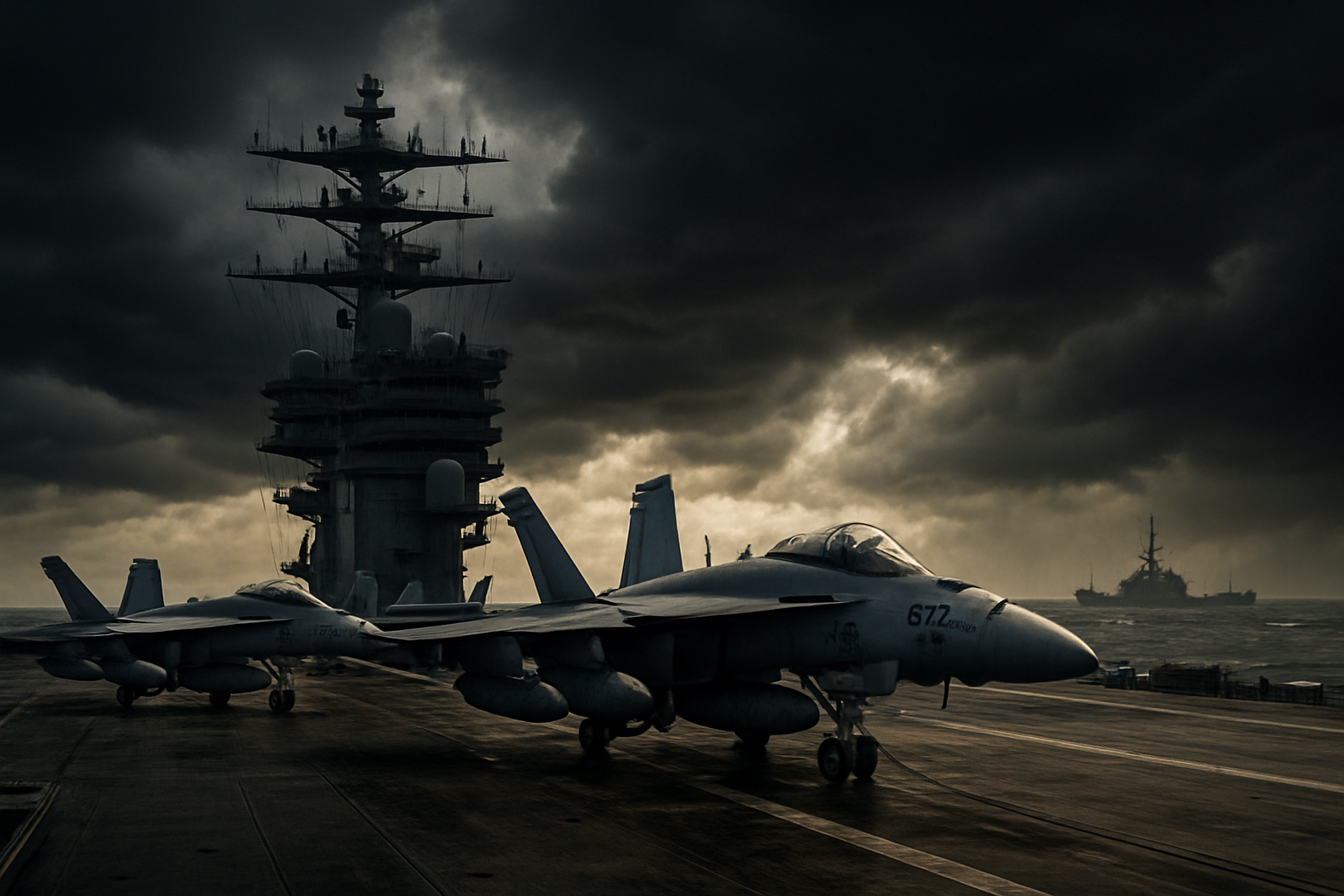
The Pentagon has deployed an unprecedented military force to the region, including the dual-carrier deployment of USS Gerald Ford and USS Abraham Lincoln – representing approximately one-third of the active US Navy fleet. Thousands of elite troops from the 82nd Airborne Division have arrived in the Middle East, with reports suggesting up to 17,000 US personnel could be positioned near Iran.
The conflict has produced the first American combat casualties in a major Middle East operation since 2003. Three US service members have been confirmed killed, with over 150 wounded, including eight in critical condition. In a historic development, the USS Charlotte submarine sank the Iranian frigate IRIS Dena off Sri Lanka, marking the first enemy vessel destroyed by a US submarine since World War II.
Iran's Leadership Transition
The death of Supreme Leader Ali Khamenei on March 1 has created the first succession crisis in the Islamic Republic's 47-year history. His son, Mojtaba Khamenei, has emerged as the new Supreme Leader – representing the first hereditary succession in Iran's modern history and signaling a shift from clerical to military governance under Revolutionary Guard influence.
The new leadership has maintained Iran's hardline stance, with Foreign Minister Abbas Araghchi declaring that Tehran will determine when and how the war ends. Iran has categorically rejected Trump's 15-point peace proposal delivered through Pakistani mediation, maintaining that ballistic missiles and proxy relationships remain non-negotiable.
Regional Coalition Strain
The conflict has severely strained what was initially an unprecedented regional coalition supporting diplomatic solutions. Saudi Arabia, the UAE, Qatar, and Egypt had formed an extraordinary Middle Eastern consensus backing nuclear negotiations. However, Iranian retaliatory strikes directly targeting their territories have fractured this unity.
Egyptian President Abdel Fattah el-Sisi condemned Iranian attacks on "sisterly Arab countries," warning of "comprehensive chaos" spreading throughout the region. Kuwait has relocated airline operations to Saudi Arabia due to repeated drone attacks, while the UAE has suspended various operations under Iranian pressure.
European Security Implications
The attack on Cyprus has fundamentally altered the conflict's scope from a regional Middle East crisis to a direct European security threat. The European Union activated its ESTIA crisis mechanism for the first time in its history, while unprecedented naval coordination has emerged to protect European interests.
However, European allies have shown resistance to broader US military demands. German Defense Minister Boris Pistorius questioned "what Trump expects a handful of European frigates to do that the powerful US Navy cannot," while Spain has closed its airspace to US military aircraft involved in Iran operations.
Congressional Opposition Mounts
Domestic political pressure in the United States continues to intensify, with bipartisan lawmakers demanding comprehensive briefings on strategy, costs, and the potential for ground troop deployment. Senator Richard Blumenthal expressed being "more concerned than ever" about boots on the ground, while the conflict maintains historically low public support at just 25%.
The Pentagon has requested over $200 billion in emergency funding from Congress – one of the largest military appropriations in recent history. Operations are expected to continue through September 2026, far beyond the initial 4-6 week timeline projected by the White House.
Humanitarian Crisis
The Iran Red Crescent reports over 787 civilian casualties from US-Israeli strikes, including the devastating attack on an elementary school in Minab that killed 165-185 students using what the Pentagon acknowledged was "outdated targeting data." The incident has prompted calls for Geneva Conventions investigations and become a symbol of the conflict's human cost.
International evacuations have reached the scale of the 2011 Arab Spring, with Australia reporting 115,000 nationals trapped in the region and Germany working to extract 30,000 stranded tourists. Multiple countries have ordered immediate evacuations citing "extremely uncertain" security conditions.
Nuclear Governance Crisis
The Iran crisis occurs within a broader context of nuclear governance breakdown. The New START treaty between the US and Russia expired in February 2026, creating the first 50-year gap in bilateral nuclear constraints. Combined with China's nuclear expansion, UN Secretary-General António Guterres has warned that nuclear risks are at their "highest in decades."
The collapse of the Geneva framework, despite achieving the most progress since 2018, raises fundamental questions about the viability of diplomatic solutions to modern nuclear crises and could encourage military approaches to similar future disputes worldwide.
Looking Ahead
As the conflict enters its second month, the trajectory points toward prolonged military confrontation rather than diplomatic resolution. Trump's explicit regime change demands have eliminated near-term negotiated solutions, while Iran's new hardline leadership shows no signs of backing down.
The crisis has become what UN Secretary-General Guterres called "the greatest test of multilateral cooperation in the modern era." Its resolution – or escalation – will establish precedents for 21st-century conflict resolution, nuclear proliferation prevention, and international law enforcement that will reverberate for decades.
The stakes extend far beyond the Middle East, affecting global energy security, nuclear governance credibility, alliance structures, and the fundamental principles of the post-World War II international order. Whether diplomatic channels can be restored or the crisis spirals into broader regional war will determine not only the future of Middle East stability but the template for international crisis management in an increasingly multipolar world.