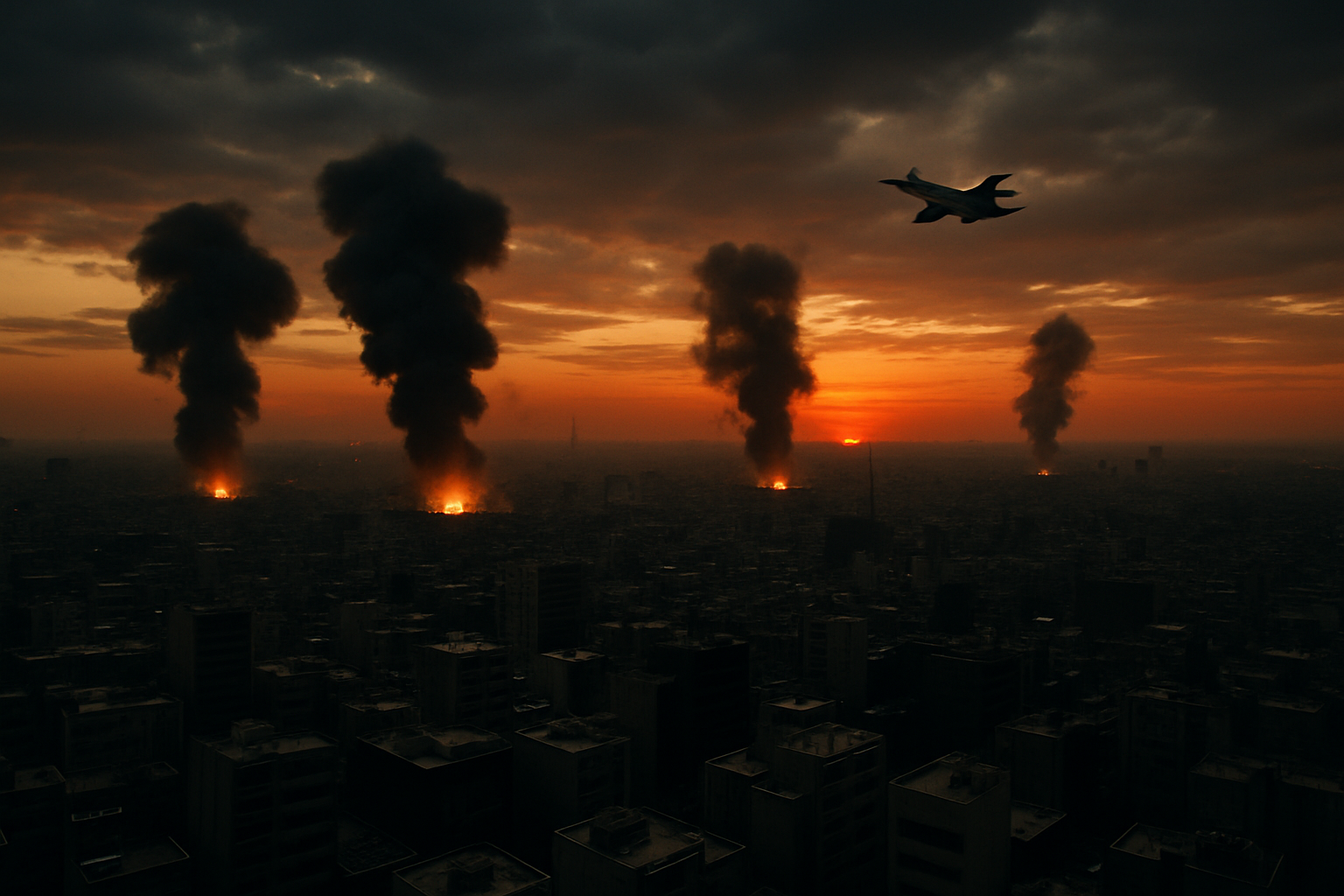
President Donald Trump demanded Iran's "unconditional surrender" on Friday as the devastating war between the United States, Israel, and Iran entered its seventh day, with fresh explosions rocking Tehran and heavy Israeli bombardment of Beirut displacing hundreds of thousands across the region.
In a stark escalation of his war aims, Trump declared via Truth Social that "there will be no deal with Iran except UNCONDITIONAL SURRENDER!" The president's maximalist demands mark a dramatic hardening from earlier suggestions he might negotiate, as the conflict that began March 1 with the killing of Iran's Supreme Leader Ali Khamenei shows no signs of abating.
The war has already emerged as the most dangerous international crisis since the Cold War, with global implications extending far beyond the Middle East as energy markets convulse, aviation networks collapse, and nuclear governance frameworks crumble.
Trump's Regime Change Vision
Trump's Friday declaration went beyond military objectives to outline explicit regime change goals, stating that after Iran's surrender and "the selection of a GREAT & ACCEPTABLE Leader(s)," the United States and its allies would "work tirelessly to bring Iran back from the brink of destruction."
The president has also claimed the right to personally influence Iran's leadership succession, telling reporters he wants to be "involved in the process of choosing the person who is going to lead Iran into the future." He specifically rejected Mojtaba Khamenei, the deceased Supreme Leader's son, as a "lightweight" in comparisons to U.S. interventions in Venezuela.
"This is the single greatest chance for the Iranian people to take back their country."
— Donald Trump, U.S. President
The explicit regime change agenda represents the most direct American assertion of control over Iranian internal affairs since the 1979 Islamic Revolution, fundamentally altering the nature of the conflict from tactical strikes to comprehensive political transformation.
Battlefield Developments
Friday witnessed some of the most intense fighting since the war began, with residents of Tehran describing the overnight bombardment as "the worst since the war started." Israeli forces announced they had destroyed an underground bunker system intended for Iran's slain Supreme Leader using 50 fighter jets in coordinated strikes across the capital.
The conflict's scope has expanded dramatically beyond traditional Middle Eastern boundaries. The U.S. submarine USS Charlotte made history by sinking the Iranian frigate IRIS Dena off Sri Lanka, killing more than 80 crew members in the first enemy vessel sunk by an American submarine since World War II.
Iranian retaliation through "Operation True Promise 4" has systematically targeted U.S. and Israeli assets across the region. The Islamic Revolutionary Guard Corps has maintained its position that "no red lines remain," with casualties reported across multiple countries including the UAE, Kuwait, Qatar, and Israel.
Regional Casualties Mount
The human cost continues to escalate across the region. In Lebanon, Israeli airstrikes have killed more than 200 people according to health ministry figures, forcing hundreds of thousands from their homes as Israel issued the widest evacuation orders in Lebanese history. The bombardment has particularly targeted Beirut's southern suburbs, Hezbollah's main stronghold in the capital.
Cyprus became the first European territory attacked since World War II when Iranian drones struck RAF Akrotiri, prompting an unprecedented naval coalition response with British, Spanish, Italian, French, Dutch, and Greek vessels deploying to protect European interests.
Global Economic Catastrophe
The conflict has triggered the most severe global economic disruption in years, with oil prices surging more than 10 percent to over $80 per barrel as Iran declared the Strait of Hormuz "unsafe," threatening 40 percent of global oil transit.
The aviation industry faces its worst crisis since COVID-19, with more than 18,000 flights cancelled worldwide as eight Middle Eastern countries simultaneously closed their airspace. Dubai International Airport, the world's busiest, remains completely shut down from missile damage, stranding hundreds of thousands of passengers globally.
Major shipping companies including Maersk and MSC have suspended Persian Gulf operations, leaving more than 150 oil and gas tankers worth billions of dollars stranded. Natural gas prices have spiked 24 percent in Europe and 78 percent in the United States, with Qatar halting LNG production after Iranian strikes on energy infrastructure.
"The consequences will be felt by the entire world if this war does not stop within weeks."
— Qatar Energy Minister
Intelligence Sharing and International Alliances
The conflict has revealed new dimensions of great power competition, with U.S. officials confirming that Russia is providing Iran with targeting information on American military assets in the Middle East. This intelligence sharing includes locations of U.S. warships and aircraft, significantly complicating American operations in the region.
In response, Ukraine has reportedly agreed to send military drone experts to assist U.S. forces in the Gulf, leveraging expertise gained from years of warfare against Russian forces. The development marks Ukraine's first direct involvement in Middle Eastern conflicts.
Meanwhile, Iran has found limited sanctuary for its naval assets, with both India and Sri Lanka allowing Iranian military vessels to seek refuge in their ports after the U.S. Navy began systematically targeting Iranian ships across the Indian Ocean.
Nuclear Diplomacy in Ruins
The military escalation represents the complete collapse of nuclear diplomacy that had shown its most promising signs in years. Just weeks before the war began, negotiations in Geneva had achieved what Iranian Foreign Minister Abbas Araghchi called "broad agreement on guiding principles" – the most significant progress since the 2018 collapse of the Joint Comprehensive Plan of Action.
However, fundamental disagreements over scope proved insurmountable. Iran maintained that ballistic missiles and regional proxy activities were "red lines" excluded from nuclear-only talks, while the United States demanded comprehensive agreements addressing missiles, armed groups, and human rights issues.
The diplomatic breakdown occurs amid a broader nuclear governance crisis, with the New START treaty between the U.S. and Russia having expired February 5 – the first time in over 50 years without nuclear constraints between the superpowers. UN Secretary-General António Guterres has warned that nuclear risks are at their "highest in decades."
Congressional and International Response
The war faces growing scrutiny from lawmakers across party lines, with Senator Richard Blumenthal expressing being "more concerned than ever" about potential deployment of ground troops. The conflict's unpopularity among the American public has been described as "almost unprecedented" for military operations in their early stages.
Financial markets have emerged as what analysts call the "ultimate constraint" on conflict escalation, with stock markets crashing worldwide. Pakistan's KSE-100 index suffered its largest single-day decline in history, falling 8.97 percent, while European and American futures markets have seen significant losses.
The Pentagon's preparation for operations lasting "through September" suggests officials anticipate a prolonged campaign far beyond President Trump's initial four-week timeline, with costs already reaching $3.7 billion in the first 100 hours.
Humanitarian Crisis and Evacuations
The conflict has triggered the largest coordinated international evacuation since the Arab Spring of 2011, with Australia reporting 115,000 nationals trapped in the region and Germany attempting to extract 30,000 tourists. The European Union activated its ESTIA evacuation plan for Cyprus for the first time in its history.
Multiple countries have ordered immediate evacuations from Iran, with Swedish and Serbian authorities citing "extremely uncertain" security conditions. The U.S. has closed its embassy in Kuwait indefinitely and ordered non-essential personnel to evacuate from 15 Middle Eastern countries.
Humanitarian concerns have intensified following a controversial strike on a school in Minab, Iran, where between 53 and 85 students and staff were killed during regular school hours. The incident has drawn international condemnation and calls for Geneva Conventions investigations.
Iran's Constitutional Crisis
Following the confirmed death of Supreme Leader Ali Khamenei on March 1, Iran faces an unprecedented constitutional succession crisis during wartime. A three-member transitional council consisting of President Masoud Pezeshkian, judiciary head Gholamhossein Mohseni Ejei, and Guardian Council representative Ayatollah Alireza Arafi currently governs the country.
The Assembly of Experts, comprising 88 clerics responsible for selecting the next Supreme Leader, must now make this crucial decision under active warfare conditions. CIA assessments suggest a Revolutionary Guards member is likely to be chosen, indicating a potential shift toward more hardline military influence in Iranian governance.
Mojtaba Khamenei, the deceased leader's son, had emerged as a favored candidate, representing the first potential hereditary succession in Islamic Republic history. However, Trump's explicit rejection of this choice has added a new dimension to Iran's internal crisis.
Looking Forward
As the conflict enters its second week, the stakes could not be higher for international stability. The war represents a template-setting moment for 21st-century crisis management in an increasingly multipolar world, where the rapid transition from diplomatic breakthrough to military confrontation demonstrates the fragility of modern conflict prevention mechanisms.
Success in containing the conflict could provide a framework for future nuclear crisis resolution and strengthen international law enforcement mechanisms. However, failure to prevent broader regional war may accelerate military solutions over diplomatic ones, potentially reshaping Middle Eastern geopolitics for decades while encouraging nuclear proliferation globally and undermining diplomatic credibility worldwide.
The coming days will prove decisive in determining whether this remains a contained regional confrontation or escalates into the broader Middle Eastern war that could have worldwide implications for energy security, supply chains, and the fundamental principles of international order established after World War II.