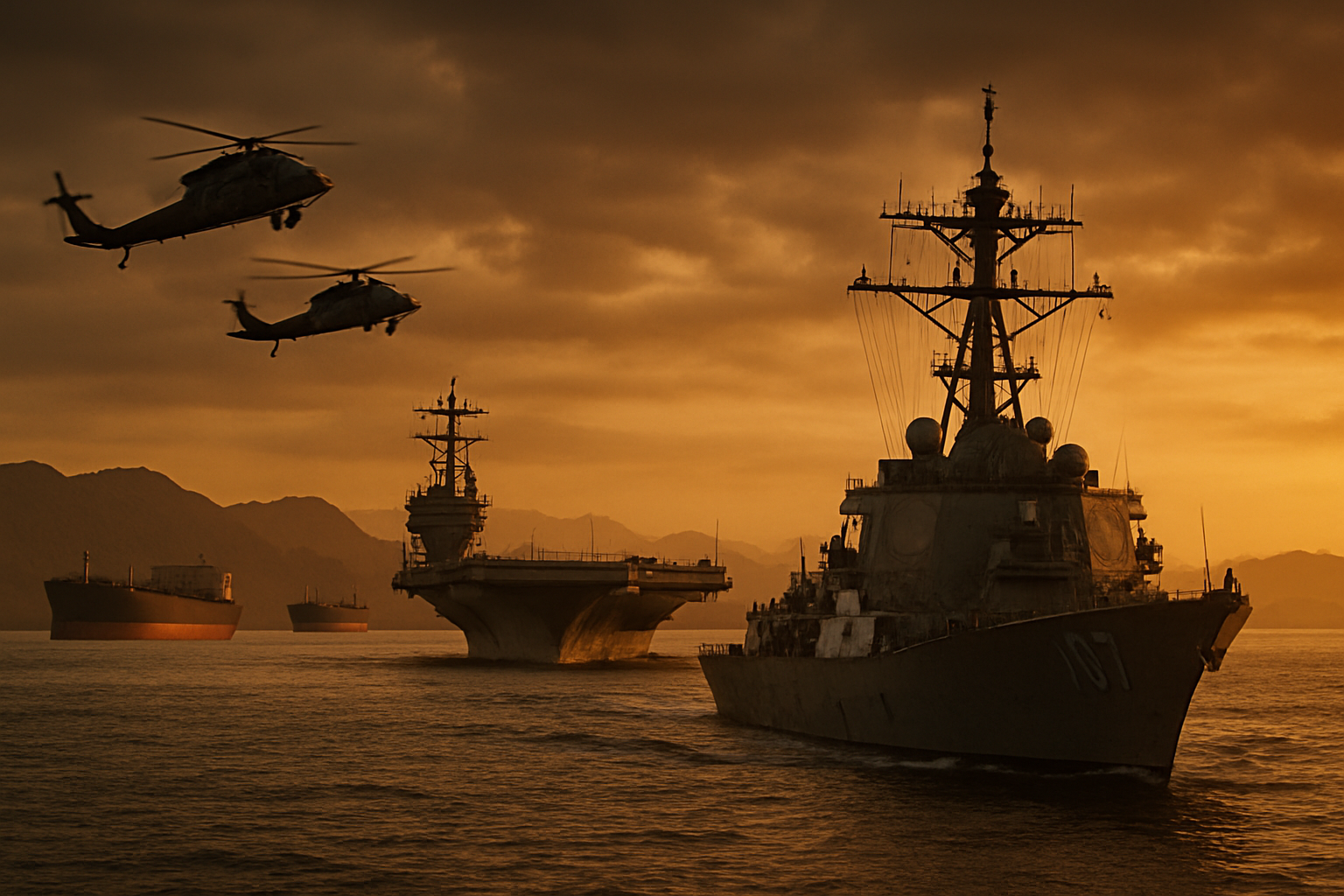
President Donald Trump extended his ultimatum for Iran to reopen the Strait of Hormuz until April 7, while Iran's Revolutionary Guard declared the critical waterway permanently closed as the devastating three-week conflict continues to reshape global energy markets and international relations.
The latest developments mark a dangerous escalation in what has become the most serious international crisis since the Cold War, with Trump warning Iran faces destruction of its energy infrastructure if the strait remains closed, while Iran's Islamic Revolutionary Guard Corps (IRGC) maintains "complete control" over the waterway that handles 40% of global oil transit.
Trump's Extended Deadline and Energy Threats
Speaking from Mar-a-Lago, Trump announced the 10-day extension after Iran rejected his comprehensive 15-point peace proposal. "I don't think they want the consequences of not making a deal," the president warned, explicitly threatening strikes against Iran's largest power plants if the strait remains closed.
The ultimatum represents the latest in a series of escalating deadlines that began in February during failed nuclear negotiations. Iran has consistently dismissed Trump's demands for "unconditional surrender," with President Masoud Pezeshkian declaring such demands "dreams they should take to the grave."
"Iran's position is clear - we will never abandon uranium enrichment even if war is imposed on us"
— Abbas Araghchi, Iranian Foreign Minister
Pakistan Emerges as Critical Mediator
In a surprising diplomatic development, Pakistan has emerged as the primary mediator between Washington and Tehran, with Chinese Foreign Minister Wang Yi expressing strong support for Islamabad's peace efforts during talks with Deputy Prime Minister Ishaq Dar.
Prime Minister Shehbaz Sharif received endorsement from Kuwait's Crown Prince Sheikh Sabah Al Khaled Al Hamad Al Sabah, who "fully endorsed" Pakistan's mediation efforts. The development represents a significant shift as traditional Gulf mediators find themselves direct targets of Iranian retaliation.
German Foreign Minister Johann Wadephul stated it was a "positive sign" that US-Iran direct talks may begin "very soon" in Pakistan, marking the first potential face-to-face negotiations since the conflict began February 28.
Global Economic Crisis Deepens
The closure of the Strait of Hormuz has triggered the most severe energy crisis since the 1970s oil shocks. Oil prices have surged past $100 per barrel, with the International Energy Agency releasing a record 400 million barrels from strategic reserves - its largest intervention in 50 years.
Iran has deployed an estimated 2,000-6,000 naval mines throughout the strait, effectively paralyzing global oil transport. Over 150 oil tankers worth billions remain stranded in the Persian Gulf, while major shipping companies Maersk and MSC have suspended all operations in the region.
The aviation industry faces unprecedented disruption, with over 18,000 flights cancelled worldwide - the most severe crisis since COVID-19. Dubai International Airport, the world's busiest, remains shuttered from missile damage, while eight Middle Eastern countries maintain simultaneous airspace closures.
European Security Implications
The conflict took a historic turn when Iranian drones struck RAF Akrotiri in Cyprus - the first attack on European territory since World War II. The strike prompted an unprecedented naval coalition response, with HMS Dragon and vessels from Spain, Italy, France, the Netherlands, and Greece deploying to protect European interests.
The European Union activated its ESTIA evacuation plan for Cyprus for the first time in the bloc's history, reflecting the gravity of the security threat posed by Iranian expansion of targeting beyond traditional Middle Eastern boundaries.
Humanitarian and Regional Impact
Iran's Red Crescent reports over 787 civilian casualties from US-Israeli strikes during "Operation Epic Fury," including the devastating attack on Minab elementary school that killed between 53-85 students and staff. International human rights organizations have called for Geneva Conventions investigations into the targeting of civilian infrastructure.
Regional casualties from Iran's "Operation True Promise 4" retaliation campaign include one civilian killed in Abu Dhabi, 32 injured in Kuwait airport strikes, and eight wounded in Qatar despite successful Patriot missile interceptions of 65 missiles and 12 drones.
The conflict has severely strained the unprecedented Arab coalition that had supported diplomatic efforts. Egyptian President Abdel Fattah el-Sisi condemned Iranian attacks on "sisterly countries," warning of "comprehensive chaos" spreading across the region.
Nuclear Diplomacy Collapse
The current military confrontation emerged from the complete breakdown of Geneva nuclear negotiations, despite achieving what negotiators called "broad agreement on guiding principles" - the most significant diplomatic progress since the 2018 JCPOA collapse.
The fundamental stumbling block remained unchanged from decade-old disputes: Iran excluded ballistic missiles and regional proxies as "red lines" from nuclear-only talks, while the US demanded comprehensive agreements addressing missiles, armed groups, and human rights violations.
Iran continues uranium enrichment at 60% purity with over 400kg of weapons-grade material - sufficient for multiple nuclear weapons if weaponized, according to former IAEA inspector Dr. Yusri Abu Shadi.
Military Assessment and Costs
Operation Epic Fury represents the largest US-Israeli coordinated campaign since the 2003 Iraq invasion, utilizing unprecedented dual-carrier deployment of USS Gerald R. Ford and Abraham Lincoln - approximately one-third of the active US Navy fleet positioned 800km from Iran's coast.
Pentagon costs have reached $11.3 billion in the first week alone, with 150 US troops wounded and three confirmed killed - the first American casualties in the largest Middle East operation since 2003. The historic sinking of Iranian frigate IRIS Dena by USS Charlotte submarine marked the first enemy vessel destroyed by US submarine since World War II.
Congressional scrutiny is intensifying, with Senator Richard Blumenthal expressing concern about potential ground troop deployment. The conflict maintains "almost unprecedented" unpopularity with only 25% public support, creating domestic political pressure on the administration.
Iranian Succession Crisis
The killing of Supreme Leader Ali Khamenei on March 1 ended his 37-year rule and triggered the Islamic Republic's first succession crisis. Mojtaba Khamenei, the Supreme Leader's son, has emerged as the favored successor in what would be the first hereditary succession in the regime's 47-year history.
CIA assessments suggest Revolutionary Guards will likely control the selection process, representing a historic shift from clerical to military governance during active warfare conditions.
International Response and Evacuations
The crisis has prompted the largest coordinated international evacuation since the Arab Spring in 2011, with Australia reporting 115,000 nationals trapped and Germany struggling to extract 30,000 stranded tourists. Multiple countries have ordered immediate evacuations citing "extremely uncertain" security conditions.
UN Secretary-General António Guterres characterized the crisis as "the greatest test of multilateral cooperation in crisis management in the modern era," with emergency Security Council sessions reflecting unprecedented global concern.
China has issued its strongest condemnation in years of what it terms "serious sovereignty violations," while Russia condemned "reckless actions by Washington and West Jerusalem" as violations of international law.
Template-Setting Implications
The rapid transition from promising diplomatic breakthrough to military confrontation demonstrates the fragility of crisis management mechanisms in the multipolar era. The collapse of the most substantive US-Iran negotiations in years raises fundamental questions about diplomatic solutions to nuclear crises in the 21st century.
Success in containing the crisis could provide a framework for future nuclear dispute resolution, while failure may accelerate military approaches for decades, potentially encouraging proliferation elsewhere and undermining diplomatic credibility for territorial and sovereignty disputes worldwide.
The stakes encompass regional war prevention, global energy security, nuclear governance credibility, and international law enforcement of post-World War II order principles - all tested simultaneously in this watershed moment for Middle Eastern geopolitics.
As Trump's extended deadline approaches April 7, the world watches whether Pakistan's mediation efforts with Chinese backing can prevent what analysts warn could become the most dangerous escalation since the Cuban Missile Crisis, with implications extending far beyond the Middle East to reshape international conflict resolution approaches for decades to come.