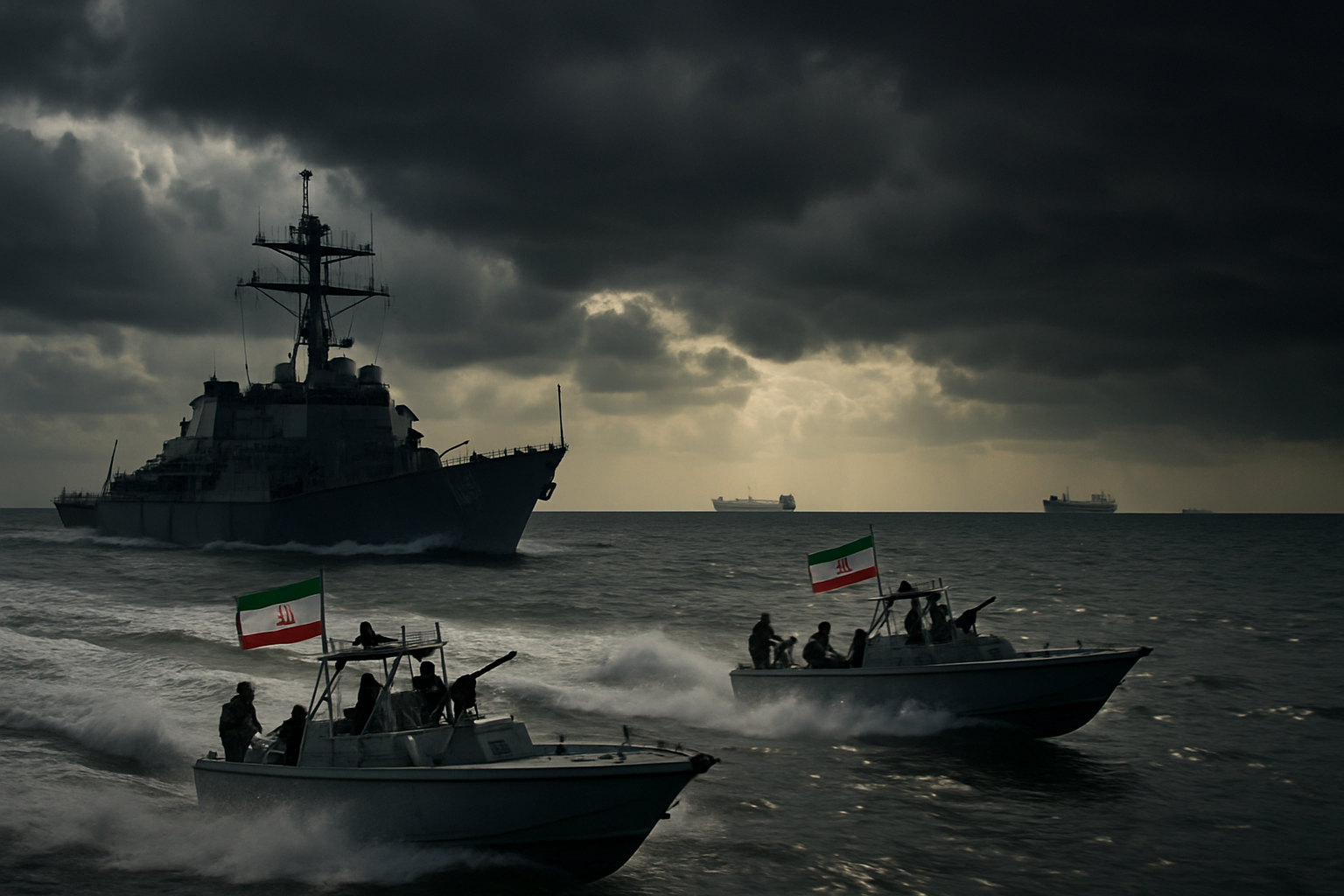
Iran's Assembly of Experts has appointed Mojtaba Khamenei as the country's new Supreme Leader, marking the first hereditary succession in the Islamic Republic's 47-year history, as the devastating 12-day conflict with the United States and Israel continues to escalate with unprecedented global implications for energy security and international stability.
The appointment comes amid what UN Secretary-General António Guterres described as "the greatest test of multilateral cooperation and crisis management in the modern era," following the confirmed death of Supreme Leader Ali Khamenei on March 1 in US-Israeli "Operation Epic Fury" strikes - the largest coordinated military operation in the Middle East since the 2003 Iraq invasion.
Historic Leadership Transition Under Fire
The selection of Mojtaba Khamenei, son of the deceased Supreme Leader, represents a seismic shift in Iranian governance from clerical to military influence. CIA intelligence assessments suggest Revolutionary Guards members now hold unprecedented control over the succession process, fundamentally altering the Islamic Republic's power structure during active warfare.
"This is no longer the Iran we've known since 1979," said a senior Western intelligence official speaking on condition of anonymity. "The Revolutionary Guards have essentially engineered a military takeover under the guise of constitutional succession."
The three-member transitional council comprising President Masoud Pezeshkian, Judiciary Chief Gholam Hossein Mohseni-Ejei, and Guardian Council representative Mohammad Yazdi has been governing under extraordinary wartime conditions since Ali Khamenei's death.
Global Aviation Crisis Reaches Breaking Point
The conflict has precipitated the most severe global aviation crisis since COVID-19, with over 18,000 flights cancelled worldwide. Eight Middle Eastern countries - Iran, Iraq, Israel, UAE, Qatar, Syria, Kuwait, and Bahrain - maintain simultaneous airspace closures, effectively severing critical Europe-Asia flight corridors.
Dubai International Airport, the world's busiest hub serving 86 million passengers annually, remains completely shuttered following Iranian missile damage on March 1. The closure has stranded hundreds of thousands of passengers globally, with major carriers including Emirates, Air France-KLM, and Wizz Air suspending Middle Eastern operations indefinitely.

"We're witnessing the collapse of the Middle East as a critical aviation hub," explained aviation analyst Sarah Mitchell. "The Persian Gulf has served as the connecting bridge between Europe and Asia for decades. This disruption fundamentally changes global travel patterns."
Energy Security Crisis Threatens Global Economy
Iran's declaration that the Strait of Hormuz is "unsafe for shipping" has created the most serious energy crisis since the 1970s oil shocks. The strategic waterway, which carries 40% of global seaborne oil transit, remains effectively closed as Iran has deployed naval mines from an estimated stockpile of 2,000-6,000 units.
Oil prices have surged past $100 per barrel, with Iran warning they could reach $200. The International Energy Agency announced the release of 400 million barrels from strategic reserves - the largest release in the agency's history - in an attempt to stabilize markets.
"The world must prepare for oil prices at $200 per barrel," Iranian military commanders declared Wednesday, as three more commercial vessels were attacked in the strategic waterway.
— Iranian Revolutionary Guard Command
Natural gas prices have increased 24% in Europe and 78% in the United States, with Qatar's LNG production - representing approximately 20% of global exports - halted due to Iranian infrastructure strikes. UK households face potential energy bill increases of £160 annually.
Military Escalation Reaches Historic Proportions
Operation Epic Fury has cost the Pentagon $5.6 billion in its first 48 hours alone, making it the most expensive military operation since the Iraq War. The deployment of dual aircraft carriers USS Gerald R. Ford and Abraham Lincoln represents approximately one-third of the US Navy's active fleet concentrated in the Arabian Sea.
In a historic first since World War II, the US submarine USS Charlotte sank the Iranian frigate IRIS Dena off Sri Lanka, killing over 80 crew members. The incident marks the expansion of the conflict beyond Middle Eastern boundaries into the Indian Ocean, demonstrating the war's global reach.
Defense Secretary Pete Hegseth confirmed the submarine action as a "quiet death" operation, emphasizing the technological superiority of US naval forces. However, the Pentagon has acknowledged 140 US service members wounded, with eight in critical condition - the first significant American casualties in the largest Middle East operation since 2003.
European Territory Attacked for First Time Since WWII
Iran's drone strikes on RAF Akrotiri in Cyprus marked the first attack on European territory since World War II, fundamentally altering the conflict's scope and triggering an unprecedented naval coalition response.
Britain's HMS Dragon, Spanish frigates, and vessels from Italy, France, the Netherlands, and Greece are deploying to protect European territory. The European Union activated its ESTIA evacuation plan for Cyprus for the first time in the bloc's history.
"This attack on European soil changes everything," stated French President Emmanuel Macron during an emergency visit to Cyprus. "We cannot allow Iranian aggression to reach European territory with impunity."
Regional Coalition Under Severe Strain
The unprecedented coalition of Saudi Arabia, UAE, Qatar, and Egypt that had supported diplomatic efforts is now severely strained as Iranian retaliation has targeted their territories directly. The attacks represent a fundamental challenge to Gulf security calculations that have dominated the region for decades.
Egyptian President Abdel Fattah el-Sisi condemned Iranian attacks on "sisterly Arab countries," warning of "comprehensive chaos" if the conflict continues to expand. The UAE reported one civilian killed in Abu Dhabi from missile debris, while Kuwait reported 32 foreign nationals injured in airport drone strikes.
Qatar successfully intercepted 65 Iranian ballistic missiles and 12 drones using Patriot defense systems, though eight people were injured by falling debris. The attacks have forced a recalibration of regional security arrangements that have provided stability for decades.
Nuclear Diplomacy's Complete Collapse
The current military confrontation emerged from the complete breakdown of nuclear negotiations despite achieving what Iranian Foreign Minister Abbas Araghchi called "broad agreement on guiding principles" - the most significant diplomatic progress since the 2018 JCPOA collapse.
However, fundamental disagreements over scope proved insurmountable. Iran maintained that ballistic missiles and regional proxies were "red lines" to be excluded from nuclear-only talks, while US Secretary of State Marco Rubio demanded a comprehensive agreement addressing missiles, armed groups, and human rights.
Iran continues uranium enrichment at 60% purity with over 400 kilograms of enriched material - approaching the 90% weapons-grade threshold and sufficient for multiple nuclear weapons if weaponized, according to former IAEA inspector Dr. Yusri Abu Shadi.
Humanitarian Crisis Deepens
Iran's Red Crescent reports over 787 civilian casualties from US-Israeli strikes, including the devastating attack on Minab elementary school that killed between 53-85 students and staff during regular school hours. The attack has drawn international condemnation and calls for Geneva Conventions investigations.
In Lebanon, where Hezbollah has joined the conflict in retaliation for Khamenei's death, health ministry officials report 394 killed, including 83 children, with over 500,000 people displaced as Israeli strikes target Hezbollah positions across the country.
The conflict has triggered the largest international evacuation since the 2011 Arab Spring, with Australia reporting 115,000 nationals trapped in the region, Germany 30,000 stranded tourists, and multiple countries ordering immediate evacuations citing "extremely uncertain" security conditions.
Congressional Pressure Mounts
Bipartisan pressure is intensifying in Congress as lawmakers demand answers about strategy, costs, and the potential deployment of ground troops. Senator Richard Blumenthal stated he was "more concerned than ever" about the possibility of American boots on the ground.
The Pentagon has quietly prepared operations extending through September, far beyond Trump's initial four-to-six-week timeline. The conflict's unpopularity is described as "almost unprecedented" for early-stage military operations, with only 25% of Americans supporting the strikes according to recent polling.
Financial markets are serving as what analysts call the "ultimate constraint" on escalation, with Pakistan's KSE-100 index suffering its largest single-day decline in history at -8.97%, and global supply chains severely disrupted as manufacturing dependent on Gulf logistics networks faces unprecedented challenges.
Trump's Regime Change Demands
President Trump has escalated rhetoric beyond military objectives to explicit regime change demands, declaring "no deal with Iran except UNCONDITIONAL SURRENDER" and claiming the right to personally choose Iran's next Supreme Leader while rejecting Mojtaba Khamenei as a "lightweight."
This represents the most direct assertion of American control over Iranian internal affairs since the 1979 revolution, effectively eliminating any diplomatic solution possibilities and transforming the conflict from nuclear-focused to comprehensive political transformation.
Trump's approach marks a dramatic evolution from tactical strikes to what analysts describe as the most aggressive US posture toward Iran in over four decades, with implications extending far beyond the current crisis.
Global Implications and Template-Setting Precedent
The crisis occurs amid broader nuclear governance challenges, with the New START treaty between the US and Russia having expired on February 5 - marking the first time in over 50 years that the world's two largest nuclear powers operate without arms control constraints.
Combined with China's nuclear expansion and what UN Secretary-General Guterres describes as nuclear risks at their "highest level in decades," the Iran crisis represents a template-setting moment for 21st-century international relations.
"This is fundamentally about whether diplomatic solutions remain viable in our multipolar world," explained Dr. Sarah Chen, director of the International Crisis Management Institute. "The rapid transition from diplomatic breakthrough to military escalation demonstrates the fragility of modern crisis management mechanisms."
Looking Ahead: Regional War or Containment?
The coming phase will determine whether this remains a contained regional confrontation or escalates into a broader Middle Eastern war with worldwide implications for energy markets, supply chains, and international law enforcement.
With Iran's new hardline military leadership, Trump's unconditional surrender demands, and regional allies caught between American security guarantees and Iranian pressure, the trajectory appears set for prolonged conflict rather than diplomatic resolution.
The stakes extend far beyond the Middle East, affecting global energy architecture, nuclear proliferation prevention mechanisms, and the credibility of international law enforcement in the post-Cold War era. Success in containing the crisis could provide a framework for future nuclear disputes, while failure may accelerate military approaches to international conflicts for decades to come.
As the world faces what analysts describe as the most dangerous moment since the Cold War's end, the decisions made in the coming days and weeks will reverberate through international relations for decades, fundamentally shaping how the 21st century approaches conflict resolution between major powers.