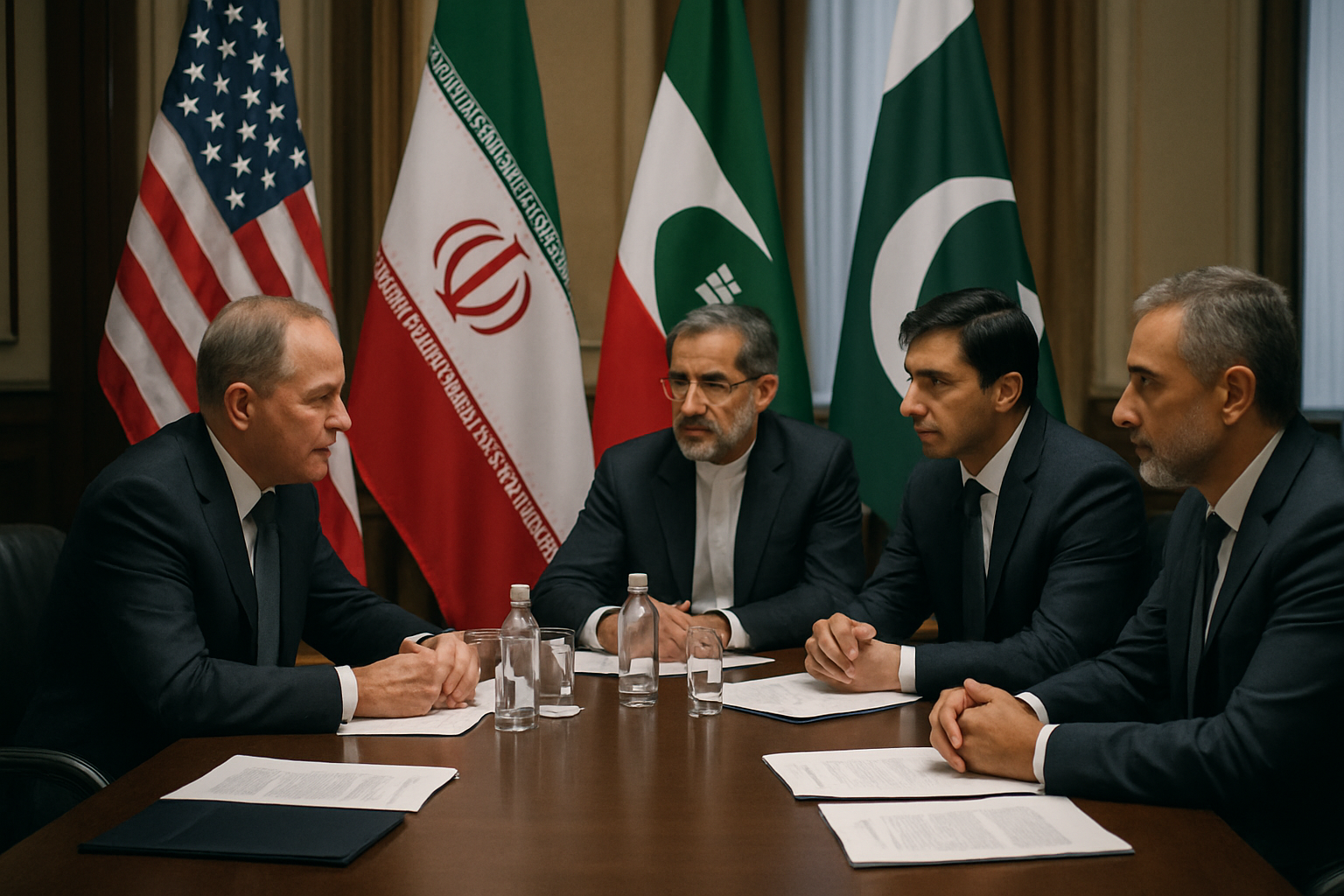
President Donald Trump claims Iran is desperately seeking a peace deal through back-channel communications while Tehran categorically denies any negotiations, as the US-Iran conflict enters its fourth week amid mounting global economic and humanitarian costs.
The contradictory claims emerged Wednesday as Pakistan formally offered to host "meaningful and conclusive talks" between Washington and Tehran, representing what may be the last diplomatic opening before further military escalation in the most dangerous international crisis since the Cold War.
Conflicting Peace Claims Create Diplomatic Confusion
White House Press Secretary Karoline Leavitt declared Wednesday that Trump is "prepared to unleash hell" if Iran fails to accept it has been "defeated militarily," while simultaneously maintaining that talks with Iran "continue to be productive."
Trump himself told reporters that Iranian negotiators "want really a deal," but deny discussions publicly out of fear of retaliation from "their own people." According to the president, this fear explains why Iran won't publicly acknowledge ongoing communications.
"President Trump does not bluff and he is prepared to unleash hell. Iran should not miscalculate again."
— Karoline Leavitt, White House Press Secretary
However, Iran's Foreign Ministry and state media have consistently contradicted these claims. Fars news agency called Trump's assertions "fake news psychological warfare," while Iranian officials maintain that communicating through mediators "does not mean negotiations with the US."
Pakistan Steps Forward as Potential Mediator
Prime Minister Shehbaz Sharif formally offered Pakistan as host for comprehensive settlement talks, marking the country's emergence as a potential key mediator alongside Turkey and Egypt. Pakistani sources indicate weeks of "hectic diplomacy" have laid the groundwork for potential negotiations.
The mediation offer comes as multiple countries are serving as message relays between the adversaries, according to European diplomatic sources. While no direct talks have been confirmed, these regional powers are providing crucial communication channels despite the disputed nature of formal negotiations.
Iran's Foreign Minister Abbas Araghchi has clarified that while Iran is "reviewing a US proposal to end the war," this exchange of messages through mediators is fundamentally different from direct bilateral negotiations.
Operation Epic Fury: Historic Military Escalation
The current crisis stems from the complete breakdown of nuclear diplomacy, despite Geneva talks in February achieving "broad agreement on guiding principles" - the most significant progress since the 2018 JCPOA collapse. The fundamental disagreement over scope proved insurmountable, with Iran excluding ballistic missiles and regional proxies as "red lines" while the US demanded comprehensive agreements.
Operation Epic Fury has now become the largest US-Israeli coordinated campaign since the 2003 Iraq invasion, utilizing dual-carrier deployment of the USS Gerald R. Ford and USS Abraham Lincoln - representing approximately one-third of the US Navy's active fleet.
The operation has struck over 9,000 Iranian targets including 140 naval vessels, according to American sources. Costs have reached $27 billion in the first weeks, running at $1 billion daily, making it one of the most expensive military campaigns in recent history.

Iranian Retaliation Targets Regional Allies
Iran's Operation True Promise 4 has systematically targeted US allies across the region, with the Revolutionary Guards declaring "no red lines remain." The retaliation has caused casualties across multiple countries:
- UAE: 1 civilian killed in Abu Dhabi, Dubai International Airport shut down
- Kuwait: 32 injured in airport strikes
- Qatar: 8 injured despite Patriot missile interceptions
- Cyprus: RAF Akrotiri struck - the first attack on European territory since World War II
This unprecedented European involvement has prompted a naval coalition response, with HMS Dragon and vessels from Spain, Italy, France, Netherlands, and Greece deploying to protect Europe.
Global Economic and Aviation Crisis
The conflict has created the most severe global aviation crisis since COVID-19, with over 18,000 flights cancelled worldwide as eight Middle Eastern countries simultaneously closed their airspace, creating an "aviation black hole" severing Asia-Europe corridors.
Oil markets have been devastated by Iran's closure of the Strait of Hormuz, which handles 40% of global oil transit. Prices have surged past $100 per barrel, with over 150 tankers stranded in the Persian Gulf carrying billions of dollars worth of cargo.
"The situation has gone too far. We need immediate diplomatic intervention to prevent regional war."
— European diplomatic source
The International Energy Agency has released a record 400 million barrels from strategic reserves - the largest intervention in the agency's 50-year history. Natural gas prices have increased 24% in Europe and 78% in the United States.
Nuclear Dimensions Add Urgency
The crisis unfolds against the backdrop of a broader nuclear governance breakdown. Iran continues uranium enrichment at 60% purity, approaching the 90% weapons-grade threshold, with over 400 kilograms of enriched material - sufficient for multiple weapons if weaponized.
The situation is complicated by the February 2026 expiration of the New START treaty between the US and Russia - the first time in over 50 years without nuclear constraints between the superpowers. UN Secretary-General António Guterres has warned that nuclear risks are at their "highest in decades."
Congressional Opposition Mounts
Domestic opposition to the military campaign has reached "almost unprecedented" levels, with only 25% of Americans supporting the operations according to recent polling. Senator Richard Blumenthal expressed being "more concerned than ever" about potential ground troop deployment.
Bipartisan lawmakers are demanding answers on strategy, costs, and timeline, with Pentagon operations planned through September - far beyond Trump's initial 4-6 week projection. Financial markets have responded negatively, with Pakistan's KSE-100 experiencing its largest single-day decline in history.
Humanitarian Costs Mount
The humanitarian toll continues to escalate, with Iranian Red Crescent reporting over 787 civilian casualties from US-Israeli strikes. International attention has focused on the Minab school attack, where 53-85 students and staff were killed during regular hours, prompting Geneva Conventions investigations.
The largest coordinated evacuation since the Arab Spring is underway, with Australia reporting 115,000 nationals trapped in the region and Germany scrambling to evacuate 30,000 stranded tourists.
Regional Coalition Under Severe Strain
The unprecedented regional coalition of Saudi Arabia, UAE, Qatar, and Egypt that had supported diplomatic processes is now severely strained as Iranian retaliation has directly targeted member territories. Egyptian President Abdel Fattah el-Sisi condemned attacks on "sisterly countries" and warned of "comprehensive chaos."
This breakdown of regional consensus represents a significant diplomatic setback, as the coalition had provided extraordinary Middle Eastern unity in support of peaceful resolution.
Template-Setting Crisis for 21st Century
UN Secretary-General Guterres has described the crisis as the "greatest test of multilateral cooperation and crisis management in the modern era." The rapid transition from diplomacy to military confrontation demonstrates the fragility of crisis management mechanisms in the multipolar era.
The stakes extend far beyond the immediate conflict, potentially setting precedents for how international disputes are resolved in the 21st century. Success in containing the crisis could provide a framework for nuclear crisis resolution, while failure may accelerate military solutions to international disputes globally.
Narrow Window for Diplomacy
Despite the contradictory claims about negotiations, Pakistan's mediation offer represents a potentially significant diplomatic opening. Sources suggest Iran prefers engaging with Vice President Vance rather than Trump's Middle East team, while Qatar and Turkey are supporting swift diplomatic efforts.
However, the Revolutionary Guards maintain they have "surprises" and "special plans" in preparation, indicating potential for further escalation. The five-day postponement announced by Trump has created a narrow window for diplomatic resolution, though fundamental disagreements remain substantial.
As the world watches this template-setting crisis unfold, the coming days will determine whether diplomatic innovation can bridge decades-old challenges or whether military confrontation will reshape international relations for years to come.