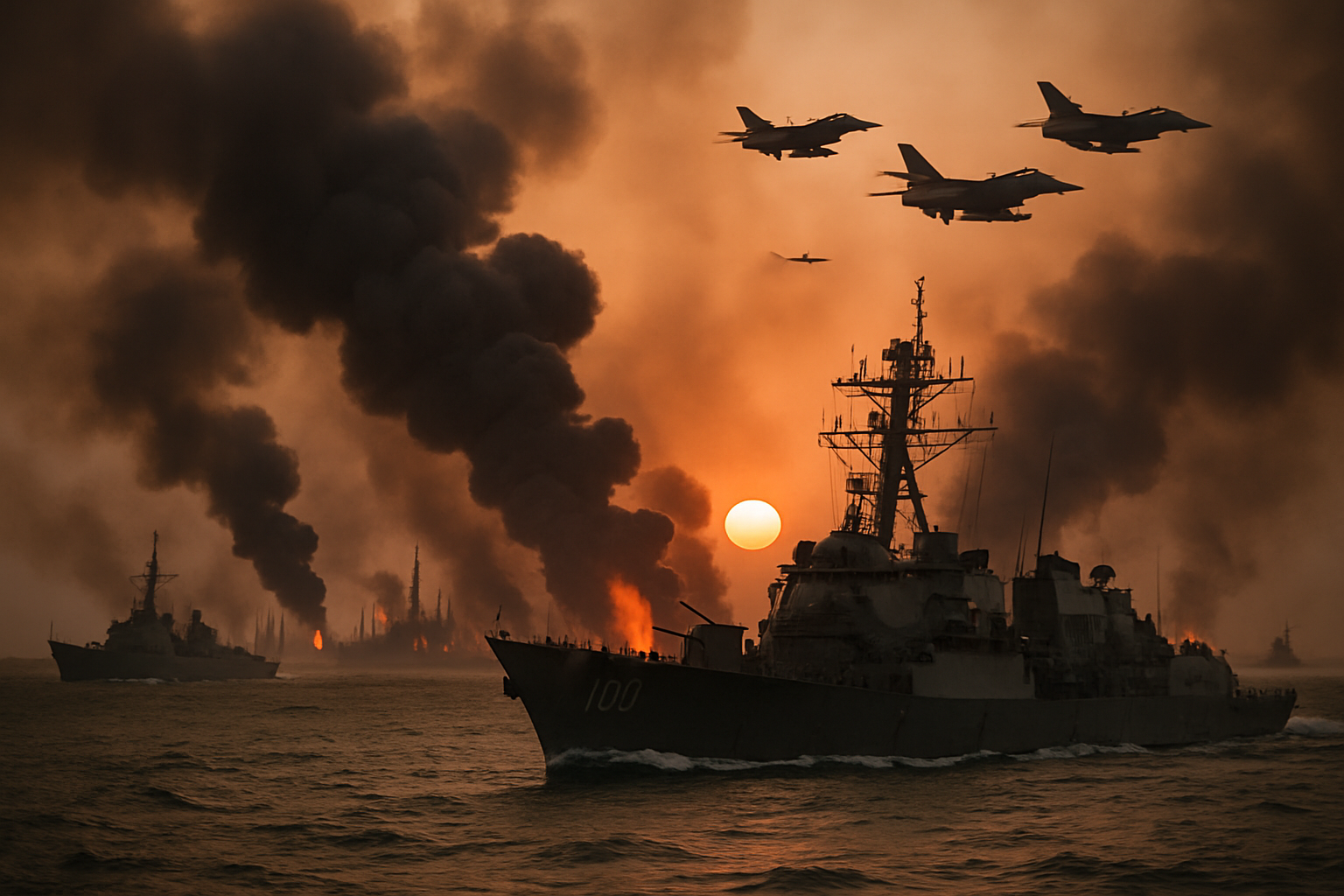
Thirty days after the launch of Operation Epic Fury, the Iran war has evolved into the most dangerous international crisis since the Cold War, triggering unprecedented disruptions to global energy markets, aviation networks, and threatening to reshape the entire Middle Eastern geopolitical landscape.
What began as a targeted operation against Iran's nuclear facilities on February 28, 2026, has escalated into a multi-front regional conflict following the confirmed death of Supreme Leader Ali Khamenei on March 1. The crisis has now expanded beyond Iran's borders, with Yemen's Houthis entering the war and Iranian forces threatening American universities in Gulf states.
Supreme Leader's Death Triggers Constitutional Crisis
The assassination of Iran's Supreme Leader Ali Khamenei in the opening hours of Operation Epic Fury created an unprecedented succession crisis. For the first time in the Islamic Republic's 47-year history, power has transferred through hereditary succession, with Mojtaba Khamenei, the former leader's son, assuming control.
This historic shift represents a fundamental change from clerical to military governance, as the Revolutionary Guards have consolidated unprecedented control over the Iranian state apparatus during the active war. U.S. intelligence assessments suggest this military influence will define Iran's future direction, marking the most significant governmental transformation since 1979.
"The elimination of Khamenei has created the single greatest chance for the Iranian people to take back their country in decades."
— President Donald Trump, Truth Social
Global Energy Crisis at Breaking Point
The conflict's most immediate global impact has been on energy markets. Iran's mining of the Strait of Hormuz with an estimated 2,000-6,000 naval mines has effectively closed the waterway carrying 40% of global seaborne oil transit. Oil prices have surged past $100 per barrel for the first time since 2014, with analysts warning of potential $200 levels.
The International Energy Agency has implemented its largest strategic petroleum reserve release in the organization's 50-year history, releasing 400 million barrels from 32 countries. Despite this unprecedented intervention, energy security remains critically compromised.
Qatar's suspension of LNG production, representing approximately 20% of global exports, has particularly impacted European energy supplies. Natural gas prices have surged 24% across Europe and 78% in the United States, creating severe winter energy security concerns.
Aviation Networks in Crisis
The war has triggered the most extensive global aviation disruption since COVID-19, with over 18,000 flights cancelled worldwide. Eight Middle Eastern countries have simultaneously closed their airspace, creating an "aviation black hole" that has severed critical Asia-Europe flight corridors.
Dubai International Airport, the world's busiest with 86 million passengers annually, remains completely shut down due to missile damage. Major carriers including Emirates, Air France-KLM, and Wizz Air have suspended operations indefinitely, stranding hundreds of thousands of passengers globally.
Airlines have implemented emergency fuel surcharges as jet fuel costs have jumped from $85-90 per barrel to $150-200, fundamentally altering the economics of global air travel.
Military Escalation and Regional Expansion
Operation Epic Fury, the largest coordinated U.S.-Israeli military campaign since the 2003 Iraq invasion, has cost $11.3 billion in its first week alone. The deployment of dual aircraft carriers USS Gerald Ford and Abraham Lincoln represents approximately one-third of the U.S. Navy's active fleet.
The conflict has expanded dramatically beyond its original scope. Yemen's Houthis entered the war with their first missile attacks on Israeli military sites, opening a dangerous new front that threatens Red Sea shipping routes. Meanwhile, Iranian forces have conducted the first attack on European territory since World War II, striking RAF Akrotiri in Cyprus.
This unprecedented escalation has prompted the largest naval coalition response in the Eastern Mediterranean since 1974, with HMS Dragon leading Spanish, Italian, French, Dutch, and Greek vessels in protecting European interests.
Humanitarian Crisis Deepens
The human cost of the conflict continues to mount, with Iran's Red Crescent reporting over 787 civilian casualties from U.S.-Israeli strikes. The Pentagon has confirmed responsibility for an elementary school attack that killed 165-185 students due to "outdated targeting data," drawing international condemnation and potential Geneva Conventions violations.
International evacuations have reached the largest scale since the Arab Spring of 2011, with Australia reporting 115,000 nationals trapped in the region and Germany struggling to repatriate 30,000 stranded tourists. The EU has activated its ESTIA evacuation plan for Cyprus for the first time in the bloc's history.
Lebanon has suffered particularly severe casualties, with 826 killed and 832,000 displaced as Hezbollah joined the conflict. The systematic targeting of medical personnel has resulted in 26 paramedics killed and 51 wounded, raising serious concerns about violations of international humanitarian law.
Nuclear Diplomacy Collapse
The military escalation occurred despite achieving the most significant diplomatic progress since the 2018 JCPOA collapse, with Geneva talks reaching "broad agreement on guiding principles" in February. However, fundamental scope disagreements proved insurmountable, with Iran maintaining that ballistic missiles and regional proxies were "red lines" excluded from nuclear-only discussions.
Iran continues uranium enrichment at 60% purity with over 400 kilograms of weapons-grade material, sufficient for multiple nuclear weapons. The crisis unfolds against the broader context of the New START treaty's expiration on February 5 – the first time in over 50 years that the United States and Russia operate without nuclear constraints.
Regional Coalition Under Strain
An unprecedented coalition of Saudi Arabia, UAE, Qatar, and Egypt had backed diplomatic efforts, representing extraordinary Middle Eastern consensus. However, Iranian retaliation has directly targeted coalition member territories, severely straining these partnerships.
Egyptian President Sisi has condemned attacks on "sisterly Arab countries," warning of "comprehensive chaos" spreading across the region. The UAE has suffered civilian casualties in Abu Dhabi, while Kuwait has relocated airline operations to Saudi Arabia due to repeated drone attacks.
Congressional and International Opposition
Domestic opposition in the United States has intensified, with bipartisan lawmakers demanding answers about strategy, costs, and potential ground troop deployment. Senator Richard Blumenthal has expressed being "more concerned than ever" about boots on the ground, while conflict approval remains at a historically low 25% among Americans.
The Pentagon's preparation for operations through September extends far beyond the initial 4-6 week timeline, suggesting a prolonged regional commitment that has sparked unprecedented congressional scrutiny.
Internationally, UN Secretary-General António Guterres has called the crisis "the greatest test of multilateral cooperation in the modern era," while Russia and China have issued their strongest condemnations in years of what they term violations of Iranian sovereignty.
Global Economic Disruption
The conflict has exposed fundamental vulnerabilities in globalized supply chains dependent on Gulf logistics networks. Manufacturing sectors including automotive, electronics, and textiles have been severely impacted, with the Pakistan stock exchange suffering its largest single-day decline in history at -8.97%.
The Persian Gulf's role as a critical Asia-Europe trade hub has been completely compromised, with Maersk and MSC suspending operations and over 150 tankers stranded with billions in cargo. PayPal has postponed its $1.1 billion IPO due to market volatility, demonstrating the crisis's reach into global financial markets.
Template-Setting Implications
The rapid transition from diplomatic breakthrough to military escalation demonstrates the fragility of crisis management in the multipolar era. The outcome will establish precedents for international dispute resolution, nuclear proliferation prevention, and the credibility of diplomatic versus military solutions that will influence global governance mechanisms for decades.
Success in containing the crisis could provide a framework for future nuclear crisis resolution, while failure may accelerate military approaches to international disputes, potentially encouraging global proliferation and undermining diplomatic credibility worldwide.
Looking Ahead: Critical Juncture
As the conflict enters its second month, multiple dynamics threaten further escalation. Iran's new hereditary leadership under Mojtaba Khamenei has consolidated hardline military influence, while President Trump's demands for "unconditional surrender" and claims of the right to personally choose Iran's next Supreme Leader have effectively eliminated diplomatic solutions.
The stakes could not be higher: regional war prevention, global energy security, nuclear governance credibility, and international law enforcement principles of the post-WWII order are all being tested simultaneously. The decisions made in the coming weeks will reverberate through international relations for decades, determining whether the post-Cold War international order can survive its greatest challenge.
March 2026 represents a watershed moment in 21st-century international relations, with the Iran war's outcome likely to establish the precedent for how territorial and nuclear disputes will be resolved for generations to come. The world watches as the most dangerous crisis since the Cold War unfolds, with global implications extending far beyond the borders of the Middle East.