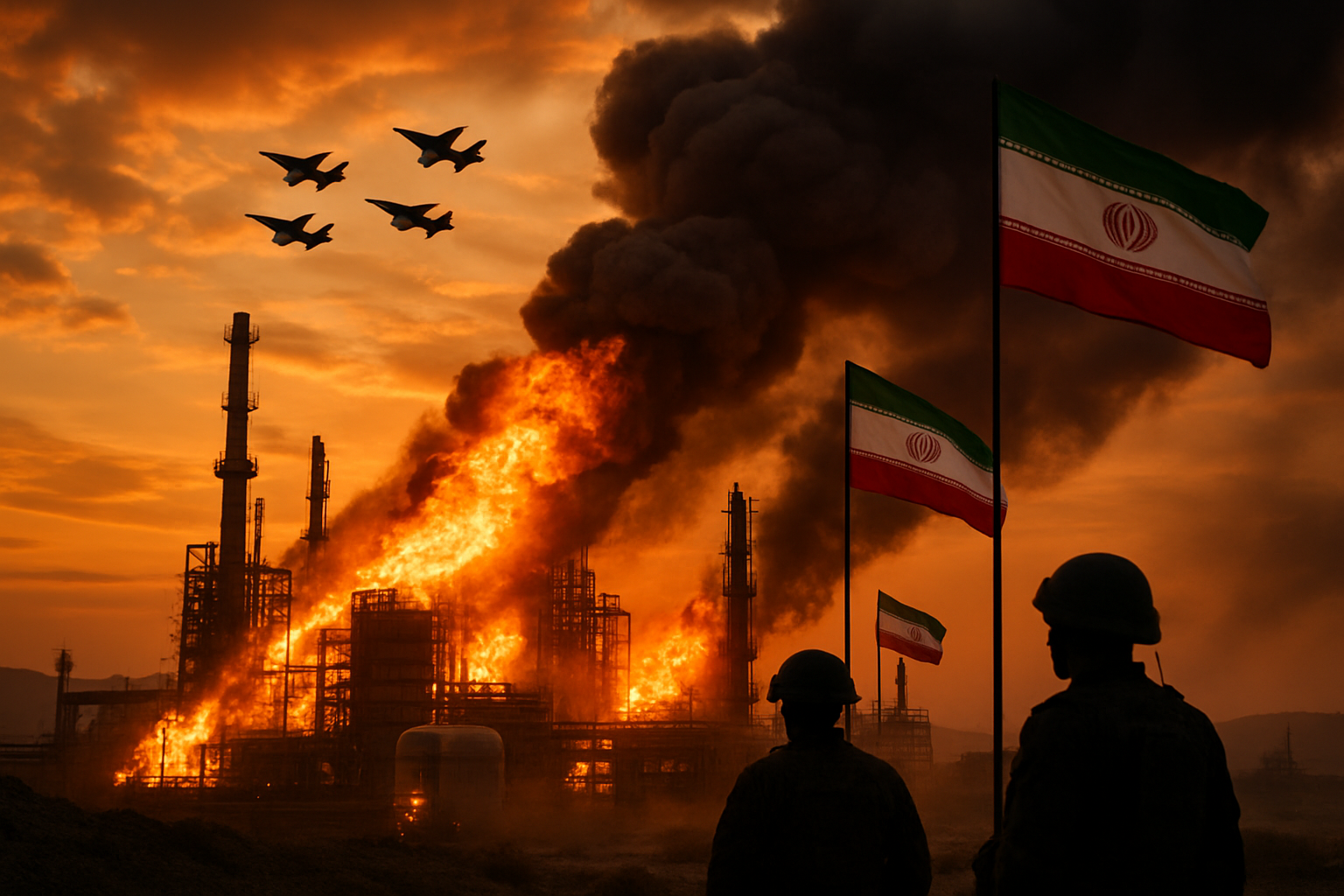
The Iran-US-Israel war enters its fifth week with unprecedented escalation as President Donald Trump warns Tehran to "make a deal before it's too late" while US forces intensify strikes across Iranian territory. Oil prices have surged past $100 per barrel for the first time since 2014, with the Strait of Hormuz—carrying 40% of global oil transit—effectively closed by Iranian naval mines.
US Central Command (CENTCOM) Commander Brad Cooper announced Thursday that American forces are making "undeniable progress" in what has become the largest Middle Eastern military operation since the 2003 Iraq invasion. The conflict, dubbed "Operation Epic Fury," has already cost $11.3 billion in its first week alone, with Pentagon officials secretly preparing operations through September despite initial 4-6 week timelines.
Trump's Pearl Harbor Moment and Escalating Rhetoric
In a provocative diplomatic exchange that has stunned international observers, President Trump made an explosive Pearl Harbor comparison to Japanese Prime Minister Takaichi, asking: "Who knows better about surprise than Japan? Okay, why didn't you tell me about Pearl Harbor?" The comment, defending surprise attacks without ally notification, represents the most inflammatory diplomatic statement of the crisis.
Trump has now demanded Iran's "unconditional surrender" and claimed the right to personally choose Iran's next Supreme Leader, rejecting the newly appointed Mojtaba Khamenei—the first hereditary succession in the Islamic Republic's 47-year history—as a "lightweight."
"Iran must fully open, without threat, the Strait of Hormuz, within 48 hours, or we will hit and obliterate their various power plants, starting with the biggest one first."
— Donald Trump, Truth Social
Global Economic and Energy Crisis
The conflict has triggered the most severe global economic disruption since the COVID-19 pandemic. Oil prices surged to $107.8 per barrel (Brent crude) and $111 per barrel (WTI), with analysts warning of potential $200 per barrel levels if the crisis escalates further.
Iran's Revolutionary Guards have effectively closed the Strait of Hormuz through extensive naval mining operations, deploying an estimated 2,000-6,000 mines across the critical waterway. Over 150 oil tankers worth billions in cargo remain stranded in the Persian Gulf, while major shipping companies Maersk and MSC have suspended all operations in the region.
The International Energy Agency (IEA) has authorized the largest strategic petroleum reserve release in its 50-year history—400 million barrels from 32 countries—double the emergency response to the 2022 Ukraine crisis. Natural gas prices have skyrocketed by 24% in Europe and 78% in the United States, threatening European energy security as Qatar's LNG production remains halted due to Iranian attacks.
Aviation Industry in Crisis
The global aviation crisis has reached unprecedented levels, with over 18,000 flights cancelled worldwide—the most extensive disruption since COVID-19. Eight Middle Eastern countries have simultaneously closed their airspace: Iran, Iraq, Israel, UAE, Qatar, Syria, Kuwait, and Bahrain, effectively severing critical Asia-Europe air corridors.
Dubai International Airport, the world's busiest with 86 million passengers annually, remains completely shut down due to missile damage. Major carriers including Emirates, Air France-KLM, and Wizz Air have suspended Middle Eastern operations indefinitely, affecting hundreds of thousands of passengers globally.
Military Developments and Casualties
Operation Epic Fury has marked several historic military milestones. The USS Charlotte submarine sank the Iranian frigate IRIS Dena off Sri Lanka, killing over 80 crew members—the first enemy vessel sunk by a US submarine since World War II, according to Defense Secretary Pete Hegseth.
The US has deployed unprecedented naval power with dual-carrier groups USS Gerald R. Ford and USS Abraham Lincoln, representing approximately one-third of the active US Navy fleet. Recent reports indicate the USS Tripoli has arrived with 3,500 Marines, sparking speculation about potential ground operations.
Iran's retaliation under "Operation True Promise 4" has been systematic and far-reaching. The Islamic Revolutionary Guard Corps (IRGC) declared "no red lines remain," with attacks spanning from the UAE to Cyprus—the first attack on European territory since World War II.
Regional Coalition Under Strain
The unprecedented regional coalition of Saudi Arabia, UAE, Qatar, and Egypt, which had supported diplomatic efforts, faces severe strain as Iranian retaliation directly targets member territories. Egyptian President Abdel Fattah el-Sisi condemned attacks on "sisterly countries," warning of "comprehensive chaos" spreading across the region.
The UAE has reported one civilian death in Abu Dhabi from missile debris, while Kuwait International Airport has been repeatedly targeted by drone strikes, injuring 32 foreign nationals. Qatar successfully intercepted 65 missiles and 12 drones but reported eight civilians injured from falling debris.
European Security Implications
The Iranian drone strike on RAF Akrotiri in Cyprus has fundamentally altered the conflict's scope, representing the first attack on European soil since World War II. The European Union responded with its first-ever activation of the ESTIA evacuation plan and deployed an unprecedented naval coalition including HMS Dragon and vessels from Spain, Italy, France, the Netherlands, and Greece.
French President Emmanuel Macron made an emergency visit to Cyprus, while multiple EU member states have issued their strongest condemnation of Iranian actions. The attack has raised critical questions about European security architecture and NATO's response to Iranian aggression.
Iran's Leadership Transition Amid Warfare
The death of Supreme Leader Ali Khamenei on March 1, confirmed by Iranian state media, marked the end of a 37-year era and triggered a constitutional succession crisis during active warfare. His son Mojtaba Khamenei has been appointed as his successor, establishing the first hereditary succession in the Islamic Republic's history.
US intelligence agencies suggest the Revolutionary Guards have consolidated unprecedented control over Iranian governance, representing a historic shift from clerical to military leadership. The transition has occurred under the most challenging circumstances in modern Iranian history, with systematic targeting of government infrastructure and leadership.
Nuclear Diplomacy Collapse
The current military confrontation emerged from the complete breakdown of nuclear negotiations despite Geneva talks achieving "broad agreement on guiding principles"—the most significant diplomatic progress since the 2018 JCPOA collapse. The fundamental disagreement proved insurmountable: Iran excluded ballistic missiles and regional proxies as "red lines," demanding nuclear-only talks, while the US insisted on comprehensive agreements including missiles, armed groups, and human rights.
Iran continues uranium enrichment at 60% purity—approaching the 90% weapons-grade threshold—with over 400 kilograms of enriched material sufficient for multiple weapons if weaponized. The crisis occurs amid broader nuclear governance breakdown following the February 5 expiration of New START—the first time in 50+ years without US-Russia nuclear constraints.
Congressional Opposition and Domestic Politics
Unprecedented bipartisan congressional opposition has emerged, with lawmakers demanding answers on strategy, costs, and potential ground troop deployment. Senator Richard Blumenthal expressed being "more concerned than ever" about "boots on the ground," while the conflict's unpopularity has reached "almost unprecedented" levels for early-stage military operations, with only 25% American public support.
Pentagon officials have reportedly prepared operations extending through September, far beyond the initial 4-6 week timeline, while costs have already reached historic levels. Financial markets have emerged as the "ultimate constraint" on escalation, with Pakistan's stock exchange posting its largest single-day decline in history at -8.97%.
Humanitarian Crisis
The humanitarian toll continues mounting on both sides. Iran's Red Crescent reports over 787 civilian casualties from US-Israeli strikes, including the devastating Minab school attack that killed 53-85 students and staff. The Pentagon has confirmed US responsibility for elementary school strikes killing 165-185 students due to "outdated targeting data."
International evacuations have reached the largest scale since the Arab Spring of 2011, with Australia reporting 115,000 nationals trapped and Germany evacuating 30,000 stranded tourists. Lebanon has reported 826 killed and 832,000 displaced as Hezbollah joined the conflict, completely collapsing the November 2024 ceasefire that had held for over a year.
Template-Setting Implications
UN Secretary-General António Guterres has characterized the crisis as the "greatest test of multilateral cooperation and crisis management in the modern era." The rapid transition from diplomatic breakthrough to military confrontation demonstrates the fragility of crisis management mechanisms in the multipolar era.
The stakes extend far beyond the Middle East, affecting regional war prevention, global energy security, nuclear governance credibility, and international law enforcement. Success in containing the crisis could provide a framework for nuclear crisis resolution, while failure may accelerate military solutions for decades, encouraging proliferation globally and undermining diplomatic credibility worldwide.
Looking Ahead
As the conflict enters its fifth week, the trajectory appears increasingly unpredictable. Trump's ultimatums eliminate negotiated solutions, while Iran's new hardline military leadership shows no signs of backing down. The international community faces its greatest test of multilateral cooperation, with decisions in the coming days and weeks likely to reverberate through international relations for decades.
The crisis represents a watershed moment in 21st-century international relations, determining precedents for diplomatic versus military solutions in future territorial and nuclear disputes worldwide. With energy architecture, aviation networks, and nuclear proliferation mechanisms all under stress, the implications extend far beyond current events, potentially reshaping the post-Cold War international order and establishing new precedents for conflict resolution in the modern era.