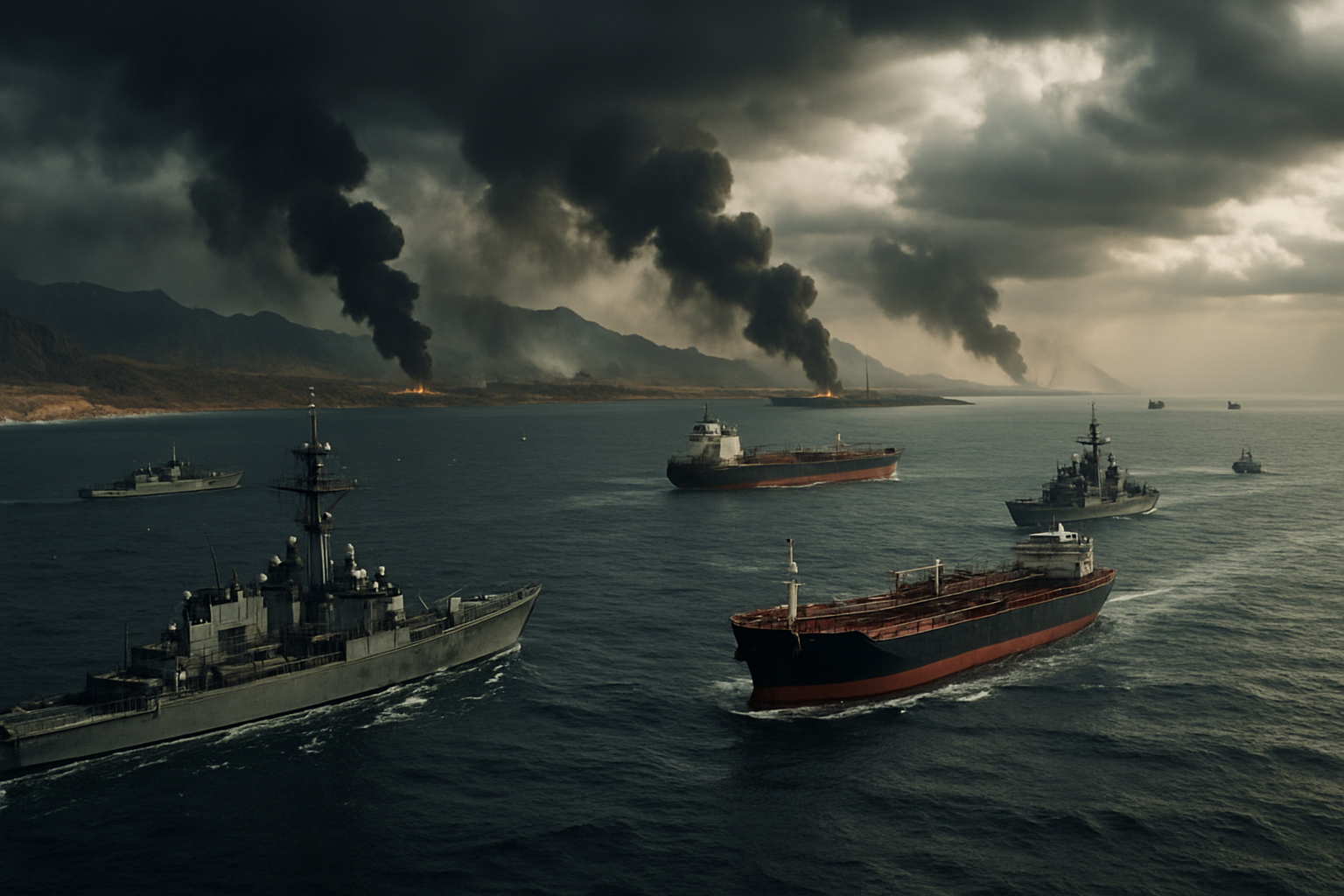
Iran has begun mining the strategically vital Strait of Hormuz, prompting US forces to destroy 16 Iranian mine-laying vessels as the regional conflict enters its most dangerous phase since the Cold War. The waterway, which carries 40% of global seaborne oil transit, has become the focal point of escalating tensions on day twelve of Operation Epic Fury.
Critical Energy Chokepoint Under Threat
US intelligence reports confirm Iran is deploying naval mines using small vessels carrying 2-3 mines each from an estimated stockpile of 2,000-6,000 total mines. President Trump has threatened Iran with "consequences never seen before" if the mines are not removed immediately, describing the action as crossing a red line that threatens global energy security.
The mining operation represents a dramatic escalation in Iran's "Operation True Promise 4" retaliation campaign, which the Islamic Revolutionary Guard Corps launched with the declaration that "no red lines remain" following the confirmed death of Supreme Leader Ali Khamenei on March 1.
"The United States will not tolerate any attempt to disrupt the free flow of commerce through international waters. Iran must remove these mines immediately or face the full consequences of their actions."
— President Donald Trump, Truth Social
Global Economic Impact Intensifies
Oil prices have surged past $80 per barrel, marking a 10% increase as markets respond to the closure of this critical energy artery. Natural gas prices have jumped 24% in Europe and 78% in the United States, creating the most severe energy crisis since the 1970s oil shocks.
Over 150 oil tankers worth billions in cargo remain stranded in the Persian Gulf as major shipping companies Maersk and MSC have suspended operations. Qatar has halted LNG production, threatening 20% of global liquid natural gas exports and further complicating Europe's energy supply chain.
The International Energy Agency is reportedly considering the largest release of strategic oil reserves in its history to stabilize markets, while European Commission President Ursula von der Leyen has announced measures to reduce energy prices.
Maritime Warfare Escalates
Three commercial vessels have been struck by projectiles in the Strait of Hormuz region, according to maritime security agencies. The Thailand-flagged bulk carrier Mayuree Naree was hit and caught fire, forcing crew evacuation, while the Japan-flagged container ship One Majesty sustained minor damage.
The United Kingdom Maritime Trade Operations (UKMTO) confirmed that fires have been extinguished on affected vessels, with all crew members accounted for. However, the incidents highlight the increasing risks to commercial shipping in one of the world's most critical trade routes.
US forces have responded decisively to Iranian mining operations, destroying 16 mine-laying vessels in coordinated strikes. The Pentagon describes these actions as defensive measures to maintain freedom of navigation in international waters.
Iranian Leadership Crisis Deepens
Reports suggest Iran's new Supreme Leader, Mojtaba Khamenei, was wounded in the early days of the conflict and has not appeared publicly since his appointment. Israeli intelligence assessments indicate he sustained injuries to his legs during joint US-Israeli airstrikes, explaining his absence from public view.
Iranian President Masoud Pezeshkian's son has disputed injury claims, stating through Telegram that the new Supreme Leader is "safe and sound." However, the succession crisis continues to complicate Iran's wartime leadership structure, with the Revolutionary Guards maintaining unprecedented influence over state decisions.
The Assembly of Experts' selection of Mojtaba Khamenei represents the first hereditary succession in the Islamic Republic's 47-year history, marking a significant departure from traditional clerical governance toward military-dominated rule.
International Response Intensifies
Four Iranian diplomats were killed in an Israeli airstrike on the Ramada Hotel in Beirut, according to Iran's UN mission, further inflaming regional tensions. The incident has drawn condemnation from Tehran and raised concerns about the conflict's expansion beyond Iranian territory.
European Union leaders are convening emergency sessions as the crisis spreads to European territory for the first time since World War II. Iranian drones struck RAF Akrotiri in Cyprus, prompting an unprecedented naval coalition response including HMS Dragon and vessels from Spain, Italy, France, Netherlands, and Greece.
Romania's President Nicusor Dan has convened the nation's top defense council to discuss allowing US aircraft access to Romanian military bases for Iran operations, indicating the conflict's expanding geographic scope.
Aviation Crisis Reaches Peak
Global aviation faces its worst disruption since COVID-19, with over 18,000 flights cancelled worldwide. Eight Middle Eastern countries maintain simultaneous airspace closures, while Dubai International Airport—the world's busiest—remains shuttered due to missile damage.
Major carriers including Emirates, Air France-KLM, and Wizz Air have suspended operations indefinitely, affecting hundreds of thousands of passengers globally. The disruption has forced complex rerouting of Europe-Asia flights, with some airlines announcing fuel surcharges due to increased costs.
Military Casualties Mount
US military casualties have reached 140 service members wounded according to Pentagon spokesperson Sean Parnell, with 108 already returned to duty and eight in critical condition. This represents the highest American casualty count in a Middle Eastern operation since the 2003 Iraq invasion.
Operation Epic Fury has cost $3.7 billion in its first week alone, with Pentagon sources indicating preparations for operations extending through September—far beyond the initially projected timeline.
Iranian casualties continue mounting, with the Red Crescent reporting over 1,300 civilians killed in US-Israeli strikes. International humanitarian organizations have called for investigations into potential Geneva Convention violations, particularly following the devastating attack on a girls' school in Minab that killed 53-85 students and staff.
Kurdish Forces Join Regional Conflict
Kurdish armed groups have declared readiness to challenge Iran's government amid the broader regional uprising, according to Agence France-Presse reports. Tehran considers these Kurdish factions terrorist organizations and has repeatedly accused them of threatening national security.
The involvement of multiple ethnic and regional groups threatens to transform the conflict from a bilateral US-Israeli versus Iran confrontation into a broader regional war with unpredictable consequences for Middle Eastern stability.
Nuclear Diplomacy Collapsed
The current military confrontation emerged from the complete breakdown of Geneva nuclear negotiations despite achieving "broad agreement on guiding principles"—the most progress since the 2018 JCPOA collapse. Iran excluded ballistic missiles and regional proxies as "red lines" while demanding nuclear-only talks, versus US demands for comprehensive agreements including missiles, armed groups, and human rights.
Iran continues uranium enrichment at 60% purity with over 400 kilograms of material—approaching the 90% weapons-grade threshold and sufficient for multiple nuclear weapons if weaponized. The collapse of diplomatic efforts has created the most serious nuclear crisis in decades.
Congressional Opposition Grows
Bipartisan lawmakers are demanding answers on strategy, costs, and potential ground troop deployment. Senator Richard Blumenthal expressed being "more concerned than ever" about the possibility of boots on the ground, while conflict unpopularity reaches "almost unprecedented" levels with only 25% American public support.
Democratic Senator Chris Murphy described the Trump administration's war plans as "incoherent and incomplete" following classified congressional briefings, warning of massive taxpayer costs and American casualties while predicting a hardline anti-American regime would likely survive.
Global Economic Disruption
Supply chains face severe disruption affecting manufacturing in automotive, electronics, and textiles industries dependent on Gulf networks. The Pakistan Stock Exchange crashed 8.97% in its largest single-day decline in history, while stock markets worldwide reflect growing economic anxiety.
The Persian Gulf's role as a critical Asia-Europe trade hub has been compromised, demonstrating the fundamental vulnerability of global systems to geopolitical shocks. Traditional monetary policy tools prove limited in addressing structural disruptions from military conflict.
Template-Setting Crisis for 21st Century
UN Secretary-General António Guterres has called the crisis the "greatest test of multilateral cooperation and crisis management in the modern era." The rapid transition from diplomatic breakthrough to military confrontation demonstrates the fragility of crisis management in the multipolar era.
The New START treaty's expiration on February 5—leaving the world without US-Russia nuclear constraints for the first time in over 50 years—compounds the nuclear governance crisis. Combined with China's nuclear expansion, experts warn of the highest nuclear risks in decades.
Success in containing this crisis could provide a diplomatic framework for future nuclear disputes, while failure may accelerate military solutions over diplomatic approaches, encouraging proliferation globally and undermining international law credibility.
Looking Ahead: Critical Juncture
The coming days represent a decisive moment for international relations, with implications extending decades beyond current events. Decisions on diplomatic versus military solutions will set precedents for future territorial and nuclear disputes globally.
Regional war prevention, global energy security, nuclear governance credibility, and international law enforcement principles face simultaneous testing. The stakes encompass Middle Eastern stability, energy architecture evolution, aviation networks, and nuclear proliferation mechanisms with worldwide implications.
As the conflict enters its most dangerous phase with the mining of the Strait of Hormuz, the international community confronts the most consequential crisis since the Cold War—one that will determine conflict resolution approaches for the 21st century and shape the post-World War II international order's sustainability.