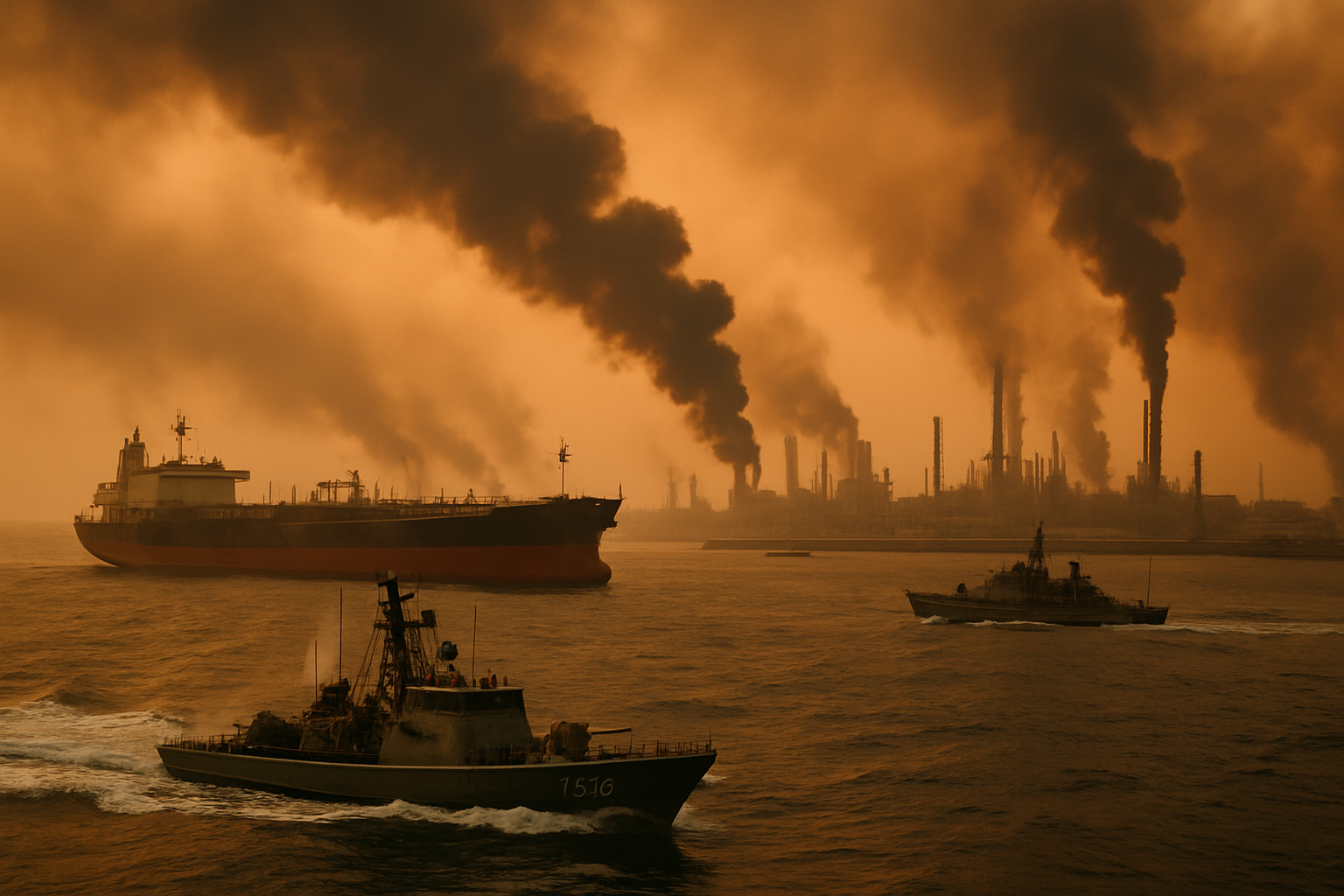
Iran's three-week war with the United States and Israel entered its "decisive phase" on Saturday, March 14, 2026, as American forces launched precision strikes against Iran's strategic Kharg Island oil hub while Tehran issued stark warnings of retaliation against energy facilities across the Middle East.
The escalation marks the most dangerous international crisis since the Cold War end, with global implications extending far beyond the Persian Gulf region. Oil prices surged past $100 per barrel as Iran threatened to reduce U.S.-linked energy facilities to "a pile of ashes" if its critical infrastructure faces further attacks.
U.S. Targets Iran's Economic Lifeline
U.S. Central Command confirmed that American forces struck over 90 military targets on Kharg Island, Iran's main oil export hub that handles approximately 90% of the country's crude shipments—roughly 1.6 million barrels per day. The strategic location, situated 300 miles northwest of the critical Strait of Hormuz, serves as Iran's economic lifeline in the Persian Gulf.
President Donald Trump announced the operation as "one of the most powerful bombing raids in the history of the Middle East," while deliberately sparing oil infrastructure "out of consideration." However, Trump warned of immediate reconsideration if Iran continues disrupting shipping through the Strait of Hormuz, which carries 40% of global oil transit.
"We completely destroyed their military targets but left their oil infrastructure intact—for now. But if Iran or anyone else interferes with passage through the Strait, I will reconsider my decision not to wipe it out."
— President Donald Trump, Truth Social
The strikes destroyed naval mine storage facilities, missile bunkers, and multiple military installations while avoiding petroleum infrastructure. Iran's state media confirmed that only military targets were hit, with oil facilities remaining operational despite the bombardment.
Iran's Retaliatory Threats
Iran's Revolutionary Guard Corps escalated tensions by threatening to attack facilities owned by U.S. companies across the region under "Operation True Promise 4," expanding their "no red lines remain" policy beyond purely military objectives to economic warfare.
Foreign Minister Abbas Araghchi announced that Iran would "act with caution to avoid targeting populated areas" but warned that all "economic centers" would become legitimate targets if energy infrastructure attacks continue. The threats represent a significant shift toward economic warfare strategy.
Iran's military command specifically warned the United Arab Emirates to evacuate ports, docks, and military locations, claiming the U.S. used these facilities to launch strikes on Iran's Kharg Island. The warning marks the first time Iran has directly threatened a neighboring country during the three-week conflict.
Global Aviation and Energy Crisis
The conflict has created the most severe global aviation crisis since COVID-19, with over 18,000 flights cancelled worldwide as eight Middle Eastern countries maintain simultaneous airspace closures. Dubai International Airport, the world's busiest, remains shuttered from missile damage.
Energy markets face unprecedented disruption as Iran declared the Strait of Hormuz "unsafe for shipping," effectively closing the critical waterway. Over 150 oil tankers worth billions in cargo remain stranded in the Persian Gulf, while major shipping companies Maersk and MSC have suspended operations.
Natural gas prices have spiked 24% in Europe and 78% in the United States, threatening to push households toward energy poverty. Qatar, which supplies 20% of global LNG exports, halted production after Iranian infrastructure strikes.
European Territory Under Attack
In a historic escalation, Iranian drones struck RAF Akrotiri in Cyprus—the first attack on European territory since World War II. The unprecedented assault prompted an immediate naval coalition response, with HMS Dragon, Spanish frigates, and vessels from Italy, France, the Netherlands, and Greece deploying to protect European interests.
The European Union activated its ESTIA evacuation plan for the first time in the bloc's history, coordinating the largest international evacuation since the Arab Spring in 2011. Australia alone has 115,000 nationals trapped in the region, while Germany is evacuating 30,000 stranded tourists.
Iranian Leadership Transition
Following the confirmed death of Supreme Leader Ali Khamenei on March 1 in U.S.-Israeli strikes, Iran's succession crisis continues under wartime conditions. Mojtaba Khamenei, the late leader's son, has emerged as the favored candidate in what would be the first hereditary succession in the Islamic Republic's 47-year history.
U.S. intelligence suggests a Revolutionary Guards member will likely be chosen as the ultimate leader, marking a historic shift from clerical to military governance. This transition consolidates hardline control over Iranian state apparatus during active warfare.
Congressional Opposition Mounts
Bipartisan lawmakers in Washington are demanding answers about strategy, costs, and potential ground troop deployment as Operation Epic Fury enters its third week. Senator Richard Blumenthal expressed being "more concerned than ever" about the prospect of boots on the ground.
The conflict's unpopularity remains "almost unprecedented" for early-stage military operations, with only 25% of Americans supporting the strikes. Pentagon estimates show operations costing $891.4 million daily, with total expenditures reaching $11.3 billion in the first week alone.
Financial markets have emerged as the "ultimate constraint" on continued escalation, with Pakistan's stock exchange suffering its largest single-day decline in history at -8.97%.
Nuclear Diplomacy Collapse
The current military confrontation emerged from the complete breakdown of Geneva nuclear negotiations despite achieving "broad agreement on guiding principles"—the most significant progress since the Joint Comprehensive Plan of Action collapsed in 2018.
Fundamental disagreements persisted, with Iran maintaining ballistic missiles and regional proxies as "red lines" while demanding nuclear-only talks. The United States insisted on comprehensive agreements covering missiles, armed groups, and human rights violations.
Iran continues enriching uranium to 60% purity—approaching the 90% weapons-grade threshold—with an estimated 400+ kilograms of enriched material sufficient for multiple weapons if weaponized.
Regional Coalition Under Strain
The unprecedented coalition of Saudi Arabia, UAE, Qatar, and Egypt that had backed diplomatic solutions faces severe strain as Iranian retaliation directly targets member territories. Egyptian President Abdel Fattah el-Sisi condemned attacks on "sisterly Arab countries," warning of "comprehensive chaos" spreading across the region.
Casualties from Iranian retaliation include: one civilian killed in Abu Dhabi from missile debris, 32 foreign nationals injured in Kuwait airport strikes, and eight wounded in Qatar despite successful Patriot missile interceptions of 65 missiles and 12 drones.
Trump's Escalation Path
President Trump has demanded Iran's "unconditional surrender" and claimed the right to personally choose Iran's next Supreme Leader, representing the most direct assertion of American control over Iranian affairs since 1979. This policy evolution from nuclear-focused operations to comprehensive regime change eliminates diplomatic solution possibilities.
Trump announced that "many countries" would send warships to keep the Strait of Hormuz open, hoping China, France, Japan, South Korea, and Britain would contribute vessels. He warned that the United States would be "bombing the hell out of the shoreline" while "continually shooting Iranian boats and ships out of the water."
Historical Implications
March 2026 represents a watershed moment for Middle Eastern geopolitics and international relations, with implications extending decades beyond current events. UN Secretary-General António Guterres called the crisis "the greatest test of multilateral cooperation and crisis management in the modern era."
The conflict occurs amid broader nuclear governance breakdown, with the New START treaty having expired in February—the first time in over 50 years without U.S.-Russia nuclear constraints. Combined with China's nuclear expansion, experts warn nuclear risks are at their "highest in decades."
The rapid transition from diplomatic breakthrough to military confrontation demonstrates the fragility of crisis management in the multipolar era. Success in containing the conflict could provide a template for future nuclear crisis resolution, while failure may accelerate military solutions and reshape international approaches to conflict resolution for decades.
Looking Ahead
As the Iran War enters its third week, the stakes encompass regional war prevention, global energy security, nuclear governance credibility, and international law enforcement. The crisis tests post-World War II order principles simultaneously, making it the most consequential international confrontation affecting energy markets, supply chains, and diplomatic precedents with worldwide implications.
The coming phase will determine whether this remains a contained regional confrontation or escalates into a broader Middle Eastern war with global consequences that could reshape international relations for the 21st century.