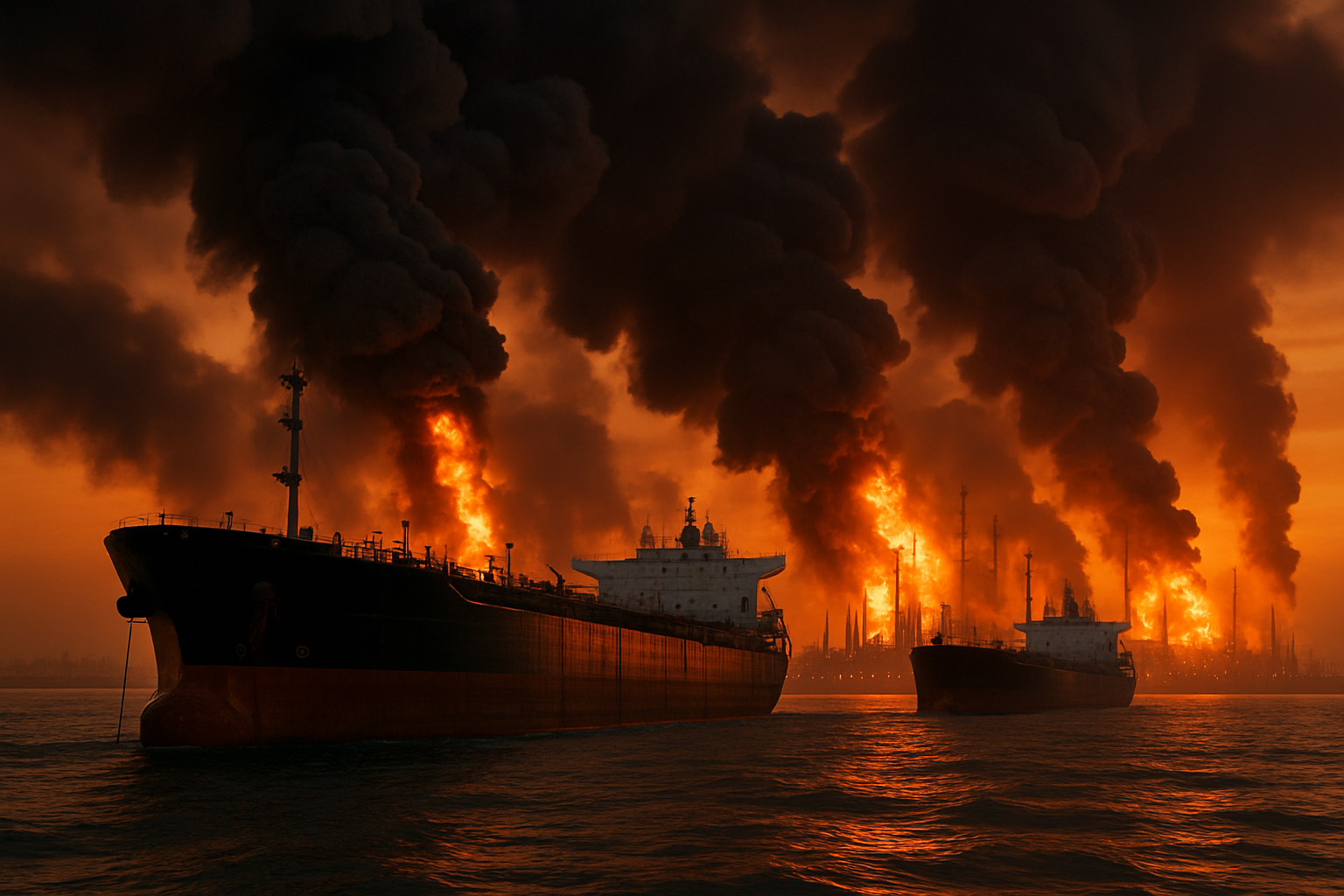
Iran has dramatically escalated its military campaign against Gulf energy infrastructure and shipping routes, pushing oil prices past $100 per barrel for the first time since 2014 as the 13-day-old conflict with the United States and Israel reaches its most dangerous phase yet.
The Islamic Revolutionary Guard Corps launched what it described as its most intensive wave of attacks yet, targeting oil tankers in Iraqi waters, Dubai's container ships, and critical energy facilities across the Persian Gulf region. The escalation has effectively shut down the Strait of Hormuz, the world's most critical energy chokepoint through which 40% of global seaborne oil transits daily.
Two oil tankers were attacked near Iraq's Basra port early Thursday, killing at least one crew member and forcing Iraq to halt operations at all its oil terminals. The attacks marked a significant expansion of Iran's campaign beyond its own territorial waters, directly threatening the energy security of neighboring Gulf states that have sought to remain neutral in the conflict.
Global Energy Crisis Deepens
Brent crude oil surged above $100 per barrel in Asian trading, representing the highest weekly gains in trading history. The price spike reflects growing market fears that Iran's mining of the Strait of Hormuz and systematic attacks on energy infrastructure could create the largest oil supply disruption in modern history.
"Iran will abandon all restraint if the US shows any aggression against Iranian islands in the Gulf," Iranian Parliament Speaker Mohammad Baqer Qalibaf warned on social media Thursday.
— Mohammad Baqer Qalibaf, Iranian Parliament Speaker
The International Energy Agency (IEA) announced it would release a record 400 million barrels from strategic stockpiles to combat the price spike, calling the Middle East conflict "the biggest oil supply disruption in history." The release represents the largest coordinated intervention from strategic reserves in the agency's 50-year history.
Major shipping companies including Maersk and MSC have suspended all operations in the Persian Gulf, leaving over 150 oil and LNG tankers stranded with cargo worth billions of dollars. Qatar has halted LNG production at its key facilities, threatening supplies to Europe which relies heavily on Qatari gas exports.
Aviation Industry in Crisis
The conflict has created an unprecedented aviation crisis, with over 18,000 flights cancelled worldwide since the war began on February 28. Eight Middle Eastern countries have closed their airspace simultaneously, creating the most severe disruption to international air travel since the COVID-19 pandemic.
Dubai International Airport, the world's busiest by passenger traffic, remains completely shut down after suffering missile damage. Major carriers including Emirates, Air France-KLM, and Wizz Air have suspended all Middle East operations indefinitely, stranding hundreds of thousands of passengers globally.
Iran's New Supreme Leader
The escalation comes as Iran's power structure undergoes a historic transformation following the confirmed death of Supreme Leader Ali Khamenei on March 1. His son, Mojtaba Khamenei, has been named as his successor in what marks the first hereditary succession in the Islamic Republic's 47-year history.
US intelligence agencies suggest the succession has consolidated power under the Islamic Revolutionary Guard Corps, representing a shift from clerical to military governance that could prolong the conflict. The younger Khamenei was reportedly wounded in recent attacks but continues to direct Iran's war efforts.
Regional Coalition Under Strain
The expanding Iranian attacks have severely strained the unprecedented coalition of Saudi Arabia, UAE, Qatar, and Egypt that had initially supported diplomatic efforts to prevent the war. Several coalition members have seen their territories directly targeted, fundamentally altering regional security calculations.
Kuwait International Airport was struck by multiple drones Thursday morning, causing no casualties but disrupting operations. The UAE confirmed one civilian death from missile debris in Abu Dhabi, while Qatar reported eight injuries from intercepting Iranian missiles and drones using Patriot defense systems.
"We are witnessing attacks on sisterly Arab countries that threaten comprehensive chaos across the region," Egyptian President Abdel Fattah el-Sisi warned in emergency remarks.
— Abdel Fattah el-Sisi, President of Egypt
US Military Response Intensifies
The United States has responded by destroying 28 Iranian mine-laying vessels attempting to block the Strait of Hormuz, according to Pentagon sources. The US military operation, dubbed "Operation Epic Fury," has now cost $11.3 billion in its first week alone, making it one of the most expensive military campaigns in recent history.
US casualties have mounted to 150 troops wounded, with 8 in critical condition, according to Pentagon briefings to Congress. The first American combat deaths occurred when 3 service members were killed in the opening phase of operations.
President Donald Trump has demanded Iran's "unconditional surrender" and claimed the right to personally choose Iran's next leader, marking the most direct assertion of American control over Iranian internal affairs since the 1979 revolution.
European Territory Attacked
In a dramatic escalation, Iranian drones struck RAF Akrotiri, a British airbase in Cyprus, marking the first attack on European territory since World War II. The attack prompted an unprecedented naval coalition response, with HMS Dragon, Spanish frigates, and vessels from Italy, France, Netherlands, and Greece deploying to protect European interests.
The European Union activated its ESTIA evacuation plan for Cyprus for the first time in the bloc's history, underlining the gravity of the security threat to European territory.
Economic Shockwaves Spread Globally
Financial markets worldwide have been in freefall since the conflict began, with Pakistan's stock exchange suffering its largest single-day decline in history at -8.97%. The economic disruption extends far beyond energy markets, affecting supply chains for automotive, electronics, and textile manufacturing that depend on Gulf logistics networks.
Airlines are implementing emergency fuel surcharges as jet fuel costs have jumped from $85-90 to $150-200 per barrel. Australia's Qantas and Air New Zealand have announced immediate fare increases, while Asian carriers struggle with the complete severance of Europe-Asia flight corridors through Middle Eastern airspace.
Nuclear Diplomacy Collapse
The current crisis emerged from the complete breakdown of nuclear negotiations that had achieved what negotiators called "broad agreement on guiding principles" in Geneva talks - the most progress since the 2018 collapse of the nuclear deal. However, fundamental disagreements over the scope of any agreement proved insurmountable.
Iran had excluded ballistic missiles and regional proxy support as "red lines" that could not be part of nuclear talks, while the US demanded a comprehensive agreement addressing missiles, armed groups, and human rights issues. Iran continues to enrich uranium at 60% purity with over 400 kilograms of material that could be converted to weapons-grade if needed.
Congressional Pressure Mounts
US lawmakers are demanding answers about the war's strategy, costs, and potential for ground troop deployment. Senator Richard Blumenthal expressed being "more concerned than ever" about the possibility of American boots on the ground, while the conflict's unpopularity has reached "almost unprecedented" levels for an early-stage military operation.
A Pentagon investigation has reportedly confirmed US responsibility for a devastating strike on an Iranian elementary school that killed 165-185 students, using what officials described as "outdated targeting data." The incident has drawn international condemnation and calls for war crimes investigations.
Humanitarian Crisis Deepens
The conflict has triggered the largest international evacuation operation since the Arab Spring in 2011, with Australia reporting 115,000 nationals trapped in the region and Germany scrambling to evacuate 30,000 stranded tourists. Iran's Red Crescent reports over 787 civilian casualties from US-Israeli airstrikes.
The war has also drawn in Lebanon, where Hezbollah has launched significant attacks on Israel in retaliation for Khamenei's death, completely collapsing the November 2024 ceasefire agreement and displacing hundreds of thousands of civilians.
Template-Setting Crisis for 21st Century
UN Secretary-General António Guterres has called the crisis "the greatest test of multilateral cooperation and crisis management in the modern era." The rapid transition from diplomatic breakthrough to military confrontation demonstrates what experts describe as the fragility of crisis management mechanisms in the multipolar world order.
The stakes extend far beyond the immediate region, affecting global energy security, nuclear governance credibility, and international law enforcement. The outcome will likely establish precedents for 21st-century conflict resolution, determining whether diplomatic or military solutions become the preferred approach for future territorial and nuclear disputes worldwide.
As the conflict enters its third week, the world watches to see whether the escalation can be contained or will spiral into a broader regional war with implications that could reshape international relations for decades to come.