Yemen's Iran-aligned Houthis have launched their first missile attack against Israel since the Iran-Israel war began February 28, dramatically expanding the Middle East conflict as Pakistan officially confirms its mediation role in US-Iran peace talks amid the most dangerous international crisis since the Cold War.
The Houthi entry marks a critical escalation of what began as a bilateral Iran-Israel conflict following the death of Iran's Supreme Leader Ali Khamenei on March 1. Spokesperson Yahya Saree confirmed ballistic missiles targeting "sensitive Israeli military sites" in southern Israel, opening a dangerous new front alongside existing Iran-Israel and Lebanon-Israel theaters.
Houthis Transform Regional Dynamics
The Yemen-based group's decision to join the conflict after nearly a month of restraint fundamentally alters the strategic landscape. Intelligence assessments warn that sustained Houthi operations could overwhelm regional air defenses and force Israel to divide military resources across multiple fronts.
The group commands over 20,000 fighters and possesses ballistic missiles, drones, and naval mines capable of threatening Red Sea shipping routes. Their entry raises the specter of disrupting the Bab al-Mandab strait, through which 12% of global trade passes, potentially creating unprecedented global commerce disruption when combined with Iran's closure of the Strait of Hormuz.
"The Houthis have proven capabilities to disrupt international shipping, having previously targeted vessels during 2023-2024. Now directly targeting Israel represents Iran's proxy expansion strategy."
— Regional Security Analyst
Pakistan Emerges as Critical Mediator
In a significant diplomatic development, Pakistan has officially confirmed its mediation role between the United States and Iran for the first time. Foreign Minister Ishaq Dar publicly acknowledged that "US-Iran indirect talks are taking place through messages being relayed by Pakistan," with the United States having "shared 15 points" that Iran is currently deliberating.
Prime Minister Shehbaz Sharif formally offered Pakistan as host for "meaningful and conclusive talks" between the adversaries to reach a "comprehensive settlement" of the ongoing conflict. The initiative represents part of a coordinated regional effort involving Turkey, Egypt, and other unnamed countries to prevent broader military escalation.
Pakistan's revelation comes as President Trump made contradictory claims about negotiations. While Trump announced postponement of military strikes against Iranian energy infrastructure citing "very good and productive conversations" with Iran, Iranian officials categorically denied any direct or indirect communications, calling the claims "fake news."
Global Crisis Reaches Unprecedented Scale
The expanding conflict has created the most severe global disruption since the COVID-19 pandemic. Over 18,000 flights have been cancelled worldwide as eight Middle Eastern countries maintain simultaneous airspace closures. Dubai International Airport, the world's busiest with 86 million passengers annually, remains completely shut down due to missile damage.
Oil prices have surged past $100 per barrel and are heading toward $200, according to warnings from energy analysts. Iran's deployment of 2,000-6,000 naval mines in the Strait of Hormuz has effectively closed the waterway that handles 40% of global oil transit. The International Energy Agency has released a record 400 million barrels from strategic reserves - the largest intervention in the agency's 50-year history.
Military Operations Escalate
The conflict has seen unprecedented military engagement between the United States, Israel, and Iran. Operation Epic Fury, the largest US-Israeli coordinated campaign since 2003, has cost $11.3 billion in its first week alone. The Pentagon reports 150 US troops wounded, with 8 in critical condition and 3 confirmed deaths.
In a historic development, the USS Charlotte submarine sank the Iranian frigate IRIS Dena off Sri Lanka, killing over 80 crew members - the first enemy vessel sunk by a US submarine since World War II. Meanwhile, Iranian forces have conducted systematic retaliation under "Operation True Promise 4," declaring that "no red lines remain."
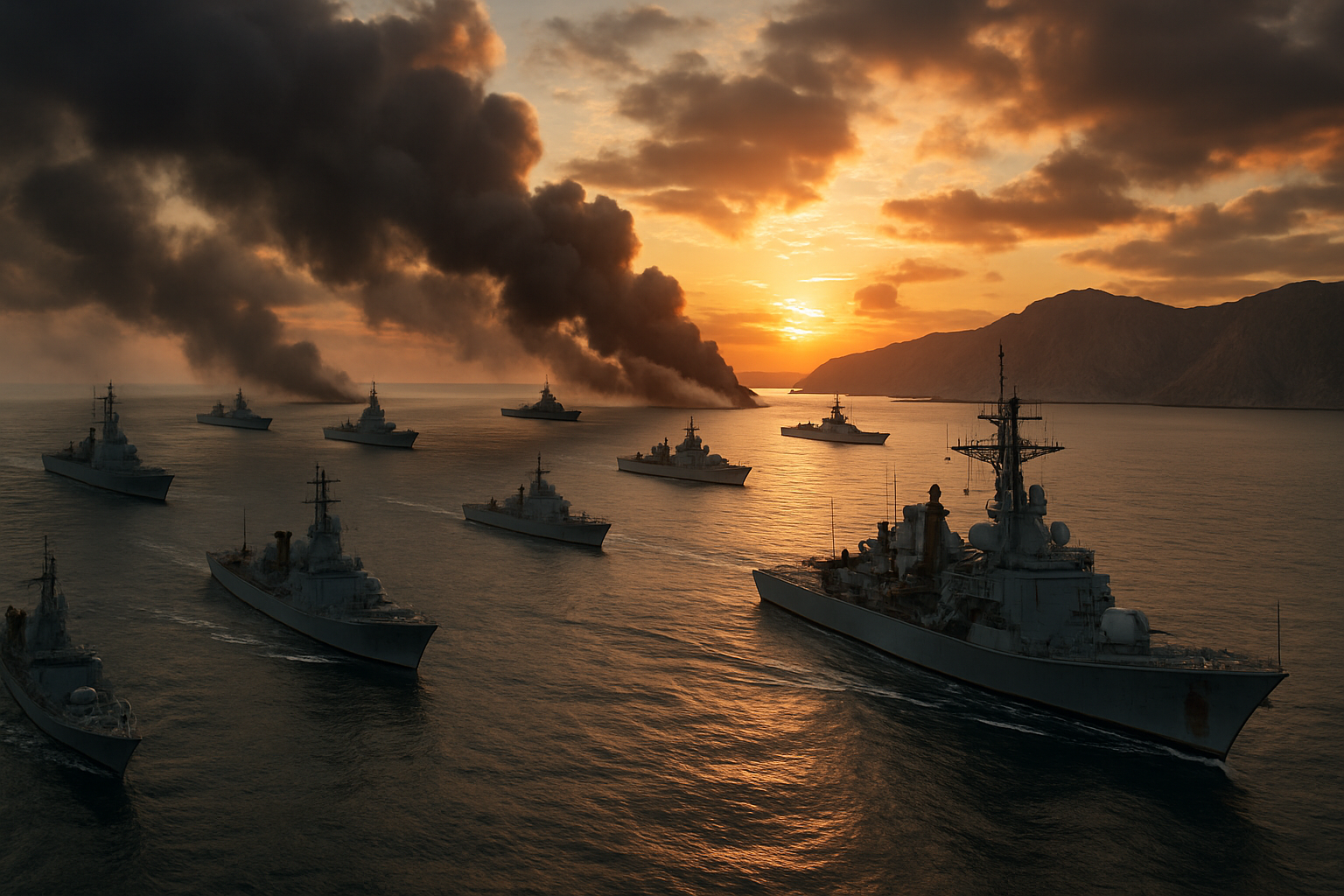
The Iranian campaign has caused casualties across the region: one civilian killed in Abu Dhabi, 32 injured in Kuwait airport strikes, and 8 wounded in Qatar despite Patriot missile intercepts. Most significantly, Iranian drones struck RAF Akrotiri in Cyprus - the first attack on European territory since World War II, prompting an unprecedented naval coalition response involving British, Spanish, Italian, French, Dutch, and Greek vessels.
Iran's Leadership Transition
Following Supreme Leader Ali Khamenei's death on March 1, Iran has undergone its first hereditary succession in the Islamic Republic's 47-year history. Mojtaba Khamenei, the former leader's son, has been appointed as the new Supreme Leader, consolidating Revolutionary Guards control over governance during active warfare.
This represents a fundamental shift from clerical to military leadership, with CIA assessments suggesting the Revolutionary Guards have gained unprecedented influence over Iranian state apparatus during the crisis.
Nuclear Diplomacy Collapse
The current crisis emerged from the complete breakdown of nuclear negotiations despite achieving what had been hailed as a breakthrough. Geneva talks in February had reached "broad agreement on guiding principles" - the most significant progress since the JCPOA collapse in 2018. However, fundamental disagreements proved insurmountable.
Iran maintained that ballistic missiles and regional proxy groups were "red lines" to be excluded from nuclear-only talks, while the US demanded a comprehensive agreement including missiles, armed groups, and human rights issues. Iran continues uranium enrichment at 60% purity with over 400kg of weapons-grade material - sufficient for multiple nuclear weapons if weaponized.
Regional Coalition Under Strain
The unprecedented coalition of Saudi Arabia, UAE, Qatar, and Egypt that had backed the diplomatic process now faces severe strain as Iranian retaliation has directly targeted member territories. Egyptian President Sisi condemned attacks on "sisterly countries," warning of "comprehensive chaos" spreading across the region.
The fracturing of this coalition represents a significant blow to Middle Eastern stability, as these nations now face the difficult choice between maintaining their US alliance and avoiding further Iranian pressure on their territories.
Humanitarian Crisis Mounts
The Iran Red Crescent reports over 787 civilian casualties from US-Israeli strikes, including a devastating attack on the Minab school that killed between 53-85 students and staff. The Pentagon has confirmed US responsibility for an elementary school strike that killed 165-185 students due to "outdated targeting data," prompting Geneva Conventions investigations.
International evacuations have reached the scale of the Arab Spring in 2011, with Australia reporting 115,000 nationals trapped and Germany coordinating the evacuation of 30,000 stranded tourists. The EU has activated its ESTIA evacuation protocol for Cyprus for the first time in the bloc's history.
Congressional Opposition Grows
In Washington, bipartisan congressional opposition to the conflict is mounting. Senator Richard Blumenthal expressed being "more concerned than ever" about potential ground troop deployment, while the Pentagon prepares operations through September - far beyond the initial 4-6 week timeline suggested by the White House.
With only 25% of Americans supporting the military strikes according to polls, the conflict faces "almost unprecedented" unpopularity for an early-stage operation. Financial markets have emerged as the "ultimate constraint" on further escalation, with Pakistan's stock exchange suffering its largest single-day decline in history at -8.97%.
Energy Architecture Under Threat
The crisis has exposed fundamental vulnerabilities in global energy architecture. Natural gas prices have surged 24% in Europe and 78% in the United States, while Qatar has halted LNG production at facilities that account for approximately 20% of global exports. Major shipping companies Maersk and MSC have suspended Persian Gulf operations entirely, leaving over 150 tankers stranded with billions in cargo value.
Airlines have implemented emergency fuel surcharges as jet fuel costs have risen from $85-90 per barrel to $150-200, fundamentally disrupting global transportation networks that had already been strained by the aviation crisis.
Template-Setting Crisis
UN Secretary-General António Guterres has described the situation as the "greatest test of multilateral cooperation in crisis management of the modern era." The rapid transition from diplomatic breakthrough to military confrontation demonstrates the fragility of crisis management in the multipolar era.
The stakes extend far beyond the immediate conflict, affecting regional war prevention, global energy security, nuclear governance credibility, and international law enforcement of post-WWII order principles. Success in containing the crisis could provide a template for future nuclear crisis resolution, while failure may accelerate military solutions for decades, encouraging proliferation globally and undermining diplomatic credibility worldwide.
Looking Ahead
As the Houthis enter the conflict and Pakistan attempts to mediate between Washington and Tehran, the coming days will be critical in determining whether diplomatic solutions remain viable for nuclear and territorial disputes in the 21st century. The crisis represents a watershed moment in international relations, with implications extending decades beyond current events.
The world watches as the most dangerous international crisis since the Cold War unfolds, testing whether innovative diplomatic solutions can bridge fundamental disagreements or whether the conflict will reshape international approaches to crisis resolution for generations to come.