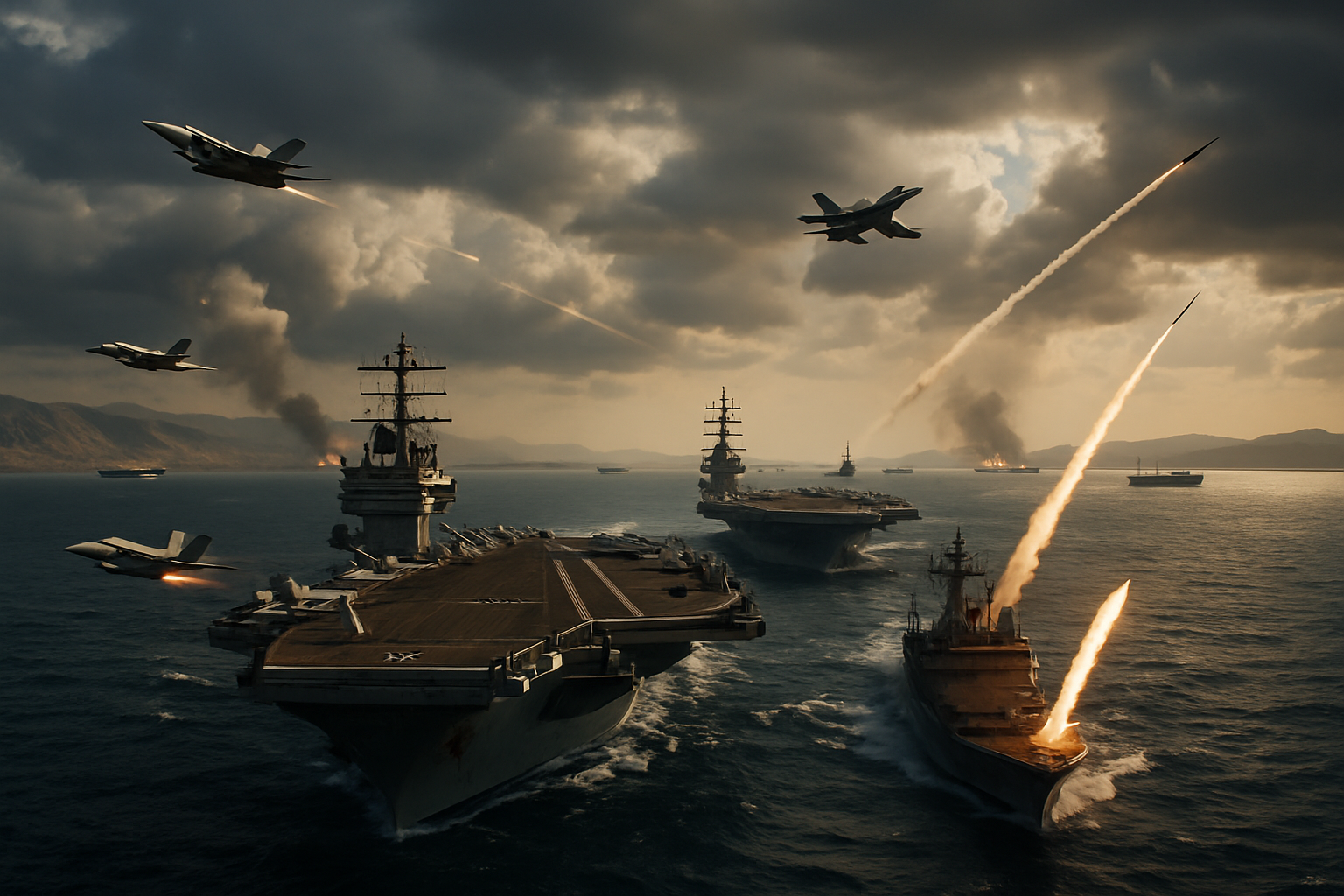
Iran launched a new wave of comprehensive attacks across multiple neighboring countries on March 5, 2026, targeting Azerbaijan, Cyprus, and regional US military installations, prompting an unprecedented international naval response as Western allies rushed warships to protect the Mediterranean island nation.
The escalation represents the most dangerous phase of the ongoing Iran war, now in its sixth day following the US-Israeli "Operation Epic Fury" that killed Supreme Leader Ali Khamenei on March 1. Iran's Revolutionary Guard Corps (IRGC) has declared "no red lines remain" as the conflict spreads beyond traditional Middle Eastern boundaries.
Azerbaijan Under Attack as Iran Expands Regional Operations
Iranian drones struck Azerbaijan's Nakhchivan International Airport early Thursday, injuring two people and prompting Baku to summon Iran's ambassador in protest. Azerbaijan's Prosecutor General's Office launched a criminal investigation after confirming four unmanned aerial vehicles launched from Iranian territory targeted civilian infrastructure in the autonomous republic.
President Ilham Aliyev convened an emergency Security Council meeting, calling the incident a "heinous terrorist act" and demanding explanations, apologies, and criminal prosecution from Iranian officials. Azerbaijan categorically rejected Iran's denial of responsibility, stating the claims were "unacceptable in light of technical evidence."
The strikes marked a significant expansion of Iran's retaliation beyond the Persian Gulf, targeting a nation that has remained neutral in regional conflicts. Ukraine expressed support for Azerbaijan, highlighting growing international concern about Iran's widening military operations.
Naval Coalition Mobilizes for Cyprus Protection
In an extraordinary display of European unity, Italy, Spain, France, Greece, and the Netherlands announced emergency naval deployments to protect Cyprus following Iranian drone attacks on the British RAF Akrotiri base. HMS Dragon and a Spanish frigate are heading to the island within days, while additional vessels from multiple nations are being dispatched.
"Cyprus declared the all-clear after a second alert over a suspicious object near the British Bases proved to be a false alarm, but the international response demonstrates the gravity of this escalation."
— Cyprus Government Spokesperson Konstantinos Letymbiotis
The UK's defense secretary arrived in Cyprus as the government activated all security protocols. The attacks on British territory mark the first Iranian strikes on European soil since World War II, fundamentally altering the scope of the conflict.
Global Aviation Crisis Deepens
The conflict has created an unprecedented global aviation crisis, with over 18,000 flights cancelled worldwide - the most extensive disruption since COVID-19. Eight Middle Eastern countries simultaneously closed their airspace, while Dubai International Airport, the world's busiest, remains shut down from missile damage.
Major airlines including Emirates, Air France-KLM, and Wizz Air have suspended Middle East operations, stranding hundreds of thousands of passengers globally. The disruption extends far beyond regional boundaries as critical Europe-Asia flight routes require complex rerouting through longer, costlier alternatives.
Energy Markets in Turmoil as Strait of Hormuz Closes
Oil prices surged past $80 per barrel (a 10% increase) as Iran declared the Strait of Hormuz "unsafe" for shipping, threatening 40% of global oil transit. Over 150 tankers worth billions of dollars remain anchored in the Persian Gulf, unable to navigate the strategic chokepoint.
Natural gas prices jumped 24% in Europe and 78% in the United States, while major shipping companies Maersk and MSC suspended all Persian Gulf operations. Qatar has halted LNG production due to Iranian strikes on infrastructure, further disrupting global energy supplies.
UK Ministers Consider Energy Intervention
British ministers are discussing emergency interventions to protect households against soaring energy bills, as the government's promises to lower costs face jeopardy. Households face potential £160 increases caused by skyrocketing oil and gas prices since the Iran war began.
US Submarine Warfare Escalates Conflict
The conflict reached new heights when the US submarine USS Charlotte sank the Iranian frigate IRIS Dena off Sri Lanka, killing over 80 crew members in the first enemy vessel sunk by American submarine forces since World War II. Defense Secretary Pete Hegseth described it as a "quiet death" demonstrating America's "global military reach."
The sinking occurred as the Iranian vessel returned from naval exercises in India, marking a dangerous expansion of operations beyond traditional Middle Eastern waters into the Indian Ocean's international shipping lanes.
Nuclear Diplomacy Collapses Completely
The military escalation followed the complete breakdown of nuclear negotiations despite achieving the most significant diplomatic progress since the 2018 JCPOA collapse. Geneva talks had reached "broad agreement on guiding principles," but fundamental disagreements over scope proved insurmountable.
Iran insisted on nuclear-only discussions while excluding ballistic missiles and regional proxies as "red lines," while the US demanded comprehensive agreements addressing missiles, armed groups, and human rights. Iran continues enriching uranium to 60% purity - approaching weapons-grade levels - with over 400kg of enriched material.
Congressional Scrutiny Intensifies
Bipartisan lawmakers in Washington are demanding answers about the Trump administration's Iran war strategy, costs, and potential ground troop deployment. Senator Richard Blumenthal expressed being "more concerned than ever" about possible "boots on the ground" after classified briefings.
The conflict's unpopularity is described as "almost unprecedented" early in operations, with financial markets emerging as potential "ultimate constraints" on further escalation. Questions mount about long-term strategy and exit plans as military success has yet to translate into sustainable political outcomes.
Regional Coalition Under Severe Strain
The unprecedented coalition of Saudi Arabia, UAE, Qatar, and Egypt that supported diplomatic efforts faces severe strain as Iranian retaliation directly targets member territories. Egyptian President Sisi condemned attacks on "sisterly Arab countries," warning of "comprehensive chaos" spreading across the region.
Multiple nations have ordered emergency evacuations: Sweden and Serbia issued immediate evacuation orders for citizens in Iran citing "extremely uncertain" security conditions, while the US authorized departure of non-essential embassy personnel from Israel.
Humanitarian Crisis Deepens
The war has created a mounting humanitarian crisis, with Iran's Red Crescent reporting over 787 killed in US-Israeli airstrikes. The tragic bombing of an elementary school in Minab killed 53-85 students and staff during regular hours, drawing international condemnation as a "barbaric crime."
In the UAE, six people were injured in Abu Dhabi by debris from intercepted drones, while Kuwait reported 32 foreign nationals wounded in airport drone strikes. The civilian toll continues mounting as both sides escalate operations.
International Response Escalates
The United Nations Security Council has held multiple emergency sessions as Secretary-General António Guterres warned of a "serious threat to international peace and security." Russia condemned "reckless actions by Washington and West Jerusalem," while China issued its strongest condemnation in years over "sovereignty violations."
The crisis occurs amid broader nuclear governance breakdown, with the New START treaty having expired February 5 - the first time in over 50 years without US-Russia nuclear constraints. This template-setting moment for 21st-century diplomacy versus military confrontation carries global implications extending far beyond the current crisis.
Trump's Regime Change Appeal
President Trump has issued his most explicit appeal for Iranian government overthrow, telling the Iranian people this represents their "single greatest chance to take back your country." The policy evolution from nuclear-focused negotiations to comprehensive political transformation marks the most aggressive US posture toward Iran since 1979.
Trump warned Iran faces "force that has never been seen before" if retaliation continues, while refusing to rule out ground troops despite predicting a 4-5 week campaign duration.
Historical Significance and Global Stakes
March 1-5, 2026 represents the most dangerous international crisis since the Cold War's end, testing regional war prevention, global energy security, nuclear governance credibility, and international law enforcement simultaneously.
The rapid transition from diplomatic breakthrough to military confrontation demonstrates the fragility of modern crisis management in a multipolar era. Success in containing the escalation could provide a framework for future nuclear crisis resolution, while failure may accelerate military solutions over diplomatic approaches, reshaping international relations for decades.
As multiple naval coalitions deploy across the Eastern Mediterranean and Persian Gulf, the coming days will determine whether this remains a contained regional confrontation or escalates into a broader Middle Eastern war with global implications affecting energy markets, supply chains, and diplomatic precedents for the 21st century.