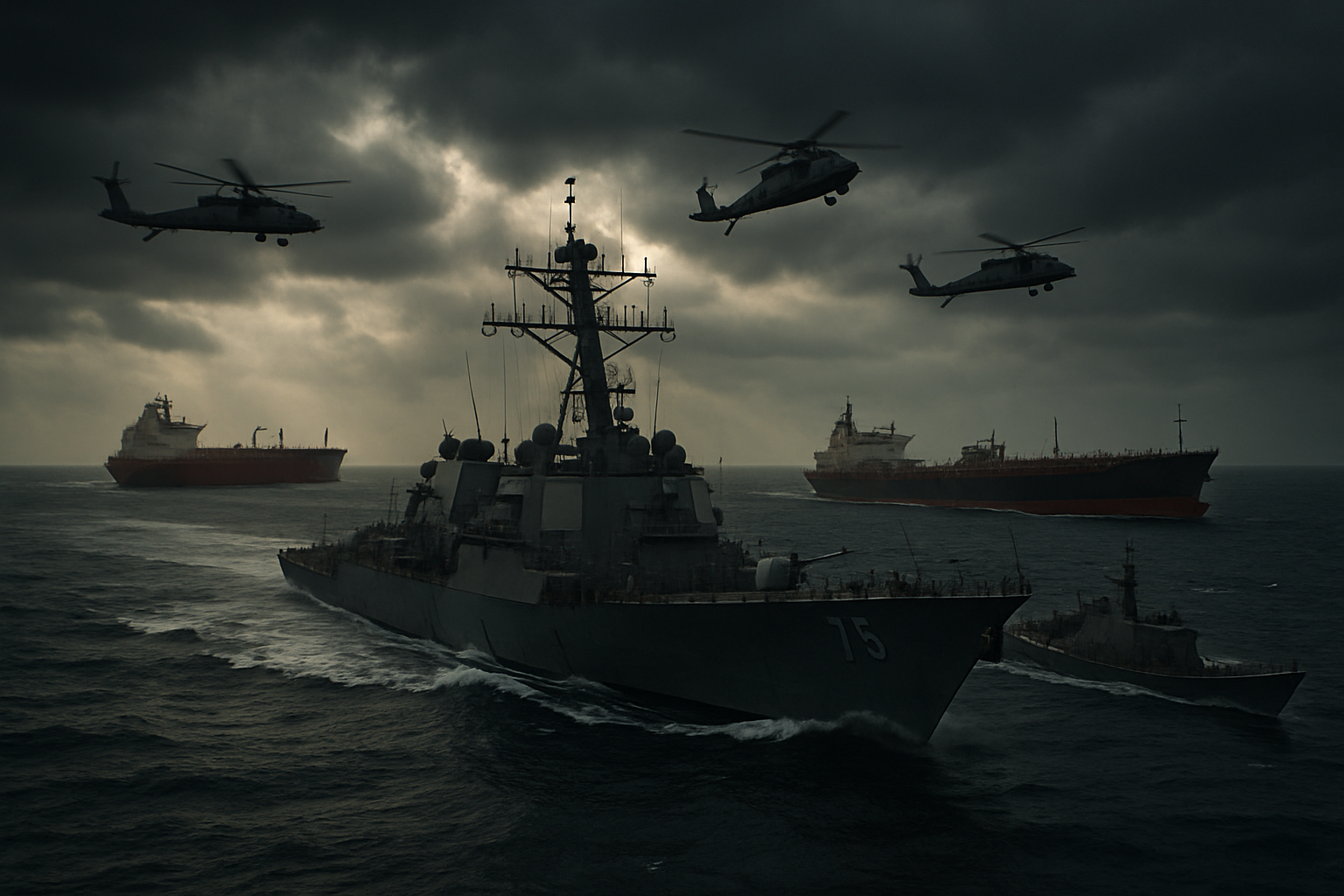
Iran launched its most devastating attacks yet on regional infrastructure and US military positions as the month-long Middle East conflict reached a critical escalation point, with international allies struggling to contain a crisis that now threatens global energy security and nuclear stability.
The Revolutionary Guards confirmed the death of Admiral Alireza Tangsiri, Iranian naval commander, following Israeli strikes that mark another high-profile military casualty in what has become the most dangerous international crisis since the Cold War. The systematic targeting of Iranian leadership, including recent eliminations of Ali Larijani and Esmail Khatib, represents a coordinated "decapitation strategy" that has severely degraded Iran's command structure.
Energy Infrastructure Under Siege
Iran's retaliation has focused increasingly on regional energy facilities, with the Revolutionary Guard declaring oil and gas installations across Gulf states as "legitimate targets" under Operation True Promise 4. The strategic shift from purely military to economic warfare targeting global chokepoints has created unprecedented market volatility.
Oil prices have surged past $100 per barrel for the first time since 2014, reaching Brent crude peaks of $119.50, as Iran continues mining the Strait of Hormuz with an estimated 2,000-6,000 naval mines. The waterway, which handles 40% of global seaborne oil transit, has been effectively closed to commercial shipping, stranding over 150 tankers worth billions in cargo.
"The next few days will be decisive," warned US Defense Secretary Pete Hegseth, noting that Iran's options are diminishing while American capabilities increase.
— Pete Hegseth, US Defense Secretary
The International Energy Agency has responded with its largest strategic petroleum reserve release in its 50-year history, coordinating the release of 400 million barrels from 32 countries—double the amount deployed during the 2022 Ukraine crisis. This unprecedented intervention underscores the severity of the global energy emergency.
Global Aviation Crisis Reaches Breaking Point
The conflict has precipitated the most extensive aviation disruption since the COVID-19 pandemic, with over 18,000 flights cancelled worldwide. Eight Middle Eastern countries have simultaneously closed their airspace, creating an "aviation black hole" that has severed critical Europe-Asia corridors.
Dubai International Airport, the world's busiest with 86 million annual passengers, remains completely shuttered due to missile damage. Major carriers including Emirates, Air France-KLM, and Wizz Air have suspended operations indefinitely, affecting hundreds of thousands of passengers globally and highlighting the vulnerability of international transportation networks to regional conflicts.
European Territory Attacked for First Time Since WWII
Iran crossed a critical threshold with drone strikes on RAF Akrotiri in Cyprus, marking the first attack on European territory since World War II. This unprecedented escalation prompted an extraordinary naval coalition response, with HMS Dragon and Spanish frigates leading a multinational deployment that includes Italian, French, Dutch, and Greek vessels—the largest Mediterranean mobilization in decades.
The European Union activated its ESTIA evacuation protocol for Cyprus for the first time in the bloc's history, fundamentally altering the conflict's scope from a regional Middle Eastern crisis to a direct threat to European security architecture.
Nuclear Diplomacy in Complete Collapse
The military confrontation emerged from the complete breakdown of nuclear negotiations despite what had been described as "broad agreement on guiding principles"—the most significant diplomatic progress since the Joint Comprehensive Plan of Action (JCPOA) collapsed in 2018.
Iran continues uranium enrichment at 60% purity, possessing over 400kg of weapons-grade material sufficient for multiple nuclear weapons. The insurmountable scope disagreement—Iran's exclusion of ballistic missiles and regional proxies as "red lines" versus comprehensive US demands addressing missiles, armed groups, and human rights—prevented any breakthrough.
Hereditary Succession Amid Warfare
Following the confirmed death of Supreme Leader Ali Khamenei on March 1, Iran appointed his son Mojtaba Khamenei as the first hereditary Supreme Leader in the Islamic Republic's 47-year history. This transition, occurring during active warfare, has consolidated Revolutionary Guards control over Iranian governance, representing a fundamental shift from clerical to military leadership.
US intelligence assessments suggest this consolidation indicates a hardline trajectory that makes diplomatic resolution even more challenging, as military commanders prioritize capability preservation over economic relief through sanctions reduction.
Unprecedented Congressional Opposition
Operation Epic Fury, the largest coordinated US-Israeli campaign since the 2003 Iraq invasion, has generated unprecedented domestic opposition. With only 25% American public support—described as "almost unprecedented" for early-stage military operations—bipartisan lawmakers are demanding comprehensive strategy briefings, cost projections, and exit timelines.
Senator Richard Blumenthal expressed being "more concerned than ever" about potential ground troop deployments, as Pentagon operations are now planned through September 2026, far beyond the initial 4-6 week timeline. The conflict's $11.3 billion cost in the first week alone has raised serious questions about long-term sustainability.
Regional Coalition Under Severe Strain
The unprecedented Saudi Arabia, UAE, Qatar, and Egypt coalition that had supported diplomatic solutions is now severely strained as Iranian retaliation directly targets member territories. Egyptian President Abdel Fattah el-Sisi condemned attacks on "sisterly Arab countries," warning of "comprehensive chaos" spreading across the region.
Recent casualties include one civilian killed in Abu Dhabi, 32 injured in Kuwait airport strikes, and eight wounded in Qatar despite Patriot missile systems intercepting 65 missiles and 12 drones. This coalition fracturing represents a significant blow to decades-long Middle Eastern security arrangements.
Humanitarian Crisis Mounting
The Iranian Red Crescent reports over 787 civilian casualties from US-Israeli strikes, while the Pentagon has confirmed responsibility for elementary school attacks that killed between 165-185 students due to "outdated targeting data." These incidents have prompted Geneva Conventions investigations and intensified international calls for de-escalation.
International evacuations are occurring on the largest scale since the Arab Spring of 2011, with Australia reporting 115,000 nationals trapped in the region and Germany evacuating 30,000 citizens. Multiple countries have ordered immediate evacuations from Iran, citing "extremely uncertain" security conditions.
Global Economic Implications
The crisis has exposed fundamental vulnerabilities in global supply chains, with manufacturing in automotive, electronics, and textiles sectors severely disrupted due to their dependence on Gulf logistics networks. Major shipping companies Maersk and MSC have suspended Persian Gulf operations entirely.
Natural gas prices have surged 24% in Europe and 78% in the United States, while airlines are implementing emergency fuel surcharges as jet fuel costs have increased from $85-90 to $150-200 per barrel—representing up to 122% increases that threaten the viability of international aviation.
Nuclear Governance Crisis Context
The Middle East crisis occurs against the backdrop of broader nuclear governance breakdown, with the New START treaty between the US and Russia having expired on February 5, 2026—marking the first time in over 50 years without bilateral nuclear constraints between the superpowers who control 80% of global nuclear weapons.
UN Secretary-General António Guterres has warned that nuclear risks are at their "highest in decades," describing the current situation as the "greatest test of multilateral cooperation in crisis management in the modern era."
Template-Setting Historical Significance
The rapid transition from diplomatic breakthrough to military escalation demonstrates the fragility of crisis management mechanisms in the multipolar era. The conflict has become template-setting for 21st-century approaches to territorial and nuclear disputes, with implications extending far beyond the Middle East.
Success in containing the escalation could provide a framework for nuclear crisis resolution and strengthen diplomatic precedents globally. However, failure may accelerate military solutions in international relations for decades to come, encouraging nuclear proliferation elsewhere while undermining diplomatic credibility worldwide.
As the conflict enters its second month, the stakes encompass regional war prevention, global energy security, nuclear governance credibility, and international law enforcement—all being tested simultaneously in what represents the most consequential international crisis since the end of the Cold War.
Looking Ahead
The coming days will be critical in determining whether this crisis remains contained as a regional confrontation or escalates into a broader Middle Eastern war with global implications. The international community faces its greatest test of multilateral cooperation in crisis management, with decisions made in the coming weeks likely to reverberate through international relations for decades.
The energy architecture exposed by this crisis—demonstrating dangerous over-dependence on strategic chokepoints in volatile geopolitical regions—will require fundamental transformation to prevent similar vulnerabilities in the future. The template established by this crisis will influence how the international community approaches conflict resolution, territorial sovereignty enforcement, and nuclear proliferation prevention for years to come.