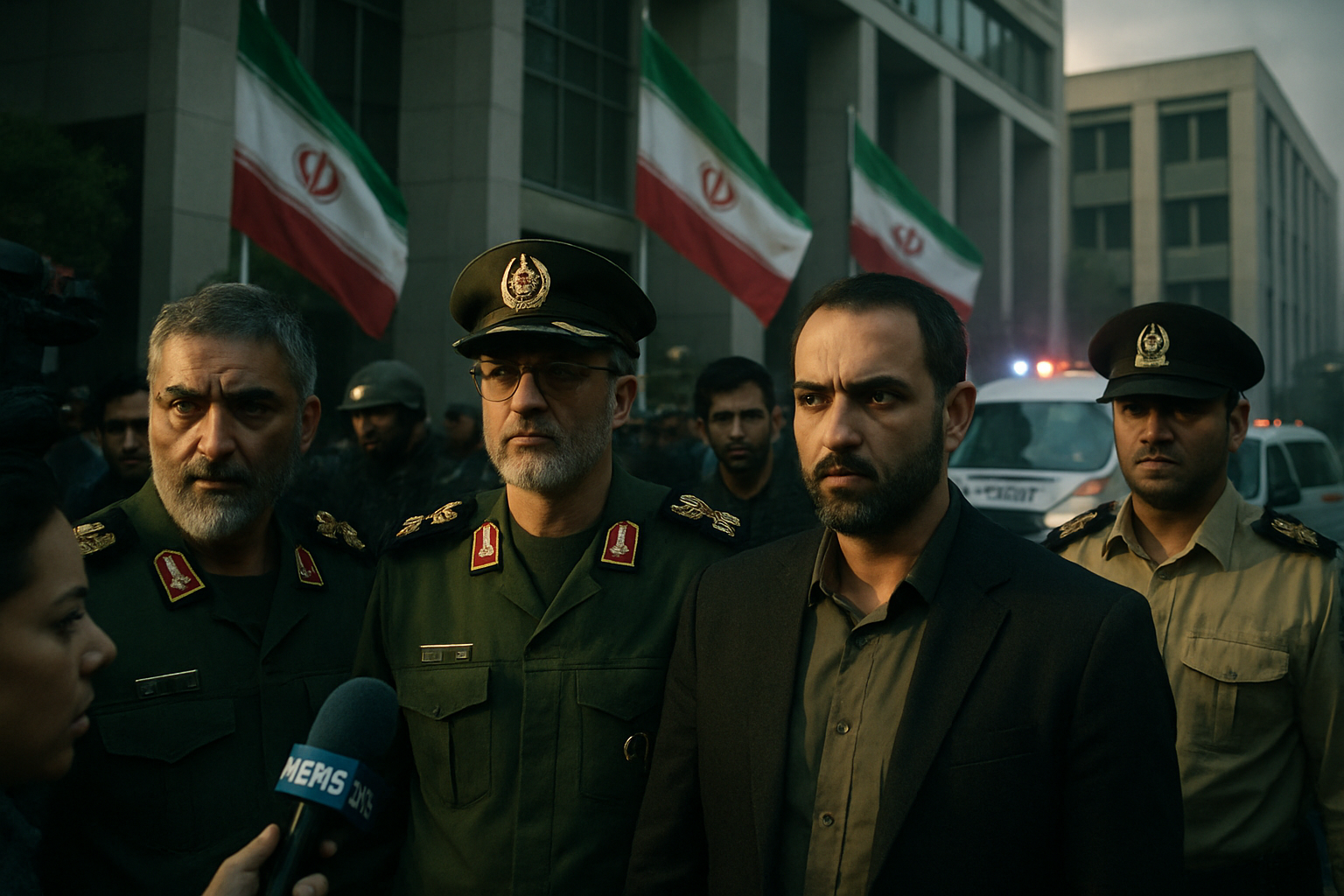
Iran's Supreme National Security Council confirmed the assassination of Intelligence Minister Esmail Khatib and senior security official Ali Larijani in coordinated Israeli airstrikes, marking the most significant Iranian leadership casualties since Supreme Leader Ali Khamenei's death on March 1, as global energy markets face unprecedented disruption.
Israeli Defense Minister Israel Katz announced Wednesday that overnight strikes had eliminated Iranian Intelligence Minister Esmail Khatib, describing him as being "in charge of the regime's internal assassination and repression system" and responsible for "promoting external threats." The announcement represents a dramatic escalation in the three-week conflict that has already claimed over 787 Iranian civilian lives and disrupted global energy markets.
Iran's Islamic Revolutionary Guard Corps responded by issuing stark warnings to residents of Saudi Arabia, the United Arab Emirates, and Qatar to stay away from major oil and gas facilities, declaring them "legitimate targets" in what analysts describe as the most serious threat to Gulf energy infrastructure since the conflict began.
Leadership Decapitation Strategy
The targeted killing of Larijani, described by officials as the "de facto leader" following the succession crisis after Khamenei's death, represents Israel's most aggressive "decapitation strategy" yet. Israeli Foreign Minister Gideon Saar claimed responsibility, stating there was a "$10 million bounty on Ali Larijani - we did it for free."
According to Iranian reports, Larijani was killed at his daughter's house in Tehran's Pardis area alongside his son Morteza and security aide Ali Reza Bayat. The 67-year-old had been serving as Secretary of the Supreme National Security Council and was considered a key architect of Iran's security policy during the current crisis.
Prime Minister Benjamin Netanyahu and Defense Minister Katz have authorized Israeli military commanders to eliminate any senior Iranian official without requiring additional approval for each strike, streamlining what military sources describe as an "accelerated targeted killing campaign."
Global Energy Crisis Deepens
The conflict has triggered the most severe global energy crisis in decades. Iran's massive South Pars gas field - which supplies approximately 70% of the country's natural gas - was struck in what officials describe as the first attacks on Iran's Gulf energy infrastructure during the war.
Oil prices have surged past $100 per barrel, with analysts warning of potential increases toward $200 as Iran continues to mine the Strait of Hormuz with an estimated 2,000-6,000 naval mines. The strategic waterway, through which 40% of global oil transits, has been effectively closed to commercial shipping.
The International Energy Agency has authorized the release of a record 400 million barrels from strategic petroleum reserves - the largest intervention in the agency's 50-year history. Major shipping companies including Maersk and Mediterranean Shipping Company have suspended Persian Gulf operations, leaving more than 150 tankers stranded with cargo worth billions of dollars.
"Iran has been taking aim at its Gulf Arab neighbors' energy facilities since the war started on February 28, and has made the Strait of Hormuz shipping channel nearly impassable."
— Regional Energy Analysis Report
Unprecedented Aviation Disruption
The global aviation industry continues to face its most severe disruption since COVID-19, with over 18,000 flights cancelled worldwide. Eight Middle Eastern countries have simultaneously closed their airspace, creating what industry experts call an "aviation black hole" in one of the world's most critical travel corridors.
Dubai International Airport, normally the world's busiest for international passengers with 86 million annual travelers, remains completely shuttered due to missile damage. Major carriers including Emirates, Air France-KLM, Wizz Air, and Bulgaria Air have suspended Middle Eastern operations indefinitely.
The ripple effects have forced airlines worldwide to implement emergency fuel surcharges as jet fuel costs have jumped from $85-90 per barrel to $150-200 per barrel. Australian carriers Qantas and Air New Zealand have announced immediate fare increases, while European airlines scramble to establish alternative routes avoiding the crisis zone.
Iranian Succession and Military Control
The assassination occurs during Iran's most vulnerable period since the 1979 Islamic Revolution. Following Ali Khamenei's confirmed death on March 1, his son Mojtaba Khamenei has been appointed as Supreme Leader - marking the first hereditary succession in the Islamic Republic's 47-year history.
U.S. intelligence assessments suggest the Revolutionary Guards have gained unprecedented control over Iranian governance, representing a fundamental shift from traditional clerical leadership to military-dominated rule. Defense Secretary Pete Hegseth has claimed the new Supreme Leader is "wounded and likely disfigured" from ongoing Israeli strikes.
The three-member transitional council, consisting of President Masoud Pezeshkian, judiciary chief Gholamhossein Mohseni Ejei, and a Guardian Council representative, continues to manage the country during active warfare - an unprecedented situation in Iranian constitutional history.
Regional Coalition Under Strain
The unprecedented Saudi Arabia-UAE-Qatar-Egypt diplomatic coalition that had initially supported negotiations has come under severe strain as Iranian retaliation directly targets member territories. Egyptian President Abdel Fattah el-Sisi condemned attacks on "sisterly Arab countries," warning of "comprehensive chaos" spreading across the region.
Kuwait has been forced to relocate Jazeera Airways operations to Saudi Arabia due to repeated drone attacks, while the UAE has reported one civilian death from missile debris in Abu Dhabi. Qatar successfully intercepted 65 ballistic missiles and 12 drones using Patriot defense systems, though eight people were injured by fragments.
Saudi Arabia has intercepted over 60 drones targeting Riyadh and Eastern Province facilities, demonstrating the geographic scope of Iran's "Operation True Promise 4" retaliation campaign, which Revolutionary Guard commanders describe as having "no red lines."
Global Economic Implications
Beyond energy markets, the crisis has exposed fundamental vulnerabilities in global supply chains dependent on Gulf logistics networks. Manufacturing sectors including automotive, electronics, and textiles face severe disruptions as the Persian Gulf's role as a critical Asia-Europe trade hub has been compromised.
Financial markets have responded with historic volatility. Pakistan's KSE-100 index crashed 8.97% in its largest single-day decline in history, while major companies including PayPal have postponed significant IPOs due to market uncertainty.
Natural gas prices have surged 24% in Europe and 78% in the United States, with Qatar's halt of LNG production (representing approximately 20% of global exports) raising acute concerns about European energy security during winter months.
European Territory Attacked
In an unprecedented escalation, Iranian drones struck RAF Akrotiri in Cyprus - marking the first attack on European territory since World War II. The strike prompted the largest naval mobilization in the Eastern Mediterranean since 1974, with the HMS Dragon leading a coalition including Spanish, Italian, French, Dutch, and Greek vessels.
The European Union activated its Emergency Support to Individuals and Assets (ESTIA) evacuation plan for Cyprus for the first time in the bloc's history, underscoring how the Middle Eastern conflict has breached traditional geographic boundaries.
Congressional and Allied Pressure
Domestic opposition to the conflict continues mounting in the United States, with Senator Richard Blumenthal expressing being "more concerned than ever" about potential ground troop deployment. The conflict's unpopularity is described as "almost unprecedented" for early-stage military operations, with only 25% of Americans supporting the strikes.
President Trump has demanded Iran's "unconditional surrender" and claimed the right to personally choose Iran's next Supreme Leader, representing the most direct assertion of American control over Iranian affairs since 1979. This has eliminated diplomatic solutions and isolated the administration from traditional allies.
Australia and Japan have notably rejected requests to contribute naval vessels to secure the Strait of Hormuz, while the UK declined to provide aircraft carrier assistance, with Trump dismissing such offers stating "we don't need people to join wars after we've already won."
Humanitarian Crisis
The Iran Red Crescent reports over 787 civilian casualties from U.S.-Israeli strikes, including a devastating attack on a Minab elementary school that killed between 53-85 students and staff. The Pentagon has confirmed responsibility for a separate school strike that killed 165-185 students due to "outdated targeting data."
International human rights organizations are demanding Geneva Conventions investigations into systematic targeting of civilian infrastructure and medical personnel. Lebanon has reported 826 killed and 832,000 displaced as Hezbollah joined the conflict, with 26 paramedics killed and 51 wounded in what appears to be deliberate targeting of medical facilities.
Nuclear Diplomacy Collapse
The current military escalation emerged from the complete breakdown of Geneva negotiations despite achieving what officials described as "broad agreement on guiding principles" - the most significant diplomatic progress since the 2018 JCPOA collapse.
The fundamental disagreement over scope remains unchanged: Iran insisted on nuclear-only discussions while excluding ballistic missiles and proxy forces as "red lines," while the United States demanded comprehensive agreements including missiles, armed groups, and human rights issues.
Iran continues uranium enrichment at 60% purity with over 400 kilograms of weapons-grade material, sufficient for multiple nuclear weapons if weaponized. The crisis occurs amid broader nuclear governance breakdown following New START treaty expiration on February 5 - marking the first time in over 50 years without U.S.-Russia nuclear constraints.
Historical Significance and Global Implications
United Nations Secretary-General António Guterres has described the crisis as the "greatest test of multilateral cooperation and crisis management in the modern era." The rapid transition from diplomatic breakthrough to military confrontation demonstrates what experts call the "fragility of crisis management in the multipolar era."
The conflict represents a template-setting moment for 21st-century international relations, with implications extending decades beyond current events. Success in containment could provide a framework for future nuclear crisis resolution, while failure may accelerate military approaches to international disputes, encouraging proliferation globally and undermining diplomatic credibility worldwide.
At stake are fundamental principles of the post-World War II international order: regional war prevention, global energy security, nuclear governance credibility, and international law enforcement mechanisms. The crisis tests all these principles simultaneously in what analysts describe as the most consequential international challenge since the Cold War's end.
As the conflict enters its third week, the assassination of key Iranian leaders, threats to Gulf energy infrastructure, and unprecedented global disruptions signal a dangerous new phase in what has become the most serious international crisis in decades, with implications that will reshape Middle Eastern geopolitics and international conflict resolution approaches for years to come.