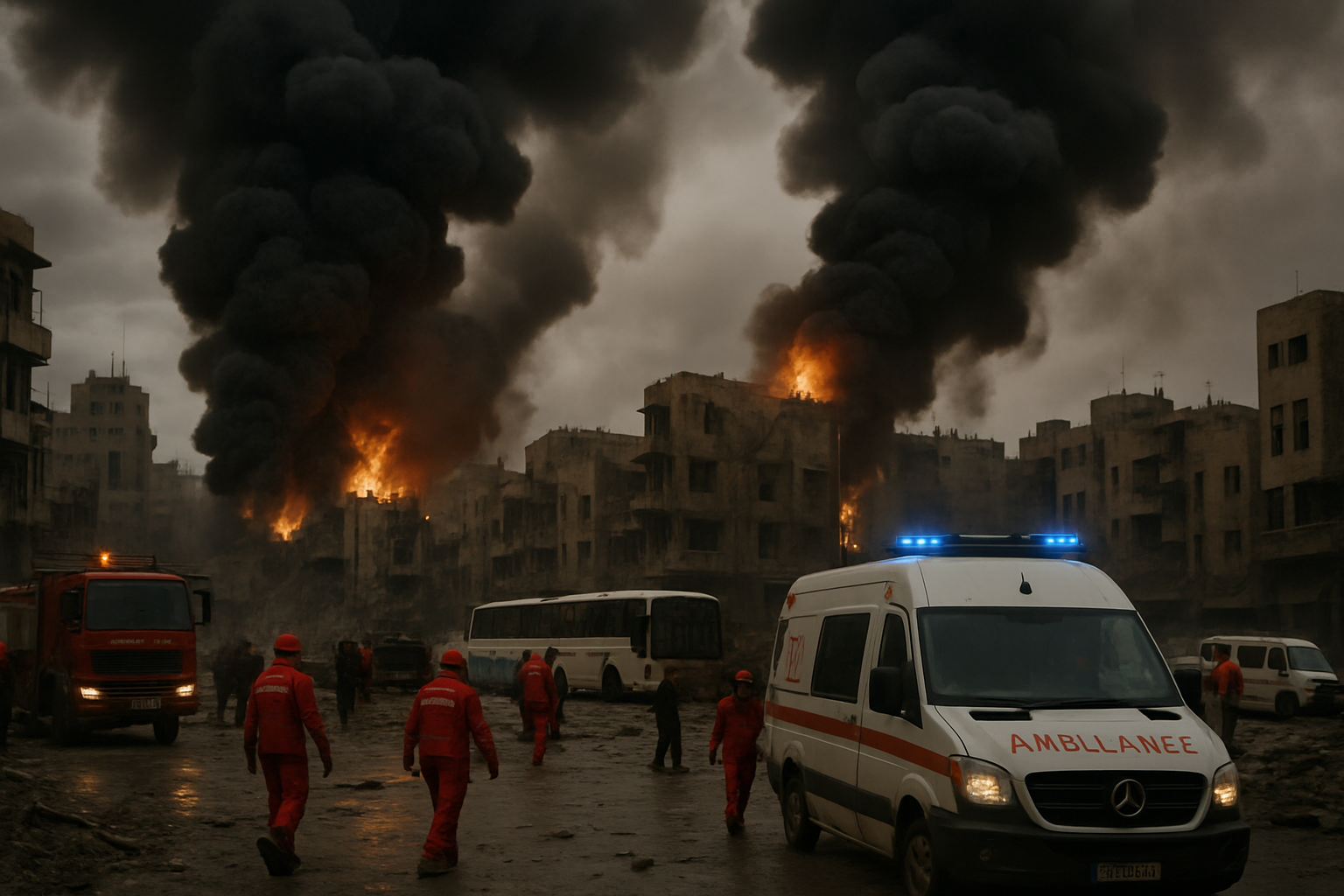
Iran's war with the United States and Israel has entered its most dangerous phase yet, with mounting civilian casualties, a global aviation crisis affecting over 18,000 flights, and energy prices surging as the conflict threatens to engulf the entire Middle East region.
According to multiple intelligence sources and humanitarian organizations, the ongoing "Operation Epic Fury" - the largest coordinated US-Israeli military campaign since the 2003 Iraq invasion - has resulted in over 1,300 Iranian casualties since March 1, 2026. The Iran Red Crescent reports at least 787 civilian deaths from US-Israeli airstrikes, while Iran's systematic retaliation campaign "Operation True Promise 4" has caused casualties across multiple Gulf states.
Devastating School Attack Sparks International Condemnation
The conflict reached a tragic nadir with the US strike on a school in Minab that killed at least 170 people, mostly children, according to Amnesty International. The human rights organization confirmed that a Tomahawk missile was likely used in the attack during regular school hours, drawing international condemnation as a potential war crime.
"This represents a barbaric crime against innocent children who posed no military threat,"
— Iranian President Masoud Pezeshkian
The devastating images of children's backpacks and schoolbooks scattered in the rubble have become symbols of the human cost of the diplomatic failure that preceded this military escalation. International human rights organizations are demanding investigations under the Geneva Conventions.
Iran's Systematic Retaliation Targets Regional Allies
Iran's Islamic Revolutionary Guard Corps (IRGC) has launched what it calls the "55th wave" of Operation True Promise 4, with spokesperson declaring that "no red lines remain" in their targeting of US and Israeli assets. The systematic campaign has caused casualties across multiple countries:
- Israel: Multiple missile salvos have caused heavy damage to homes, with fragments landing near the Knesset and Church of the Holy Sepulchre. A woman was lightly injured in Rishon Lezion after a missile impacted her home.
- UAE: One civilian killed in Abu Dhabi, with Dubai International Airport - the world's busiest - completely shut down due to missile damage.
- Kuwait: 32 foreign nationals injured in drone strikes on the international airport.
- Qatar: Eight people injured from missile fragments despite successful Patriot intercepts of 65 missiles and 12 drones.
Iran's Foreign Minister Abbas Araghchi has declared that his country is prepared to take the war "as far as necessary," demonstrating Iran's resolve despite facing the largest military operation against it since the 1980-1988 Iran-Iraq War.
Global Aviation Crisis Reaches Unprecedented Scale
The conflict has created the most severe global aviation disruption since COVID-19, with over 18,000 flights cancelled worldwide. Eight Middle Eastern countries have simultaneously closed their airspace, including Iran, Iraq, Israel, UAE, Qatar, Syria, Kuwait, and Bahrain.
Major carriers including Emirates, Air France-KLM, Wizz Air, and Bulgaria Air have suspended all Middle Eastern operations indefinitely, affecting hundreds of thousands of passengers globally. Dubai International Airport, which handles over 86 million passengers annually, remains shuttered due to missile damage with no reopening timeline announced.
Energy Markets in Crisis
Oil prices have surged past $80 per barrel - a 10% increase - as Iran has effectively closed the Strait of Hormuz, through which 40% of global seaborne oil transits. Over 150 oil and LNG tankers worth billions of dollars remain stranded in the Persian Gulf after major shipping companies Maersk and MSC suspended operations.
Natural gas prices have jumped 24% in Europe and 78% in the United States, creating a severe energy security crisis. Qatar has halted LNG production following Iranian infrastructure strikes, threatening European gas supplies during the critical winter period.
US Military Casualties and Escalating Costs
The US Central Command has confirmed the first American military casualties of Operation Epic Fury: three service members killed and five wounded - the first confirmed US deaths in the largest Middle East operation since 2003. Pentagon officials describe "major combat operations" as ongoing, with responsive actions continuing.
The financial cost of the operation has reached $3.7 billion in just the first week, at a rate of $891.4 million daily, making it one of the most expensive recent military operations. The unprecedented dual-carrier deployment of USS Gerald R. Ford and USS Abraham Lincoln represents approximately one-third of the US Navy's active fleet.
Iranian Leadership Succession Crisis
Following the confirmed death of Supreme Leader Ali Khamenei on March 1, Iran faces an unprecedented constitutional succession crisis during active warfare. A three-member transitional council consisting of President Masoud Pezeshkian, judiciary head Gholamhossein Mohseni Ejei, and Guardian Council jurist Ayatollah Alireza Arafi is managing the country.
Intelligence sources suggest that Mojtaba Khamenei, the deceased leader's son, has emerged as the favored successor - which would represent the first hereditary succession in the Islamic Republic's 47-year history. CIA assessments indicate that a Revolutionary Guards member is likely to assume ultimate control, marking a shift from clerical to military governance.
Regional Coalition Under Severe Strain
The unprecedented Saudi Arabia, UAE, Qatar, and Egypt consensus that had supported diplomatic efforts is now severely strained as Iranian retaliation has directly targeted member territories. Egyptian President Abdel Fattah al-Sisi condemned the attacks on "sisterly Arab countries," warning of "comprehensive chaos" spreading across the region.
The targeting of Gulf allies represents a significant escalation in Iran's retaliation strategy, moving beyond traditional US-Israeli targets to include countries that had advocated for diplomatic solutions to the nuclear crisis.
Nuclear Diplomacy Completely Collapsed
The current military confrontation emerged from the complete breakdown of Geneva nuclear negotiations, despite achieving what Iran's Foreign Minister called "broad agreement on guiding principles" - the most significant progress since the 2018 JCPOA collapse.
The fundamental scope disagreement proved insurmountable: Iran insisted on nuclear-only talks excluding ballistic missiles and regional proxies as "red lines," while the US demanded comprehensive agreements including missiles, armed groups, and human rights issues. Iran continues uranium enrichment at 60% purity with over 400 kilograms of material - sufficient for multiple weapons if weaponized.
International Response and Evacuations
The United Nations Security Council has held multiple emergency sessions, with Secretary-General António Guterres warning of a "serious threat to international peace and security." Russia has condemned what it calls "reckless actions by Washington and West Jerusalem," while China has issued its strongest condemnation in years, calling the strikes a "serious violation of Iran's sovereignty."
The crisis has prompted the largest coordinated international evacuation since the Arab Spring in 2011, with Australia reporting 115,000 nationals trapped in the region and Germany struggling to evacuate 30,000 stranded tourists. The European Union activated its ESTIA evacuation plan for Cyprus for the first time in the bloc's history.
Cultural Heritage Under Attack
Iranian officials report that over 50 cultural heritage sites have been damaged in US and Israeli strikes, including museums, historic government buildings, traditional bazaars, and mosques across the country. The damage highlights growing concerns about the impact of military operations on historically significant landmarks, raising questions about compliance with international laws protecting cultural heritage during armed conflict.
Congressional Scrutiny Intensifies
Bipartisan US lawmakers are demanding comprehensive briefings on strategy, costs, and the potential for ground troop deployment. Senator Richard Blumenthal has expressed being "more concerned than ever" about the possibility of "boots on the ground," while the conflict's unpopularity remains "almost unprecedented" for early-stage military operations.
Financial markets are emerging as the "ultimate constraint" on conflict escalation, with Pakistan's stock exchange suffering its largest single-day decline in history at -8.97%, and Dow futures dropping 400-570 points.
Trump's Regime Change Goals
President Trump has made his most explicit regime change appeal since 1979, calling the situation the "single greatest chance for the Iranian people to take back their country." This represents a significant policy evolution from nuclear-focused objectives to comprehensive political transformation, with Pentagon officials preparing for "weeks-long operations" that could extend well beyond initial timelines.
Global Economic Implications
The conflict has exposed fundamental vulnerabilities in global supply chains dependent on Middle Eastern trade networks. The Persian Gulf serves as a critical hub beyond energy, affecting shipping routes connecting Asia and Europe. Manufacturing sectors including automotive, electronics, and textiles are experiencing severe disruptions.
Qatar's LNG production halt threatens European energy supplies during winter, while the closure of Dubai International Airport has severed critical Asia-Europe flight corridors. Airlines are implementing emergency fuel surcharges as jet fuel prices have jumped from $85-90 to $150-200 per barrel.
Nuclear Governance Crisis
The current crisis is unfolding amid a broader nuclear governance breakdown, with the New START treaty having expired on February 5 - the first time in over 50 years without US-Russia nuclear constraints. Combined with China's nuclear expansion and what UN Secretary-General Guterres calls nuclear risks at their "highest in decades," the Iran conflict represents a template-setting moment for 21st-century diplomacy versus military confrontation.
Looking Ahead: Critical Crossroads
As the conflict enters its third week, international observers warn that the coming phase will be decisive in determining whether this remains a contained regional confrontation or escalates into a broader Middle Eastern war with global implications. The rapid transition from diplomatic breakthrough to military confrontation demonstrates what experts call the "fragility of modern crisis management in the multipolar era."
Success in containing the crisis could provide a diplomatic template for future nuclear disputes, while failure may accelerate military solutions over diplomatic approaches for decades to come. The stakes include regional war prevention, global energy security, nuclear governance credibility, and the enforcement of international law - all being tested simultaneously in what many consider the most dangerous international crisis since the end of the Cold War.
The decisions made in the coming days and weeks will reverberate through international relations for decades, potentially reshaping approaches to conflict resolution, energy security architecture, and the fundamental principles of the post-World War II international order.