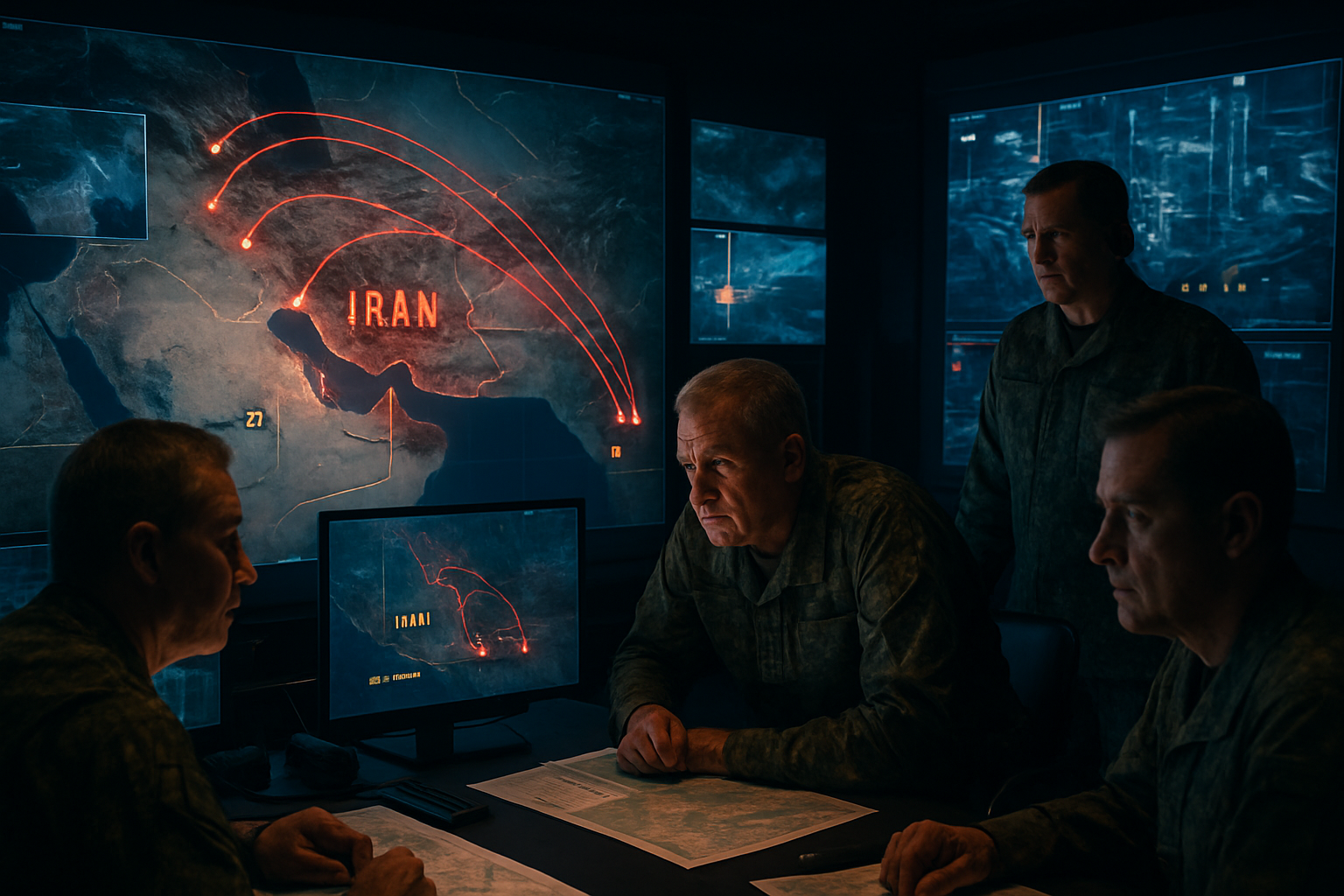
The United States has pledged to launch its "most intense day of strikes" against Iran as the devastating 11-day conflict escalates into the most dangerous international crisis since the Cold War, with global oil markets in chaos and over 18,000 flights cancelled worldwide.
Defense Secretary Pete Hegseth announced Tuesday that the day would see "the largest number of fighter jets, the largest number of bombers, the largest number of attacks" since Operation Epic Fury began on March 1, marking a dramatic escalation in the largest coordinated U.S.-Israeli military campaign since the 2003 Iraq invasion.
Unprecedented Military Escalation
The conflict, now in its eleventh day, has transformed from a targeted military operation into a comprehensive regional war that threatens to engulf the entire Middle East. Hegseth's announcement comes as Iranian Supreme Leader Ali Khamenei's death on March 1 has created a constitutional succession crisis, with the Assembly of Experts working to select a replacement under unprecedented wartime conditions.
"We will not relent in our efforts until we defeat the enemy in a total and decisive manner,"
— Pete Hegseth, U.S. Defense Secretary
The Pentagon has deployed approximately one-third of the active U.S. Navy fleet to the region, with the USS Gerald R. Ford and USS Abraham Lincoln carrier strike groups positioned 800 kilometers from Iran's coast. The operation has already cost $5.6 billion in the first two days alone, making it one of the most expensive military operations in recent history.
Global Economic Crisis Intensifies
The economic ramifications of the conflict have spread far beyond the Middle East. Oil prices have surged past $100 per barrel before falling to $93.50 following Trump's predictions that the war could end "soon." However, Iran's closure of the Strait of Hormuz, through which 40% of global oil transit occurs, has stranded over 150 tankers worth billions of dollars.
The aviation industry faces its worst crisis since COVID-19, with eight Middle Eastern countries maintaining simultaneous airspace closures. Dubai International Airport, the world's busiest, remains shuttered due to missile damage, while major carriers including Emirates, Air France-KLM, and Wizz Air have suspended Middle Eastern operations indefinitely.
Natural gas prices have skyrocketed by 24% in Europe and 78% in the United States, forcing airlines to implement fuel surcharges as jet fuel costs jumped from $85-90 to $150-200 per barrel. Australia's Qantas and Air New Zealand have announced fare increases in response to the volatility.
Iranian Defiance and Regional Retaliation
Despite mounting international pressure and devastating military strikes, Iran's Revolutionary Guard has vowed to continue fighting until they "determine the end of the war." Foreign Minister Abbas Araghchi told PBS News that Tehran is prepared to continue missile attacks "as long as necessary," categorically ruling out negotiations with the Trump administration.
Iran's "Operation True Promise 4" has systematically targeted U.S. military installations across the Middle East, with the IRGC declaring that "no red lines remain." The campaign has resulted in casualties across multiple countries:
- UAE: 1 civilian killed in Abu Dhabi, with Dubai International Airport completely shut down
- Kuwait: 32 foreign nationals injured in airport drone strikes
- Qatar: 8 injured despite Patriots intercepting 65 missiles and 12 drones
- Cyprus: RAF Akrotiri struck in the first attack on European territory since World War II
Historic Naval Response
The Iranian strike on Cyprus has triggered an unprecedented European naval coalition response. HMS Dragon, Spanish frigates, and vessels from Italy, France, the Netherlands, and Greece are deploying to protect European interests. The European Union activated its ESTIA evacuation plan for Cyprus for the first time in the bloc's history.
In a historic naval engagement, the U.S. submarine USS Charlotte sank the Iranian frigate IRIS Dena off Sri Lanka, killing over 80 crew members in the first enemy vessel sunk by a U.S. submarine since World War II. Defense Secretary Hegseth called it a "quiet death" demonstrating America's "global military reach."
Congressional Pressure Mounts
Congressional scrutiny of the operation has intensified, with bipartisan lawmakers demanding answers about strategy, costs, and the potential deployment of ground troops. Senator Richard Blumenthal expressed being "more concerned than ever" about the possibility of "boots on the ground."
The conflict's unpopularity is "almost unprecedented" for early-stage military operations, with only 25% of Americans supporting the strikes according to recent polling. Financial markets have emerged as a potential "ultimate constraint" on further escalation, with Pakistan's stock market suffering its largest single-day decline in history at -8.97%.
Humanitarian Crisis Deepens
The human cost of the conflict continues to mount, with Iran's Red Crescent reporting over 787 civilian casualties from U.S.-Israeli strikes. The devastating attack on the Minab girls' school, which killed 53-85 students and staff, has become a symbol of the conflict's tragic human toll and prompted calls for Geneva Conventions investigations.
The crisis has triggered the largest international evacuation since the Arab Spring in 2011, with Australia reporting 115,000 nationals trapped in the region and Germany struggling to evacuate 30,000 stranded tourists.
Nuclear Diplomacy Collapsed
The military escalation represents the complete breakdown of what appeared to be promising nuclear negotiations. The Geneva talks had achieved a "broad agreement on guiding principles" — the most significant progress since the JCPOA collapse in 2018. However, fundamental scope disagreements proved insurmountable, with Iran insisting on nuclear-only discussions while the U.S. demanded comprehensive agreements addressing missiles, armed groups, and human rights.
Iran continues to enrich uranium at 60% purity with over 400 kilograms of material approaching weapons-grade levels, possessing sufficient material for multiple nuclear weapons if weaponized.
Regional Coalition Under Strain
The unprecedented coalition of Saudi Arabia, UAE, Qatar, and Egypt that had supported diplomatic solutions is severely strained as Iranian retaliation targets their territories. Egyptian President Abdel Fattah el-Sisi condemned attacks on "sisterly countries," warning of "comprehensive chaos" spreading across the region.
Multiple countries have ordered immediate evacuations of their citizens from Iran, citing "extremely uncertain" security conditions. The crisis has forced a fundamental reassessment of regional security arrangements that had provided stability for decades.
Global Implications
The Iran crisis occurs against the backdrop of broader nuclear governance breakdown, with the New START treaty having expired on February 5 — the first time in over 50 years without U.S.-Russia nuclear constraints. Combined with China's nuclear expansion, UN Secretary-General António Guterres has warned that nuclear risks are at their "highest in decades."
The crisis represents what Guterres has called "the greatest test of multilateral cooperation and crisis management in the modern era." The rapid transition from diplomatic breakthrough to military confrontation demonstrates the fragility of crisis management mechanisms in the multipolar era.
Looking Ahead
As the conflict enters its second week, the stakes could not be higher. Success in containing the crisis could provide a template for future diplomatic interventions, while failure might accelerate military approaches to international disputes for decades to come.
The implications extend far beyond Middle Eastern boundaries, affecting global energy security, nuclear governance credibility, and the fundamental principles of the post-World War II international order. Supply chains for automotive, electronics, and textiles industries dependent on Gulf logistics networks have been severely disrupted, exposing the vulnerability of globalized economic systems to geopolitical shocks.
"This is a template-setting moment for 21st-century conflict resolution that will reverberate through international relations for decades,"
— UN Secretary-General António Guterres
With Trump's promises of the "most intense day of strikes" and Iran's vow to fight "as long as it takes," the world watches as two paths diverge: contained regional confrontation or broader Middle Eastern war with global implications extending decades beyond the current crisis. The decisions made in the coming days will determine whether diplomatic or military solutions become the preferred approach to international disputes in the 21st century.