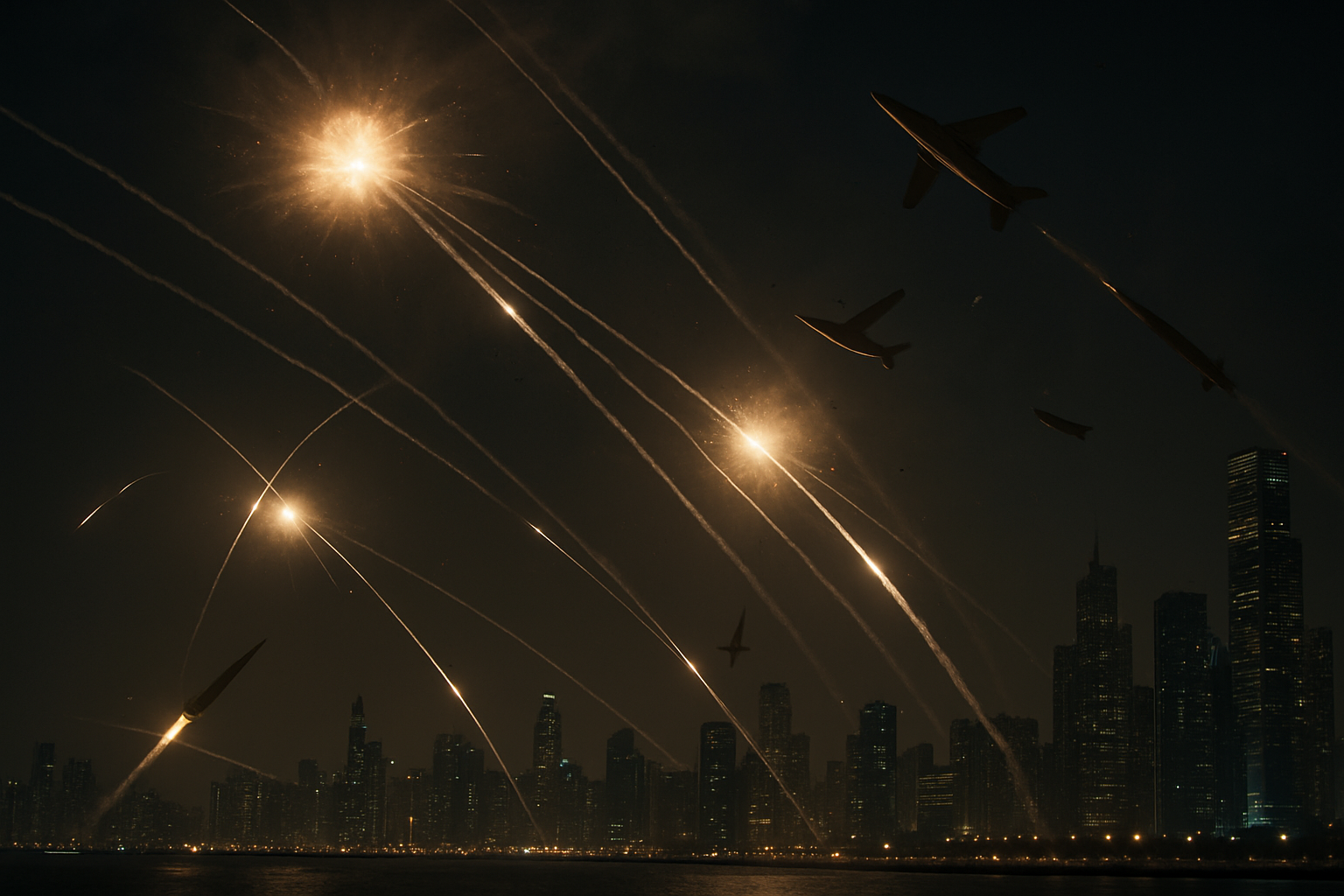
Iran's war against the United States and Israel has escalated dramatically into its second week, with Iranian forces launching systematic attacks against neighboring Gulf states while President Donald Trump demands Iran's "unconditional surrender" and claims the right to personally choose the country's next Supreme Leader.
The conflict, which began March 1 with the confirmed killing of Iran's Supreme Leader Ali Khamenei in Operation Epic Fury, has now expanded far beyond its initial boundaries. Iranian President Masoud Pezeshkian offered a conditional ceasefire to neighboring countries on Saturday, apologizing for civilian casualties while firmly rejecting American demands for complete capitulation.
Trump's Unconditional Surrender Ultimatum
President Trump dramatically escalated his position via Truth Social, declaring "no deal with Iran except UNCONDITIONAL SURRENDER!" This represents a complete reversal from earlier hints at negotiations and marks the most explicit regime change demand since the 1979 Iranian revolution.
In an unprecedented assertion of American control over Iranian internal affairs, Trump claimed he must be "involved in the appointment" of Iran's next Supreme Leader, dismissing Mojtaba Khamenei, the deceased leader's son, as a "lightweight." The president's position eliminates any possibility of a negotiated diplomatic solution to the crisis.
"Iran will never surrender to the United States and Israel. This is a dream they should take to their grave."
— Iranian President Masoud Pezeshkian
Regional Coalition Under Severe Strain
The unprecedented coalition of Saudi Arabia, the United Arab Emirates, Qatar, and Egypt that had supported diplomatic efforts is now severely threatened as Iranian retaliation has directly targeted member territories. Gulf states are caught between their alliance with the United States and mounting pressure from Iranian attacks.
The UAE has confirmed one civilian killed in Abu Dhabi from missile debris, while Dubai International Airport, the world's busiest, remains shut down from missile damage. Kuwait reported 32 foreign nationals injured in airport drone strikes, and Qatar was forced to intercept 65 missiles and 12 drones using Patriot defense systems, with 8 people injured by falling debris.
Egyptian President Abdel Fattah el-Sisi condemned the attacks on "sisterly Arab countries," warning of "comprehensive chaos" spreading across the region. The targeting of coalition member territories represents a fundamental challenge to decades-old security arrangements in the Gulf.
Global Aviation and Energy Crisis
The conflict has triggered an unprecedented global crisis affecting both aviation and energy markets. Over 18,000 flights have been cancelled worldwide—the most extensive disruption since COVID-19—as eight countries have simultaneously closed their airspace to civilian traffic.
Oil prices have surged past $80 per barrel, representing a 10% increase, after Iran declared the Strait of Hormuz "unsafe for shipping." This critical waterway handles 40% of global seaborne oil transit, and its effective closure has stranded more than 150 tankers in the Persian Gulf carrying billions of dollars worth of cargo.
Natural gas prices have exploded by 24% in Europe and 78% in the United States, while Qatar has halted LNG production, affecting approximately 20% of global exports. Major shipping companies Maersk and MSC have suspended operations in the region, exposing fundamental vulnerabilities in global supply chains.
European Territory Attacked for First Time Since WWII
In a dramatic escalation, Iranian drones struck RAF Akrotiri in Cyprus, marking the first attack on European territory since World War II. This unprecedented breach has prompted an international naval coalition response, with HMS Dragon, Spanish frigates, and vessels from Italy, France, the Netherlands, and Greece deploying to protect European interests.
The attack on European soil has fundamentally altered the scope of the conflict, with template-setting implications for European security architecture. The European Union activated its ESTIA evacuation plan for the first time, coordinating the largest international evacuation since the Arab Spring of 2011.
Iran's Constitutional Crisis
Following Supreme Leader Khamenei's confirmed death on March 1, Iran operates under a three-member transitional council consisting of President Pezeshkian, judiciary head Mohseni-Ejei, and a Guardian Council representative. The Assembly of Experts is attempting to select a permanent successor under unprecedented wartime conditions.
CIA assessments suggest that a Revolutionary Guards member is likely to be chosen as the next Supreme Leader, indicating a significant shift from traditional clerical governance toward hardline military influence. This would represent the first time in the Islamic Republic's 47-year history that military rather than clerical authority would directly control the state.
Nuclear Diplomacy Collapse
The military escalation followed the complete breakdown of nuclear negotiations, despite achieving what officials called "broad agreement on guiding principles"—the most significant diplomatic progress since the JCPOA collapse in 2018. The fundamental disagreement proved insurmountable: Iran excluded ballistic missiles and regional proxies as "red lines," demanding nuclear-only talks, while the US insisted on comprehensive agreements including missiles, armed groups, and human rights.
Iran continues enriching uranium at 60% purity with over 400 kilograms of weapons-grade material—sufficient for multiple nuclear weapons if weaponized. The diplomatic collapse occurs within the broader context of nuclear governance crisis, as the New START treaty expired February 5, leaving the world without US-Russia nuclear constraints for the first time in over 50 years.
Congressional Opposition Intensifies
Bipartisan lawmakers in Congress are demanding answers about the administration's strategy, costs, and potential ground troop deployment. Senator Richard Blumenthal expressed being "more concerned than ever" about the prospect of "boots on the ground," while the conflict's unpopularity has been described as "almost unprecedented" in its early stages.
Financial markets are emerging as the "ultimate constraint" on conflict escalation, with Pakistan's KSE-100 index suffering its largest single-day decline in history at -8.97%. The war has already cost $3.7 billion in its first week, making it one of the most expensive military operations in recent history at $891.4 million daily.
Humanitarian Crisis Mounting
The Iranian Red Crescent reports over 787 civilian casualties from US-Israeli strikes, while international human rights organizations are demanding Geneva Conventions investigations, particularly regarding the Minab school attack that killed 53-85 students and staff during regular school hours.
The largest international evacuation since the Arab Spring is underway, with Australia reporting 115,000 nationals trapped in the region and Germany struggling to evacuate 30,000 stranded tourists. Multiple countries have ordered immediate evacuations from Iran, citing "extremely uncertain" security conditions.
Historical Significance and Global Implications
March 2026 represents a watershed moment in Middle Eastern geopolitics and international relations. The rapid transition from diplomatic breakthrough to military confrontation demonstrates the fragility of crisis management mechanisms in the multipolar era. The stakes include regional war prevention, global energy security, nuclear governance credibility, and international law enforcement—all tested simultaneously.
UN Secretary-General António Guterres has called this "the greatest test of multilateral cooperation and crisis management in the modern era." The decisions made in the coming days and weeks will reverberate through international relations for decades, determining whether diplomatic or military solutions become the preferred template for future territorial and nuclear disputes worldwide.
As the conflict enters its second week, the world faces the most dangerous international crisis since the end of the Cold War, with implications extending far beyond the Middle East to affect energy markets, supply chains, aviation networks, and the fundamental principles of post-World War II international order.