The seventh day of the Iran War has brought unprecedented escalation as Israeli forces destroyed Supreme Leader Ali Khamenei's underground bunker in Tehran while a US submarine sank an Iranian naval vessel in the Indian Ocean, marking the deadliest period of Middle Eastern conflict since the Cold War's end.
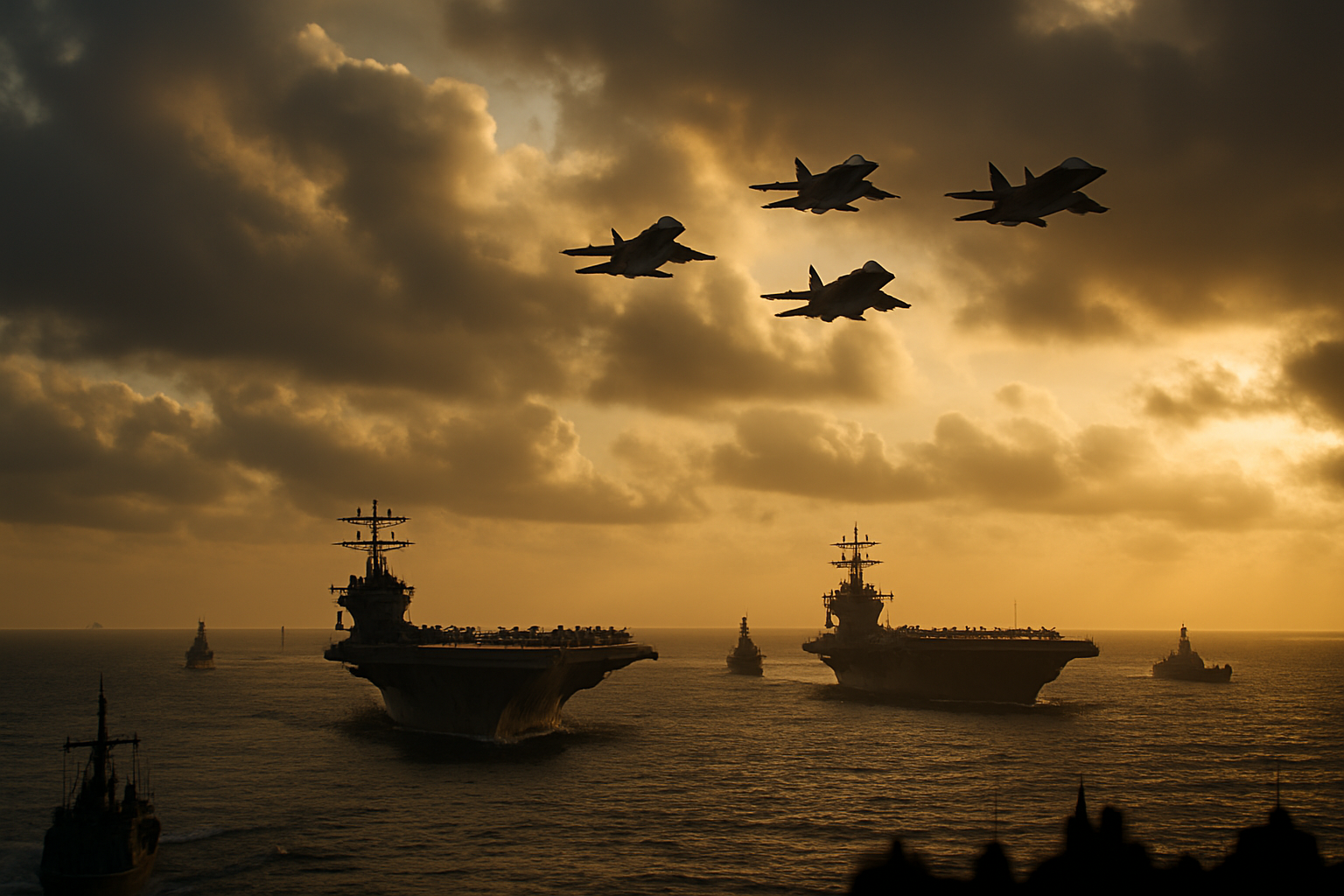
Israeli Defense Forces announced Friday that 50 fighter jets successfully targeted and destroyed an underground military bunker in the heart of Tehran that served as a command center for Iran's deceased Supreme Leader Ali Khamenei. The operation represents the latest phase of "Operation Epic Fury," the largest coordinated US-Israeli military campaign since the 2003 Iraq invasion.
"The Israeli Air Force has successfully eliminated a critical infrastructure facility used by senior regime officials," the IDF stated in a public release, accompanied by video footage showing the precision strike on the fortified compound.
Naval Warfare Expands Beyond Middle East
The conflict expanded dramatically beyond traditional Middle Eastern boundaries when the US submarine USS Charlotte torpedoed and sank the Iranian frigate IRIS Dena approximately 800 kilometers off the coast of Sri Lanka, killing over 80 crew members. Defense Secretary Pete Hegseth called it a "quiet death" that demonstrated America's "global military reach."
The naval strike represents the first enemy vessel sunk by a US submarine since World War II, marking a historic military milestone while extending the conflict into international waters of the Indian Ocean. Only 32 crew members were rescued from the 148-person vessel, which was returning from naval exercises in India.
The USS Charlotte's attack signals Washington's commitment to target Iranian military assets worldwide, not just within the Persian Gulf region where most of the seven-day conflict has been concentrated.
Global Aviation Crisis Reaches Peak
The war has created the most extensive aviation disruption since COVID-19, with over 18,000 flights cancelled worldwide as eight Middle Eastern countries simultaneously closed their airspace. Dubai International Airport, the world's busiest international hub, remains completely shut down due to missile damage from Iranian retaliatory strikes.
Major carriers including Emirates, Air France-KLM, Wizz Air, and Bulgaria Air have suspended operations indefinitely, leaving hundreds of thousands of passengers stranded globally. The simultaneous closure of airspace by Iran, Iraq, Israel, the UAE, Qatar, Syria, Kuwait, and Bahrain represents an unprecedented peacetime aviation crisis.
"The scope of airspace closures is unlike anything we've seen in modern aviation history outside of wartime conditions."
— Aviation Industry Source
Energy Security Crisis Deepens
Oil prices have surged over 10% to more than $80 per barrel as Iran declared the Strait of Hormuz "unsafe" for commercial shipping, threatening 40% of global oil transit. Over 150 tankers worth billions in cargo remain anchored in the Persian Gulf as major shipping companies Maersk and MSC have suspended operations through the critical waterway.
Natural gas prices have spiked 24% in Europe and 78% in the United States, while Qatar has halted LNG production due to Iranian strikes on regional infrastructure. UK households face potential energy bill increases of £160 as the crisis disrupts global energy markets.
The energy disruption extends far beyond oil, affecting manufacturing supply chains dependent on Gulf logistics networks, particularly in automotive, electronics, and textile industries.
Iranian Retaliation Targets European Soil
Iran's "Operation True Promise 4" marked a dramatic escalation when Iranian drones struck RAF Akrotiri in Cyprus – the first attack on European territory since World War II. The unprecedented strike prompted an immediate naval coalition response from European allies.
HMS Dragon and Spanish frigates are deploying to protect Cyprus, joined by vessels from Italy, France, the Netherlands, and Greece in the largest coordinated European naval response to Middle Eastern crisis in decades.
The Iranian Revolutionary Guard Corps has maintained its declaration that "no red lines remain," systematically targeting US military installations and allied territories across the region. Casualties from the week-long conflict now span multiple Gulf states, with civilian deaths reported in the UAE, Kuwait, Qatar, and Cyprus.
Regional Coalition Under Strain
The unprecedented coalition of Saudi Arabia, UAE, Qatar, and Egypt that had supported diplomatic engagement is now severely strained as Iranian retaliation directly targets member territories. Egyptian President Abdel Fattah el-Sisi condemned Iranian attacks on "sisterly Arab countries," warning of "comprehensive chaos" across the region.
Nuclear Diplomacy Collapses Completely
The military escalation followed the complete breakdown of nuclear negotiations despite achieving what Iranian Foreign Minister Abbas Araghchi had called "broad agreement on guiding principles" – the most significant diplomatic progress since the 2018 JCPOA collapse.
The fundamental disagreement proved insurmountable: Iran insisted on nuclear-only talks while excluding ballistic missiles and regional proxies as "red lines," while the US demanded comprehensive agreements covering missiles, armed groups, and human rights issues.
Iran continues uranium enrichment at 60% purity with over 400 kilograms of weapons-grade material, approaching the capability for multiple nuclear weapons if weaponized.
Congressional Scrutiny Intensifies
Bipartisan lawmakers in Washington are demanding answers about strategy, costs, and the potential for ground troop deployment as the conflict enters its second week. Senator Richard Blumenthal stated he is "more concerned than ever" about the possibility of "boots on the ground."
The conflict's unpopularity has been described as "almost unprecedented" in its early stages, with financial markets emerging as the "ultimate constraint" on further escalation. Pakistan's stock market crashed 8.97% in its largest single-day decline in history, while Dow futures dropped 400-570 points.
Succession Crisis in Tehran
Following the confirmed death of Supreme Leader Ali Khamenei on March 1, Iran faces its most significant constitutional crisis since the 1979 revolution. A three-member transitional council consisting of President Masoud Pezeshkian, judiciary head Gholamhossein Mohseni-Ejei, and Guardian Council representative Ayatollah Alireza Arafi is managing the country during wartime conditions.
Mojtaba Khamenei, the deceased leader's son, has emerged as the favored successor in what would be the Islamic Republic's first hereditary succession. CIA assessments suggest a Revolutionary Guards member is likely to be chosen, indicating a potential hardline military shift in governance.
International Evacuations and Response
The crisis has triggered the largest coordinated international evacuation since the Arab Spring of 2011, with Australia reporting 115,000 nationals trapped in the region and Germany struggling to evacuate 30,000 tourists. The European Union activated its ESTIA evacuation protocol for Cyprus for the first time since its establishment.
United Nations Secretary-General António Guterres has declared the situation a "serious threat to international peace and security," while China issued its strongest condemnation in years, calling the military actions "serious violations of Iran's sovereignty."
Russia has condemned what it terms "reckless actions by Washington and West Jerusalem," warning against any pursuit of regime change that could escalate to global conflict.
Historical Significance and Global Implications
The March 1-6, 2026 period represents the most dangerous international crisis since the Cold War's end, with experts describing it as a watershed moment for Middle Eastern geopolitics. The rapid transition from diplomatic breakthrough to military confrontation demonstrates the fragility of crisis management in the multipolar era.
The conflict occurs amid broader nuclear governance breakdown, with the New START treaty having expired on February 5 – marking the first time in over 50 years without US-Russia nuclear constraints. Combined with China's nuclear expansion, UN officials warn that nuclear risks are at their "highest in decades."
"This crisis will set the template for how 21st-century nuclear disputes are resolved – either through diplomatic frameworks or military solutions."
— International Relations Expert
Economic Disruption Worldwide
The Persian Gulf crisis has exposed fundamental vulnerabilities in global supply chains, with disruptions extending far beyond energy markets. Manufacturing centers dependent on Gulf trade networks are experiencing shortages, while the closure of Middle Eastern aviation hubs has complicated Europe-Asia trade routes.
PayPal postponed its $1.1 billion IPO due to market volatility, highlighting how geopolitical crisis reverberates through global financial systems. The conflict demonstrates the interconnectedness of modern economic networks and their susceptibility to regional conflicts.
Looking Ahead
As the Iran War enters its second week, the coming phase will be decisive in determining whether the crisis remains a contained regional confrontation or escalates into a broader Middle Eastern war with global implications extending decades beyond current events.
Success in containment could provide a framework for future nuclear crisis resolution, while failure may accelerate military solutions that reshape international approaches to conflict resolution, potentially encouraging nuclear proliferation globally and undermining diplomatic credibility worldwide.
The stakes include regional war prevention, global energy security, nuclear governance credibility, and international law enforcement mechanisms that have governed the post-World War II order. The world watches as the greatest test of multilateral cooperation and crisis management in the modern era unfolds in real-time.