One month into the most dangerous international crisis since the Cold War, the Iran-US conflict has evolved from targeted strikes to a full-scale regional war that threatens global energy security and challenges the foundations of international diplomacy.
As of March 28, 2026, what began as Operation Epic Fury on February 28 has expanded far beyond its initial objectives, engulfing much of the Middle East in conflict while diplomatic efforts struggle to contain escalation that has already cost thousands of lives and triggered the largest energy crisis in decades.
The Current Crisis State
The conflict reached a critical juncture this week with Iran's launch of over 40 airstrikes against Bahrain in 24 hours, while the kingdom's defenses intercepted 20 incoming missiles. This latest escalation demonstrates how the war has expanded from its initial Iran-Israel-US triangle to encompass the entire Persian Gulf region.
Iranian-backed Houthi rebels have now formally entered the conflict, with spokesperson Yahya Saree announcing missile attacks on "sensitive Israeli military sites" in southern Israel. This development threatens to close yet another critical shipping lane in the Red Sea, potentially strangling global commerce through both the Strait of Hormuz and the Bab el-Mandeb strait.
The human toll continues mounting. Iran's Red Crescent reports over 787 civilian casualties from US-Israeli strikes, while regional retaliation has killed civilians across UAE, Kuwait, Qatar, and Bahrain. The Pentagon confirmed responsibility for elementary school strikes that killed 165-185 students, describing it as the result of "outdated targeting data."
Diplomatic Scramble for Solutions
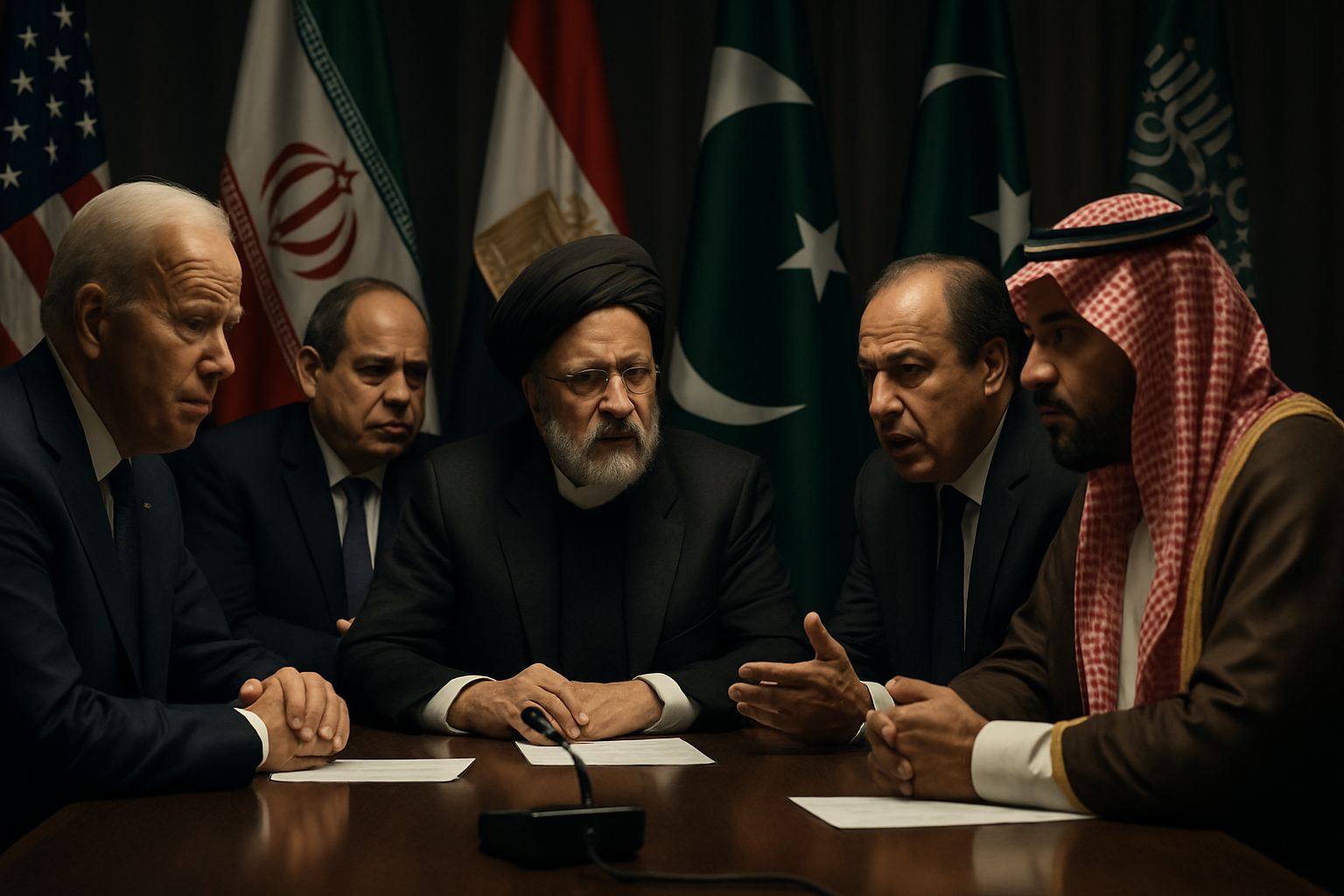
Against this backdrop of escalating violence, a remarkable diplomatic effort is taking shape. The foreign ministers of Egypt, Pakistan, Saudi Arabia, and Turkey are set to convene in Islamabad on Monday for emergency talks aimed at halting the nearly four-week conflict.
This gathering represents the most visible multilateral diplomatic push yet to end the fighting. Pakistan has emerged as the principal intermediary between Washington and Tehran, relaying a 15-point American proposal endorsed by President Trump that demands the full dismantlement of Iran's nuclear program and effective cession of the Strait of Hormuz.
Iranian officials have reviewed the plan but concluded it serves only American and Israeli interests. Iranian Foreign Minister Abbas Araghchi stressed that while Tehran has rejected the current terms, "diplomacy had not been exhausted." Trump, however, urged Iran to "get serious before it is too late."
The United States has also expressed cautious optimism about potential breakthrough talks. American envoy Steve Witkoff stated, "We think there will be meetings this week," while Secretary of State Marco Rubio suggested that American operations could conclude "within weeks, not months."
Economic and Global Impact
The economic consequences of the month-long conflict have reached unprecedented levels. Global stock markets have lost trillions of dollars in market capitalization as investors flee risk assets amid what economists are calling a "historic energy shock."
Oil prices have surged past $114 per barrel, with Iran's effective closure of the Strait of Hormuz—which carries 40% of global oil transit—creating the worst energy crisis since the 1970s. Over 150 tankers carrying billions of dollars worth of cargo remain stranded in the Persian Gulf, while major shipping companies Maersk and MSC have suspended all operations in the region.
The aviation industry faces its worst crisis since COVID-19, with over 18,000 flights cancelled worldwide. Eight Middle Eastern countries have simultaneously closed their airspace, creating what industry experts call an "aviation black hole" that has severed critical Asia-Europe flight corridors. Dubai International Airport, the world's busiest, remains completely shut down due to missile damage.
Military Escalation Without End
Operation Epic Fury has become the largest US-Israeli coordinated military campaign since the 2003 Iraq invasion, utilizing dual-carrier deployments representing approximately one-third of the active US Navy fleet. The operation has cost American taxpayers $11.3 billion in its first week alone, with Pentagon sources revealing that operations are planned through September 2026—far beyond the initial 4-6 week timeline.
The conflict has produced several historic firsts: the USS Charlotte submarine sank Iranian frigate IRIS Dena off Sri Lanka, marking the first enemy vessel sunk by a US submarine since World War II. Iranian drones struck RAF Akrotiri in Cyprus, representing the first attack on European territory since WWII and prompting an unprecedented naval coalition response involving British, Spanish, Italian, French, Dutch, and Greek vessels.
The death of Iranian Supreme Leader Ali Khamenei on March 1 fundamentally altered the conflict's trajectory. His son Mojtaba Khamenei has been appointed as the new Supreme Leader, marking the first hereditary succession in the Islamic Republic's 47-year history and consolidating Revolutionary Guards control over the government.
Regional Powers Under Pressure
The war has severely strained the unprecedented regional coalition of Saudi Arabia, UAE, Qatar, and Egypt that had initially supported diplomatic solutions. Egyptian President Abdel Fattah el-Sisi condemned Iranian attacks on "sisterly Arab countries," warning of "comprehensive chaos" spreading across the region.
The Gulf states find themselves caught between their alliance with the United States and increasing Iranian pressure. Kuwait has been forced to relocate airline operations to Saudi Arabia due to repeated drone attacks, while Qatar has intercepted 65 missiles and 12 drones using Patriot defense systems, resulting in eight civilian injuries from debris.
International evacuations are now occurring on a scale not seen since the Arab Spring of 2011, with Australia reporting 115,000 nationals trapped in the region and Germany struggling to evacuate 30,000 stranded tourists.
Nuclear Diplomacy's Complete Collapse
The current military confrontation emerged from the complete breakdown of nuclear negotiations in Geneva, despite achieving what diplomats called "broad agreement on guiding principles"—the most progress since the JCPOA collapse in 2018.
The fundamental obstacle remained unchanged: Iran excluded ballistic missiles and regional proxies as "red lines," demanding nuclear-only talks, while the US insisted on comprehensive agreements including missiles, armed groups, and human rights issues. Iran continues uranium enrichment at 60% purity with over 400 kilograms of material approaching weapons-grade levels.
The crisis unfolds against the broader context of nuclear governance breakdown, with the New START treaty having expired on February 5—marking the first time in over 50 years that the US and Russia operate without nuclear constraints. China's nuclear expansion adds further complexity to what UN Secretary-General António Guterres calls "the highest nuclear risks in decades."
Congressional Opposition Mounting
In Washington, bipartisan congressional opposition to the war is mounting, with lawmakers demanding answers about strategy, costs, and the potential for ground troop deployment. Senator Richard Blumenthal expressed being "more concerned than ever" about the possibility of "boots on the ground," while polls show conflict support at only 25%—historically low for early-stage military operations.
President Trump's demands for Iran's "unconditional surrender" and his claim to personally choose Iran's next Supreme Leader represent the most direct assertion of American control over Iranian affairs since 1979, effectively eliminating diplomatic solutions and transforming nuclear-focused operations into comprehensive regime change.
Template-Setting Moment for 21st Century
UN Secretary-General Guterres has described the current crisis as "the greatest test of multilateral cooperation in crisis management of the modern era." The rapid transition from diplomatic breakthrough to military escalation demonstrates what experts call the fragility of crisis management mechanisms in the multipolar era.
The stakes extend far beyond the Middle East, encompassing regional war prevention, global energy security, nuclear governance credibility, and international law enforcement of post-WWII order principles. Success in containing the crisis could provide a framework for future nuclear dispute resolution, while failure may accelerate military solutions over diplomatic ones for decades to come.
Looking Ahead
As the Iran war enters its second month, the international community faces a critical choice between escalation and containment. The upcoming diplomatic meetings in Islamabad represent perhaps the last best hope for a negotiated settlement before the conflict expands into an even broader regional war with global consequences.
The coming days will determine whether the world witnesses the successful containment of the most dangerous international crisis since the Cold War, or its transformation into a conflict that reshapes Middle Eastern geopolitics and global energy architecture for decades to come.
With energy markets in crisis, aviation networks paralyzed, and nuclear proliferation risks at their highest levels in decades, March 2026 may well be remembered as a watershed moment that determined whether 21st-century international disputes are resolved through diplomacy or military force.