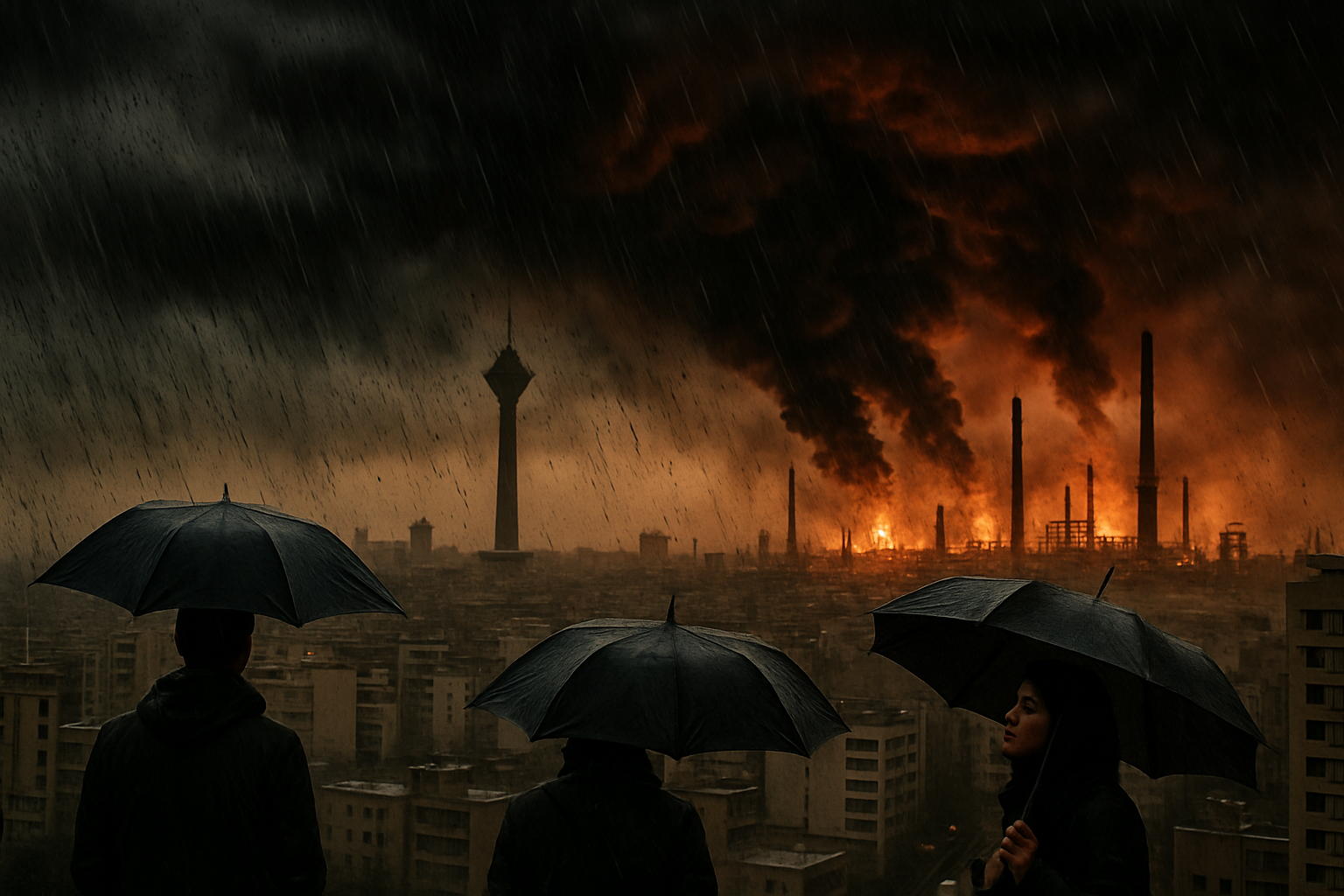
A toxic phenomenon reminiscent of environmental disasters past descended on Tehran on March 8, 2026, as "black rain" - contaminated precipitation mixed with petroleum byproducts from burning oil facilities - fell across Iran's capital, affecting nearly 10 million residents and creating what environmental experts warn could be a decades-long contamination crisis.
The ominous downpour followed Israeli drone strikes on five strategic oil installations around Tehran, part of the larger "Operation Epic Fury" that has escalated into the most dangerous international crisis since the Cold War. What began as military targeting of energy infrastructure has evolved into an environmental catastrophe with implications that extend far beyond the immediate conflict zone.
The Environmental Disaster Unfolds
Nejat Rahmanian, an environmental scientist monitoring the crisis remotely, described the March 8 scene as "apocalyptic." The strikes hit enormous petroleum storage facilities and refineries on Tehran's outskirts, creating massive fires that sent columns of black smoke into the atmosphere. When these toxic clouds mixed with natural weather patterns, the result was precipitation laden with hydrocarbons, heavy metals, and combustion byproducts.
"This is not just rain contaminated with oil," explained Dr. Maryam Hosseini, a environmental toxicologist formerly with Tehran University. "The high-temperature combustion of petroleum products creates complex chemical compounds - polycyclic aromatic hydrocarbons, benzene derivatives, and particulate matter that can penetrate deep into lung tissue and contaminate soil and water supplies for decades."
The Iranian National Oil Distribution Company confirmed that fuel distribution in Tehran was "temporarily interrupted" due to the facility damage, while Governor Mohammad Sadegh Motamedian acknowledged the unprecedented nature of the environmental emergency facing the metropolitan area.
Historical Parallels and Environmental Precedent
The "black rain" phenomenon evokes historical parallels to some of the world's worst environmental disasters. During the 1991 Gulf War, Iraqi forces set fire to over 700 Kuwaiti oil wells, creating massive environmental contamination that persisted for years. The 1945 atomic bombings of Hiroshima and Nagasaki also produced "black rain" containing radioactive particles that caused long-term health effects in exposed populations.
Environmental scientists studying satellite imagery of the Tehran crisis note that the scale of petroleum fires and the urban density of the affected area create a unique environmental challenge. Unlike desert fires in Kuwait or industrial accidents in remote areas, this contamination is occurring in one of the Middle East's largest metropolitan areas.
"The combination of urban population density and the scale of petroleum combustion creates a perfect storm for long-term environmental contamination," said Dr. Samuel Richardson, an environmental health specialist at Imperial College London. "We're looking at potential soil contamination, groundwater pollution, and atmospheric particulate matter that could affect public health for a generation."
Immediate Health Impacts and Medical Response
Tehran's healthcare system is already reporting respiratory cases linked to the toxic precipitation and smoke exposure. Preliminary medical data indicates increased emergency room visits for breathing difficulties, skin irritation, and eye problems - symptoms consistent with exposure to petroleum combustion products.
The Iranian Red Crescent, which has reported 787+ civilian casualties from US-Israeli strikes across the country, faces the additional challenge of treating environmental exposure cases while managing war-related injuries. Medical facilities in Tehran are implementing emergency protocols for treating hydrocarbon exposure, but the long-term health monitoring infrastructure remains uncertain given the ongoing conflict.
Children and elderly residents face particular risks from the contamination. Petroleum byproducts can cause immediate respiratory distress and have been linked to increased cancer rates, developmental problems, and cardiovascular disease in long-term exposure studies.
Environmental Contamination Scope
The environmental impact extends far beyond the immediate precipitation event. Soil samples collected by remaining environmental monitoring stations show petroleum contamination levels that exceed international safety standards by orders of magnitude. The contamination is particularly concentrated in residential areas downwind from the struck facilities.
Groundwater contamination poses perhaps the most serious long-term threat. Petroleum products can seep into aquifers that supply drinking water to millions of Tehran residents. Once groundwater becomes contaminated with hydrocarbons, remediation can take decades and cost billions of dollars.
"We're potentially looking at contamination that will require environmental remediation efforts lasting 20-30 years," warned Dr. Elena Vasquez, who studied long-term contamination from petroleum spills. "The cost of cleanup often exceeds the initial economic damage from the conflict itself."

Regional Environmental Impact
The environmental crisis is not confined to Tehran. Air currents have carried contaminated particles across the broader region, with reports of air quality warnings issued in neighboring provinces. The massive petroleum fires have created a regional haze that satellite imagery shows extending across parts of Iraq, Afghanistan, and Central Asia.
Agricultural areas surrounding Tehran face particularly severe challenges. Contaminated rainfall on farmland can render crops unsuitable for consumption and contaminate soil for multiple growing seasons. The timing of the contamination, occurring during the spring growing season, maximizes potential agricultural damage.
Water resources across the region face contamination risks as petroleum byproducts enter river systems and reservoirs. The Karaj River, a major water source for Tehran, shows elevated hydrocarbon levels that require extensive treatment to meet drinking water standards.
Global Environmental Justice Concerns
International environmental groups have raised concerns about the use of oil infrastructure targeting as a military strategy, citing potential violations of international environmental law. The 1977 Environmental Modification Convention prohibits military tactics that cause "widespread, long-lasting or severe" environmental damage.
"The targeting of petroleum infrastructure in densely populated areas creates environmental consequences that extend far beyond legitimate military objectives. Civilians will bear the health and environmental costs for decades while military planners move on to other targets."
— Dr. Jennifer Matthews, International Environmental Law Institute
The crisis highlights growing concerns about environmental warfare and the civilian impact of targeting critical infrastructure. While military strategists focus on disrupting enemy capabilities, environmental scientists warn that the long-term civilian costs of such tactics often outweigh short-term military gains.
International Response and Monitoring
International environmental monitoring organizations are struggling to assess the full scope of contamination due to the ongoing conflict. Satellite imagery provides some data, but ground-truth environmental sampling requires access that current security conditions make impossible.
The European Space Agency has redirected environmental monitoring satellites to track the pollution plume, while the United Nations Environment Programme has called for immediate international assistance for environmental assessment and potential cleanup efforts.
However, the broader context of escalating conflict between Iran and a US-Israeli coalition has complicated international environmental response efforts. Standard protocols for environmental disaster response assume peacetime conditions where international teams can safely conduct assessment and remediation work.
Economic and Social Implications
The environmental contamination creates economic costs that will persist long after military operations conclude. Property values in affected areas face long-term depreciation, while businesses dealing with food production, water treatment, and tourism confront fundamental operational challenges.
Social justice concerns arise as environmental contamination typically affects lower-income populations disproportionately. Wealthier residents have greater ability to relocate temporarily, access medical treatment, and obtain alternative food and water sources, while working-class neighborhoods bear the primary burden of environmental exposure.
The psychological impact of environmental contamination adds another layer to the war's civilian toll. Residents face not only immediate physical threats from military operations but also uncertainty about long-term health risks and environmental recovery prospects.
Looking Forward: Recovery Challenges
Environmental recovery from the "black rain" crisis will require massive international cooperation and sustained financial commitment. Experts estimate that comprehensive environmental remediation could cost tens of billions of dollars and require decades to complete.
The immediate priority involves protecting public health through alternative water supplies, soil remediation in residential areas, and long-term health monitoring for affected populations. However, the ongoing conflict makes systematic environmental response nearly impossible.
International precedent suggests that environmental cleanup efforts often lag behind political settlements. The Kuwait oil well fires were extinguished relatively quickly, but environmental monitoring and health studies continued for decades. In Iran's case, the urban setting and scale of contamination present even greater challenges.
Template for Future Conflicts
The Tehran "black rain" crisis sets a troubling precedent for environmental warfare in the 21st century. As military planners increasingly target critical infrastructure, the environmental consequences for civilian populations become more severe and long-lasting.
Environmental scientists warn that climate change makes such contamination events more dangerous, as extreme weather patterns can spread pollution more widely and unpredictably. The intersection of warfare, environmental vulnerability, and urban population density creates new categories of humanitarian crisis.
"This represents a new type of environmental warfare where the consequences for civilians extend decades beyond the immediate military conflict. We need international protocols that account for long-term environmental impact, not just immediate military objectives."
— Dr. Ahmed Hassan, Environmental Security Institute
The crisis also highlights the vulnerability of modern urban centers to environmental warfare. Cities concentrate both economic infrastructure and civilian populations in ways that make environmental attacks particularly devastating.
As the broader Iran conflict continues to escalate - with oil prices breaching $100 per barrel and aviation systems disrupted globally - the "black rain" phenomenon serves as a stark reminder that modern warfare's environmental consequences may prove more lasting than its military outcomes. For the millions of Tehran residents facing decades of potential environmental contamination, the war's true costs are only beginning to emerge.
The international community faces urgent questions about how to address environmental warfare, protect civilian populations from long-term contamination, and establish accountability for environmental destruction that outlasts the conflicts that cause it. The answers to these questions will shape both international law and civilian protection protocols for generations to come.