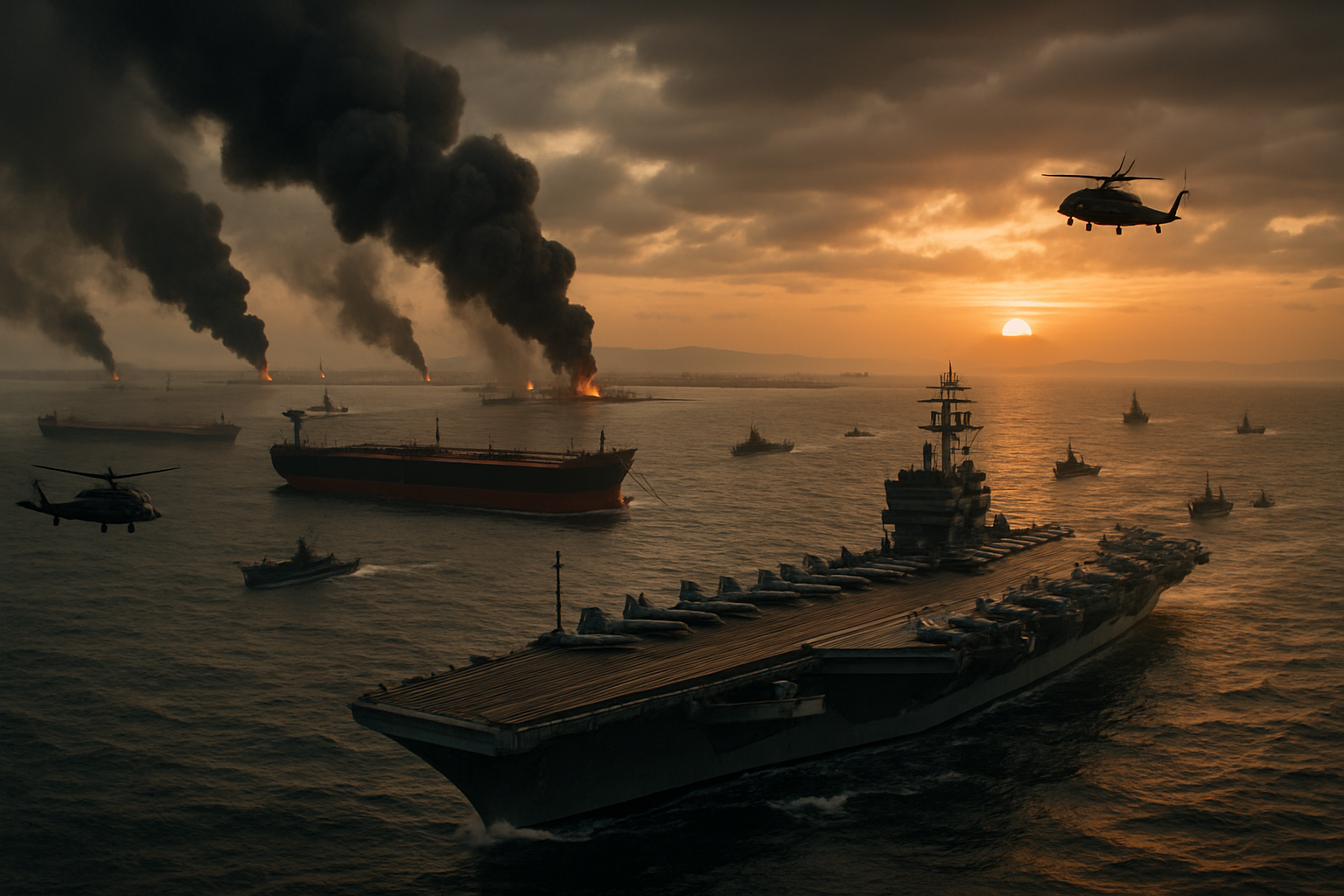
Two weeks into the most dangerous international crisis since the Cold War, the Iran-US-Israel conflict has reached a critical juncture with President Donald Trump calling Iranian leaders "deranged scumbags" while Iran's new Supreme Leader Mojtaba Khamenei makes his first public statement vowing to keep the Strait of Hormuz closed indefinitely.
The conflict, which began February 28 with joint US-Israeli "Operation Epic Fury" strikes, has killed over 2,000 people, displaced millions, and triggered the worst global energy crisis in decades. Oil prices have surged past $100 per barrel for the first time since 2014, heading toward $200 according to market warnings, as Iran continues mining the Strait of Hormuz - the critical waterway carrying 40% of global oil transit.
Trump Escalates Rhetoric Amid Growing Pressure
In his most inflammatory statement yet, President Trump declared on Truth Social Friday morning: "We have unparalleled firepower, unlimited ammunition, and plenty of time – Watch what happens to these deranged scumbags today." The president claimed it was his "great honor" to kill Iranian leaders as the 47th President, referencing Iran's 47-year history of "killing innocent people."
Trump's escalation comes as domestic pressure mounts over the conflict's unprecedented costs and scope. Operation Epic Fury has already consumed $11.3 billion in its first week, with Pentagon sources confirming preparations for operations extending through September - far beyond the administration's initial 4-6 week timeline.
"They've been killing innocent people all over the world for 47 years, and now I, as the 47th President of the United States of America, am killing them. What a great honor it is to do so!"
— Donald Trump, President of the United States
New Iranian Leadership Defiant
Iran's new Supreme Leader Mojtaba Khamenei - elevated following his father Ali Khamenei's death on March 1 - issued his first public statement through state television Thursday, marking the first hereditary succession in the Islamic Republic's 47-year history. The younger Khamenei vowed to maintain the Strait of Hormuz blockade and called on neighboring countries to expel US military bases or face targeting by Iranian forces.
Notably, the new Supreme Leader did not appear in person, with his statement read by a television presenter. Iranian officials have suggested he was lightly injured in recent strikes but remains "firmly in command." Intelligence sources indicate this represents a historic shift from clerical to military governance, with the Revolutionary Guards exercising unprecedented control over Iranian state apparatus.
"I assure everyone that we will not neglect avenging the blood of your martyrs," the hardline cleric declared, in what analysts describe as a continuation of Iran's "no red lines remain" policy established under Operation True Promise 4.
Global Economic Crisis Deepens
The conflict has triggered the most severe global economic disruption since the 2008 financial crisis. Over 18,000 flights have been cancelled worldwide - the most extensive aviation crisis since COVID-19 - as eight Middle Eastern countries maintain simultaneous airspace closures. Dubai International Airport, the world's busiest with 86 million annual passengers, remains completely shut down from missile damage.
The International Energy Agency has authorized the largest strategic oil reserve release in its 50-year history - 400 million barrels - in an attempt to stabilize markets. However, with Iran deploying an estimated 2,000-6,000 naval mines in the Strait of Hormuz and over 150 oil tankers stranded in the Persian Gulf, the intervention has failed to prevent oil from surging past $100 per barrel.
Natural gas prices have spiked 24% in Europe and 78% in the United States, with Qatar's LNG production - representing 20% of global exports - completely halted due to Iranian infrastructure attacks. Major shipping companies Maersk and MSC have suspended all Persian Gulf operations, stranding billions of dollars worth of cargo.
Unprecedented Military Escalation
The conflict has expanded far beyond its Middle Eastern origins, marking several historic firsts. Iranian drones struck RAF Akrotiri in Cyprus - the first attack on European territory since World War II - prompting an unprecedented naval coalition response. HMS Dragon, Spanish frigates, and vessels from Italy, France, Netherlands, and Greece are now protecting European waters.
The USS Charlotte submarine's sinking of Iranian frigate IRIS Dena near Sri Lanka, killing over 80 crew members, represents the first enemy vessel sunk by a US submarine since World War II. The incident expanded the conflict into the Indian Ocean, demonstrating the truly global nature of the crisis.
US casualties have mounted to 150 wounded troops, with 8 in critical condition, according to Pentagon confirmation. Three American service members have been killed - the first deaths in the largest Middle East military operation since the 2003 Iraq invasion.
Regional Coalition Under Strain
The unprecedented coalition of Saudi Arabia, UAE, Qatar, and Egypt that had supported diplomatic efforts is severely strained as Iranian retaliation directly targets member territories. Egyptian President Abdel Fattah el-Sisi has condemned attacks on "sisterly Arab countries," warning of "comprehensive chaos" spreading across the region.
Casualties from Iranian attacks include one civilian killed in Abu Dhabi, 32 foreign nationals injured in Kuwait airport strikes, and eight wounded in Qatar despite successful Patriot missile interceptions. The UAE's carefully cultivated image as a safe regional hub has been "shattered," according to diplomatic sources.
Nuclear Diplomacy Completely Collapsed
The conflict's origins trace back to the complete breakdown of nuclear negotiations, despite achieving the most significant progress since the 2018 JCPOA collapse. Geneva talks had reached "broad agreement on guiding principles," but foundered on the same fundamental disagreement that has plagued US-Iran relations: Tehran's insistence on nuclear-only discussions versus Washington's demands for comprehensive agreements including ballistic missiles, proxy groups, and human rights.
Iran continues enriching uranium to 60% purity with over 400 kilograms of weapons-grade material - sufficient for multiple nuclear weapons if weaponized. The crisis occurs against the backdrop of broader nuclear governance breakdown, with the New START treaty's expiration in February marking the first time in over 50 years without US-Russia nuclear constraints.
Congressional Opposition Intensifies
Bipartisan congressional opposition to the conflict is mounting, with lawmakers demanding comprehensive briefings on strategy, costs, and potential ground troop deployment. Senator Richard Blumenthal expressed being "more concerned than ever" about the prospect of boots on the ground, while the conflict's unpopularity has reached "almost unprecedented" levels with only 25% American support.
Financial markets are increasingly viewed as the "ultimate constraint" on further escalation, with Pakistan's stock exchange suffering its largest single-day decline in history at -8.97%. The disruption extends far beyond energy markets, affecting automotive, electronics, and textile manufacturing dependent on Gulf logistics networks.
Humanitarian Crisis Mounts
The Iran Red Crescent reports over 787 civilian casualties from US-Israeli strikes, with international condemnation focusing on the Minab elementary school attack that killed 53-85 students and staff during regular school hours. Human rights organizations are demanding Geneva Conventions investigations into what they term potential war crimes.
The largest international evacuation operation since the 2011 Arab Spring is underway, with Australia reporting 115,000 trapped nationals and Germany 30,000 stranded tourists. The European Union activated its ESTIA evacuation mechanism for Cyprus for the first time in the bloc's history.
Historical Significance and Global Implications
UN Secretary-General António Guterres has characterized the crisis as the "greatest test of multilateral cooperation and crisis management in the modern era." The rapid transition from diplomatic breakthrough to military confrontation demonstrates what experts call the "fragility of crisis management in the multipolar era."
March 2026 represents a watershed moment in international relations, with implications extending far beyond the Middle East. The conflict has already reshaped energy architecture, disrupted global supply chains, and challenged post-World War II international order principles.
"We are witnessing template-setting precedents for 21st-century conflict resolution that will influence how territorial and nuclear disputes are handled for decades to come."
— António Guterres, UN Secretary-General
French Military Casualties Internationalize Conflict
The conflict's international dimension was underscored by the death of French soldier Adjutant-Chief Arnaud Frion in a drone attack in Iraqi Kurdistan. President Emmanuel Macron confirmed the death of the 7th Alpine Battalion member, representing the first French military casualty in the broader regional conflict and highlighting how the Iran war is drawing in additional Western forces.
Pro-Iranian militia group Ashab Al-Kahf has warned that French interests "in Iraq and the region" are now "under targeting fire" following France's deployment of naval assets to the region.
The Path Forward
As the conflict enters its third week, the prospects for diplomatic resolution appear increasingly dim. Trump's demands for Iran's "unconditional surrender" and claims to personally choose the next Supreme Leader have eliminated negotiated settlement possibilities, while Mojtaba Khamenei's elevation ensures hardline military influence over Iranian policy.
The success or failure of containing this crisis will determine whether it provides a framework for future nuclear dispute resolution or accelerates military solutions to international conflicts, potentially reshaping global geopolitics for decades. With regional war prevention, global energy security, nuclear governance credibility, and international law enforcement all at stake simultaneously, the coming phase represents the most consequential test of international crisis management since the Cold War's end.
As oil heads toward $200 per barrel and global supply chains face unprecedented disruption, the world watches to see whether diplomatic channels can be restored or if this regional confrontation will expand into the broader Middle Eastern war that many experts now fear is inevitable.