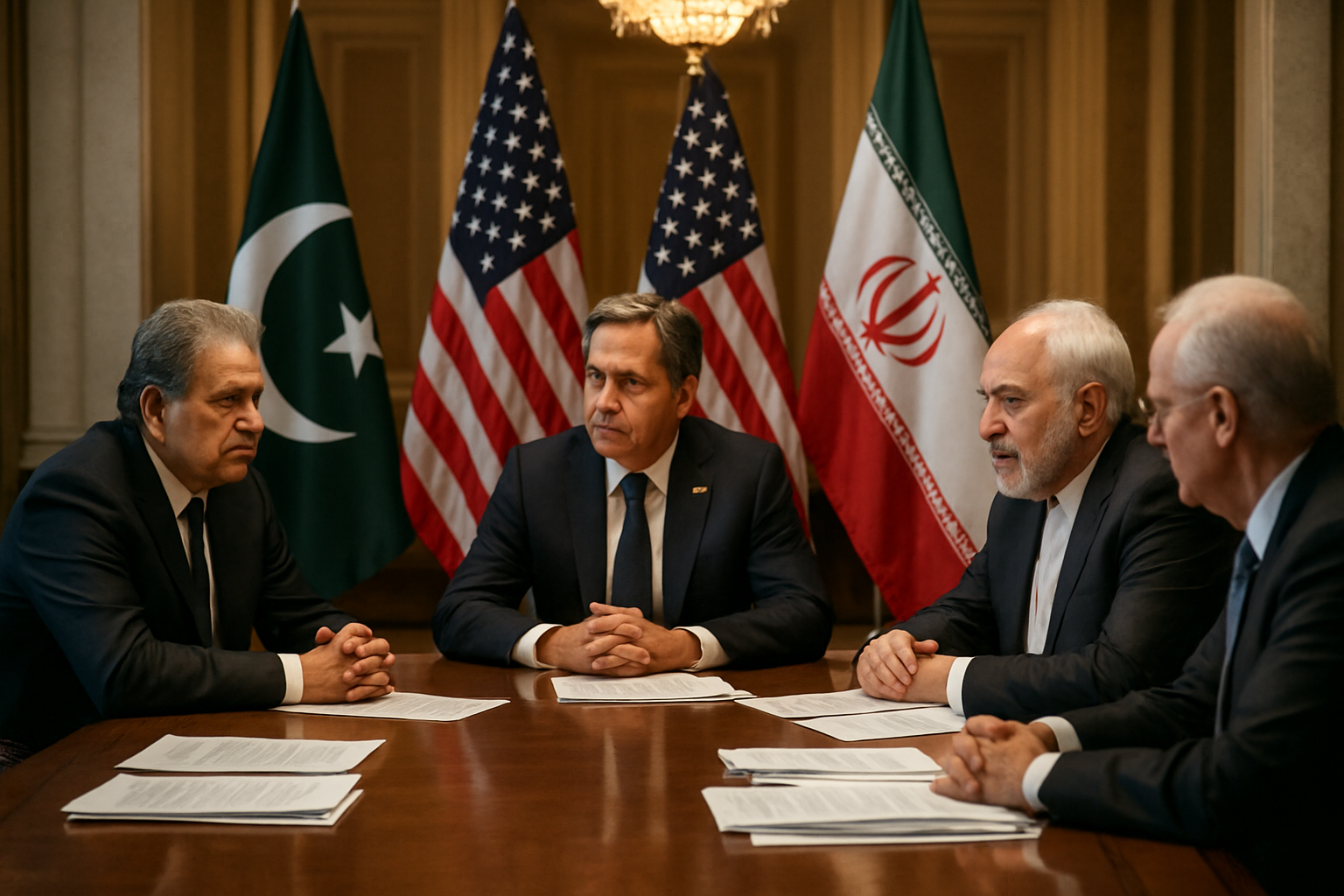
The fragile two-week ceasefire between the United States and Iran, mediated by Pakistan just days ago, faces its gravest test as Israeli strikes on Lebanon threaten to derail historic peace talks scheduled for this weekend in Islamabad. What began as a diplomatic breakthrough ending the most dangerous crisis since the Cold War now hangs by a thread as regional tensions escalate and oil markets remain volatile.
The ceasefire, dubbed the "Islamabad Accord," was achieved just 88 minutes before President Trump's "whole civilization will die tonight" deadline on April 8, when oil prices crashed 20% from $119.50 to below $100 per barrel. Pakistan's Prime Minister Shehbaz Sharif and Field Marshal Asim Munir successfully mediated the breakthrough through round-the-clock contact with Vice President JD Vance and Iranian officials.
Critical Lebanon Loophole Threatens Agreement
The ceasefire's most dangerous vulnerability has emerged over Lebanon's status. Israeli Prime Minister Benjamin Netanyahu explicitly stated that Lebanon is not covered by the ceasefire agreement, creating what analysts describe as a "critical loophole" in the diplomatic framework. This exclusion has allowed Israel to conduct its deadliest bombardment of Lebanon since March, killing 254+ people in a single day while targeting over 100 Hezbollah sites across Beirut, the Bekaa Valley, and southern Lebanon.
Vice President Vance acknowledged Iran's "legitimate misunderstanding" about Lebanon's inclusion but confirmed the US never agreed to include Israeli-Hezbollah operations in the ceasefire terms. Iran has threatened to withdraw from Friday's talks unless comprehensive enforcement covers all fronts, with Parliament Speaker Mohammad Bager Qalibaf warning negotiations would become "meaningless" if violations continue.
"Pakistan stated the ceasefire 'covers all fronts including Lebanon,' but Netanyahu explicitly rejected this, creating a dangerous gap threatening the broader peace framework."
— Diplomatic Source, speaking anonymously
Humanitarian Catastrophe in Lebanon
The Lebanon crisis has reached unprecedented proportions, with 1.2 million people displaced—representing 25% of the country's population. Emergency shelters are overwhelmed, forcing thousands to sleep on Beirut's streets. The systematic targeting of medical personnel has intensified, with 26 paramedics killed and 51 wounded since March 2, raising concerns about potential Geneva Conventions violations.
The November 2024 US-French brokered Israel-Hezbollah ceasefire, which had held for over a year, completely collapsed in March 2026. Hezbollah faced an "impossible choice" between maintaining the ceasefire versus Iranian pressure for retaliation following Supreme Leader Ali Khamenei's death on March 1. The organization chose "Iranian solidarity over Lebanese sovereignty," declaring "resistance only option" and pulling Lebanon into the broader Iran-Israel war.
Strait of Hormuz Controversy
Another major strain on the ceasefire involves the Strait of Hormuz, through which 40% of global seaborne oil transits. Iran has agreed to reopen the strategic waterway for "safe passage" coordinated with Iranian forces, but implementation has been problematic. President Trump criticized Iran's "very poor job" of allowing oil flow, stating on Truth Social: "That is not the agreement we have!"
Iran has implemented an unprecedented cryptocurrency payment system requiring $1 per barrel for oil tankers, while empty vessels pass free. The first ships—Greek NJ Earth and Liberian Daytona Beach—successfully navigated the strait, but vessel owners remain reluctant to send tankers fearing they could be stranded if the ceasefire collapses.
Pakistan's Historic Mediation Success
Pakistan has emerged as a crucial mediator, demonstrating what experts call "middle power diplomacy" success. Using a sophisticated "message relay system," Pakistani officials maintained communication between the US and Iran when direct talks were impossible. The breakthrough came after China provided "full support" for Pakistan's initiative, with German officials noting "positive signs" for direct talks.
The scheduled talks in Islamabad represent the most direct US-Iran diplomatic engagement in decades. The US delegation potentially includes VP Vance, Steve Witkoff, and Jared Kushner. Iranian President Pezeshkian confirmed participation following a "warm, cordial" 45-minute call with PM Sharif. Iran's 10-point proposal addresses Hormuz protocols, sanctions relief, regional conflicts, and security guarantees—the most comprehensive framework since the 2015 nuclear deal.
"This represents the greatest test of multilateral cooperation in the modern era."
— UN Secretary-General António Guterres
Regional and Global Implications
The crisis has had massive global impact. Over 18,000 flights were cancelled worldwide during the peak crisis—comparable to COVID-19 disruption levels. Dubai International, the world's busiest airport, was completely shut down due to missile damage. The International Energy Agency deployed the largest strategic reserve release in 50 years—400 million barrels from 32 countries.
The regional coalition of Saudi Arabia, UAE, Qatar, and Egypt has managed to preserve diplomatic unity despite Iranian attacks during the crisis that killed 1 person in Abu Dhabi, injured 32 in Kuwait, and wounded 8 in Qatar. Egyptian President Sisi's warnings about "comprehensive chaos" were heeded, maintaining unprecedented Middle Eastern support for the diplomatic process.
Nuclear Diplomacy Context
The current crisis emerged from the collapse of Geneva nuclear talks despite achieving "broad agreement on guiding principles"—the most progress since the 2018 JCPOA breakdown. The fundamental disagreement persists: Iran wants nuclear-only discussions excluding ballistic missiles and regional proxies, while the US demands comprehensive agreements covering missiles, armed groups, and human rights.
Iran continues 60% uranium enrichment with over 400kg of weapons-grade material—sufficient for multiple weapons if weaponized. The crisis occurs against the backdrop of New START's expiration in February 2026, creating the first period in 50+ years without US-Russia nuclear constraints.
Congressional and Domestic Pressures
Congressional opposition to military action reached historic levels during the crisis, with only 25% American support—"almost unprecedented" unpopularity for early-stage operations. Republican lawmakers have begun floating impeachment discussions for the first time since Trump's reelection, particularly after his threat that "a whole civilization will die" sparked new concern among Democrats.
Operation Epic Fury cost $11.3 billion in the first week alone—the largest Middle East operation since the 2003 Iraq invasion. The USS Charlotte submarine sank an Iranian frigate, marking the first enemy vessel sunk by a US submarine since World War II. European territory was attacked for the first time since WWII when Iranian drones struck RAF Akrotiri in Cyprus.
Economic Recovery Signs
Despite ongoing tensions, markets have shown explosive recovery since the ceasefire. Asian stocks surged, with Pakistan's KSE-100 posting a record 8.15% rally. Airlines are planning Middle East route resumptions, and the shipping industry is mobilizing 150+ stranded tankers worth billions in cargo. Consumer relief is anticipated globally, with Bangladesh reviewing fuel rationing for 170 million people and Pakistan considering reversing wartime austerity measures.
Template-Setting Moment
The coming days are critical for determining whether this diplomatic innovation can prevent broader regional war. The two-week window provides breathing space for innovative solutions to bridge decades-old US-Iran disagreements, but success depends on addressing the Lebanon loophole and ensuring Strait of Hormuz compliance.
This crisis represents a template-setting moment for 21st-century conflict resolution, testing whether multilateral cooperation can succeed in a volatile, interconnected world. The stakes include regional war prevention, global energy security, nuclear governance credibility, and international law enforcement mechanisms—with implications extending decades beyond current events.
As diplomatic teams prepare to gather in Islamabad, the world watches to see whether Pakistan's mediation success can convert a temporary pause into lasting stability, or whether fundamental disagreements will return the region to the most dangerous international crisis since the Cold War's end.