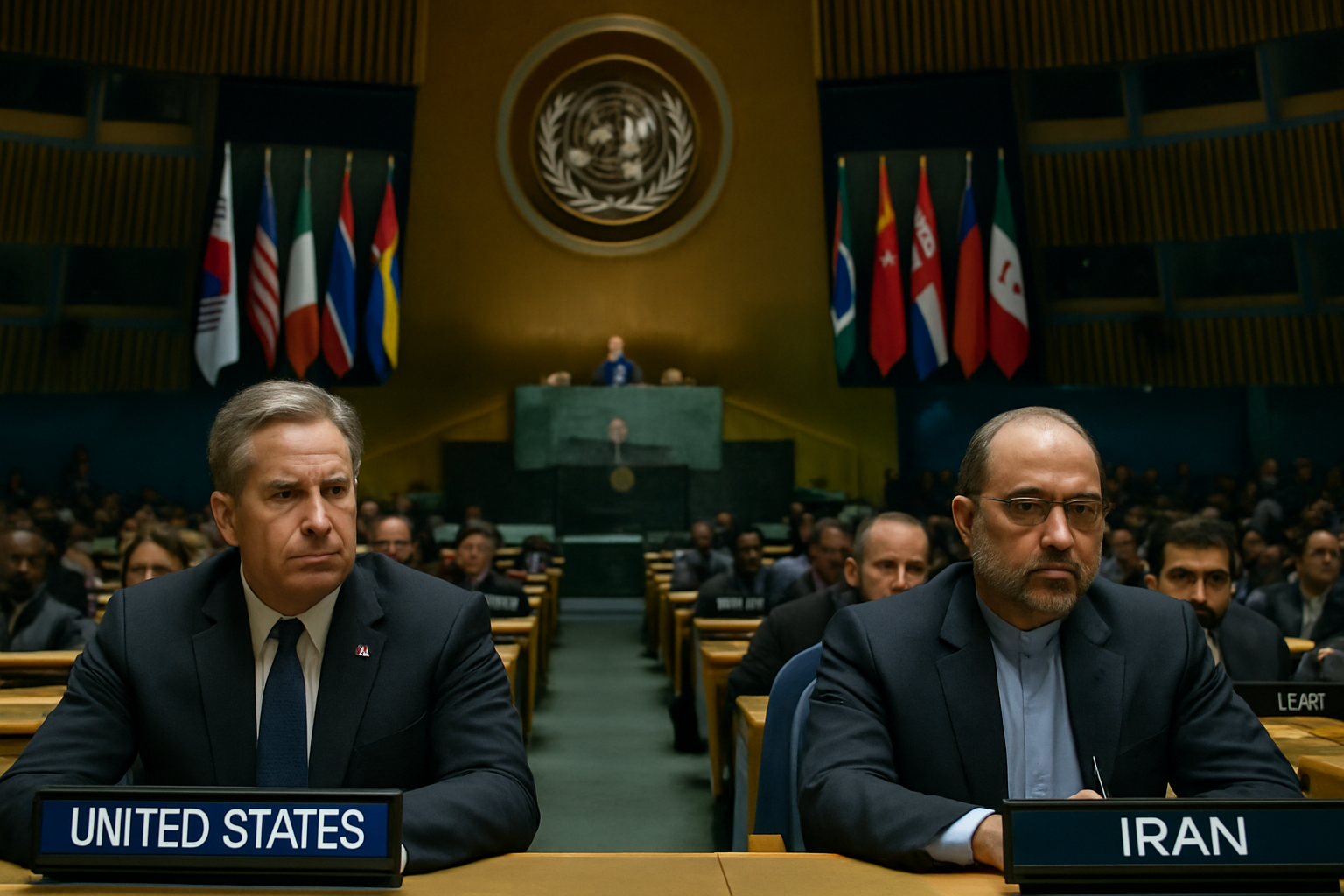
Iran has delivered its strongest warning yet to the United Nations, declaring that all US military bases, facilities, and assets in the Middle East would become "legitimate targets" if the United States follows through on its military threats and attacks the Islamic Republic.
The stark warning came through a formal letter to UN Secretary-General António Guterres from Iran's Ambassador to the United Nations, Amir Saeid Iravani, as tensions between Washington and Tehran reach critical levels. The communication represents Tehran's most direct threat against American military installations across the region, affecting bases from Qatar to Kuwait that house thousands of US personnel.
"Iran has informed the United Nations that it does not seek to initiate a war," Iravani stated in the letter delivered Thursday. "However, should the United States resort to military aggression against the Islamic Republic of Iran, we will respond decisively, and all US bases, facilities, and assets in the region will become legitimate targets."
Unprecedented Military Buildup Creates Powder Keg
The Iranian warning comes as President Trump has deployed the largest US naval presence in the Middle East since the 2003 Iraq invasion. Two aircraft carrier strike groups—the USS Gerald R. Ford and USS Abraham Lincoln—are positioned approximately 800 kilometers from Iran's coast, representing roughly one-third of the entire active US Navy fleet concentrated in a single region.
Pentagon officials have confirmed that American forces are prepared for "potentially weeks-long operations against Iran," with military scenarios ranging from targeted strikes on nuclear facilities to broader campaigns against Revolutionary Guard infrastructure. Military planners expect Iranian retaliation would create cycles of "back-and-forth attacks" that could engulf the entire Persian Gulf region.
The military tensions have already produced concerning incidents. An F-35C fighter jet from the USS Abraham Lincoln shot down an Iranian Shahed-139 drone that approached the carrier in what officials described as an "aggressive manner." Simultaneously, vessels from Iran's Revolutionary Guard Corps (IRGC) have been harassing US-flagged tankers in the Strait of Hormuz, the vital waterway through which 40% of global oil supplies transit.
Trump Issues Historic 10-15 Day Ultimatum
The Iranian warning follows President Trump's issuance of the most explicit deadline yet in the nuclear standoff. Speaking at the inaugural Board of Peace meeting, Trump warned Iran that the world would learn "over the next 10 days" whether diplomatic negotiations would succeed or military action would begin.
"Bad things will happen" if no meaningful nuclear deal is reached within this timeframe, Trump declared, representing the most direct ultimatum issued to Iran in decades. The president has also made his most explicit regime change comments, calling the Iranian government's overthrow "the best thing that could happen."
These statements mark a significant evolution in Trump's policy approach—shifting from nuclear-focused negotiations to what appears to be a comprehensive political transformation agenda for Iran.
Nuclear Crisis Reaches Critical Phase
At the heart of the escalating crisis lies Iran's nuclear program, which has advanced dramatically since the collapse of the Joint Comprehensive Plan of Action (JCPOA) in 2018. Iran is currently enriching uranium at 60% purity—significantly above the 3.67% limit established by the original nuclear deal and approaching the 90% threshold required for weapons-grade material.
Intelligence assessments confirm that Iran now possesses sufficient enriched uranium to produce multiple nuclear weapons if it chooses to weaponize its program. Iranian Foreign Minister Abbas Araghchi has maintained Tehran's hardline position, declaring that Iran will "never abandon uranium enrichment even if war is imposed."
Despite this defiance, recent diplomatic efforts in Geneva achieved what negotiators described as "broad agreement on guiding principles"—the most significant progress since the JCPOA's collapse. However, fundamental disagreements persist over the scope of any potential agreement.
Fundamental Scope Disagreement Blocks Progress
The core obstacle preventing a breakthrough lies in competing visions of what any nuclear agreement should encompass. Iran insists on nuclear-only talks, explicitly excluding its ballistic missile program and regional proxy activities as "red lines" that cannot be negotiated.
Conversely, US Secretary of State Marco Rubio demands a comprehensive agreement that addresses not only nuclear issues but also Iran's missile capabilities, support for armed groups like Hezbollah and Hamas, and human rights violations within Iran. This fundamental scope disagreement has prevented diplomatic breakthroughs for over a decade.
"These are the same structural obstacles that have blocked progress since the original JCPOA collapsed," explains a senior diplomatic source familiar with the negotiations. "Iran wants compartmentalized talks while America demands an integrated approach to all security threats."
Unprecedented Regional Coalition Backs Diplomacy
Despite the military tensions, an extraordinary coalition of Middle Eastern powers is supporting diplomatic engagement between Washington and Tehran. Saudi Arabia, the United Arab Emirates, Qatar, and Egypt—traditional rivals with differing regional interests—have all endorsed continued negotiations.
This unprecedented regional consensus reflects the massive economic stakes involved. The Persian Gulf handles 40% of global oil transit, and any regional conflict would destabilize energy markets worldwide. Oil prices have already risen more than $1 per barrel due to current tensions, with analysts warning that actual conflict could produce price shocks affecting the global economy.
Oman continues to play a crucial mediation role, leveraging its historical neutrality and success in facilitating the original 2015 JCPOA negotiations. The sultanate's diplomatic efforts, now supported by Switzerland, represent the international community's investment in preventing military confrontation.
Israeli Coordination Adds Complexity
Israel's security concerns add another layer of complexity to the crisis. Prime Minister Benjamin Netanyahu has conducted multiple meetings with Trump, emphasizing Israeli "red lines" that any agreement must include limitations on Iran's ballistic missile program and an end to support for Iranian proxy forces.
From Israel's perspective, nuclear-only agreements that ignore Iran's extensive missile arsenal and proxy network—including Hezbollah in Lebanon, Hamas in Gaza, and the Houthis in Yemen—are insufficient to address existential security threats. This Israeli position aligns with broader US demands for comprehensive agreements.
Domestic Pressures Shape Both Sides
Internal political pressures significantly influence both governments' negotiating positions. Iran faces severe domestic challenges, with over 42,000 people arrested since the 2022 protests and Nobel Peace Prize laureate Narges Mohammadi recently sentenced to an additional 7.5 years in prison for "gathering and collusion."
The Iranian regime prioritizes maintaining its nuclear capabilities over economic relief from sanctions, calculating that nuclear leverage provides more security than international integration. Economic sanctions have created a regime survival crisis, but Tehran appears willing to endure continued hardship rather than accept what it views as capitulation.
Meanwhile, Trump faces pressure from Republican hawks who view diplomatic engagement as appeasement, while simultaneously needing a foreign policy victory. The president must balance these competing pressures while managing the real risks that military action could produce a wider regional conflict.
Nuclear Governance Crisis Adds Urgency
The Iran crisis unfolds against a broader breakdown in global nuclear governance. The New START Treaty between the United States and Russia expired on February 5, 2026—marking the first time in over 50 years that no nuclear arms control constraints exist between the world's largest nuclear powers.
China's rapid nuclear expansion, with warhead estimates increasing from 350 to over 500 in recent years, further complicates multilateral frameworks. UN Secretary-General Guterres has warned that nuclear risks are now "at their highest level in decades."
Success in resolving the Iran crisis could provide a template for 21st-century nuclear crisis management. Failure, however, might accelerate military solutions to nuclear proliferation challenges, potentially encouraging other nations to pursue weapons programs while undermining diplomatic credibility globally.
Verification Challenges Mount
Any potential agreement faces unprecedented verification challenges. Iran's nuclear infrastructure has expanded dramatically since 2018, featuring advanced centrifuge technology, sophisticated facilities, and dispersed capabilities that would require monitoring mechanisms far exceeding the original JCPOA's complexity.
Technical experts note that rebuilding trust between historically antagonistic parties would require years of careful implementation, even if political agreements could bridge current disagreements. The International Atomic Energy Agency suspended inspections in November 2025, though recent meetings suggest potential progress toward restoring monitoring.
Weekend Decision Point Approaches
Multiple intelligence sources confirm that US military forces could be ready for operations against Iran as early as this weekend, though President Trump has not yet made a final authorization decision. White House officials describe active discussions weighing escalation risks against the potential consequences of allowing Iran's nuclear program to advance further.
The stakes of this weekend decision extend far beyond bilateral US-Iran relations. Regional war prevention, global energy stability, nuclear governance credibility, Middle East stability architecture, and international law enforcement all hang in the balance.
Template-Setting Moment for Global Diplomacy
The current crisis represents a template-setting moment for how the international community addresses nuclear proliferation challenges in a multipolar era. Success in finding diplomatic solutions could provide precedents for managing similar crises with other potential nuclear powers.
Conversely, failure might accelerate a shift toward military solutions for nuclear challenges, potentially reshaping Middle Eastern geopolitics for decades while encouraging nuclear proliferation elsewhere. The undermining of diplomatic credibility could affect international approaches to territorial disputes and security challenges far beyond the current crisis.
The coming days will determine whether innovative diplomatic solutions can bridge decade-old challenges or whether the gravitational pull toward military confrontation in this volatile region proves irresistible. With Iran's warning now formally delivered to the United Nations, the international community watches anxiously as two nations approach what could become a defining moment for 21st-century conflict resolution.