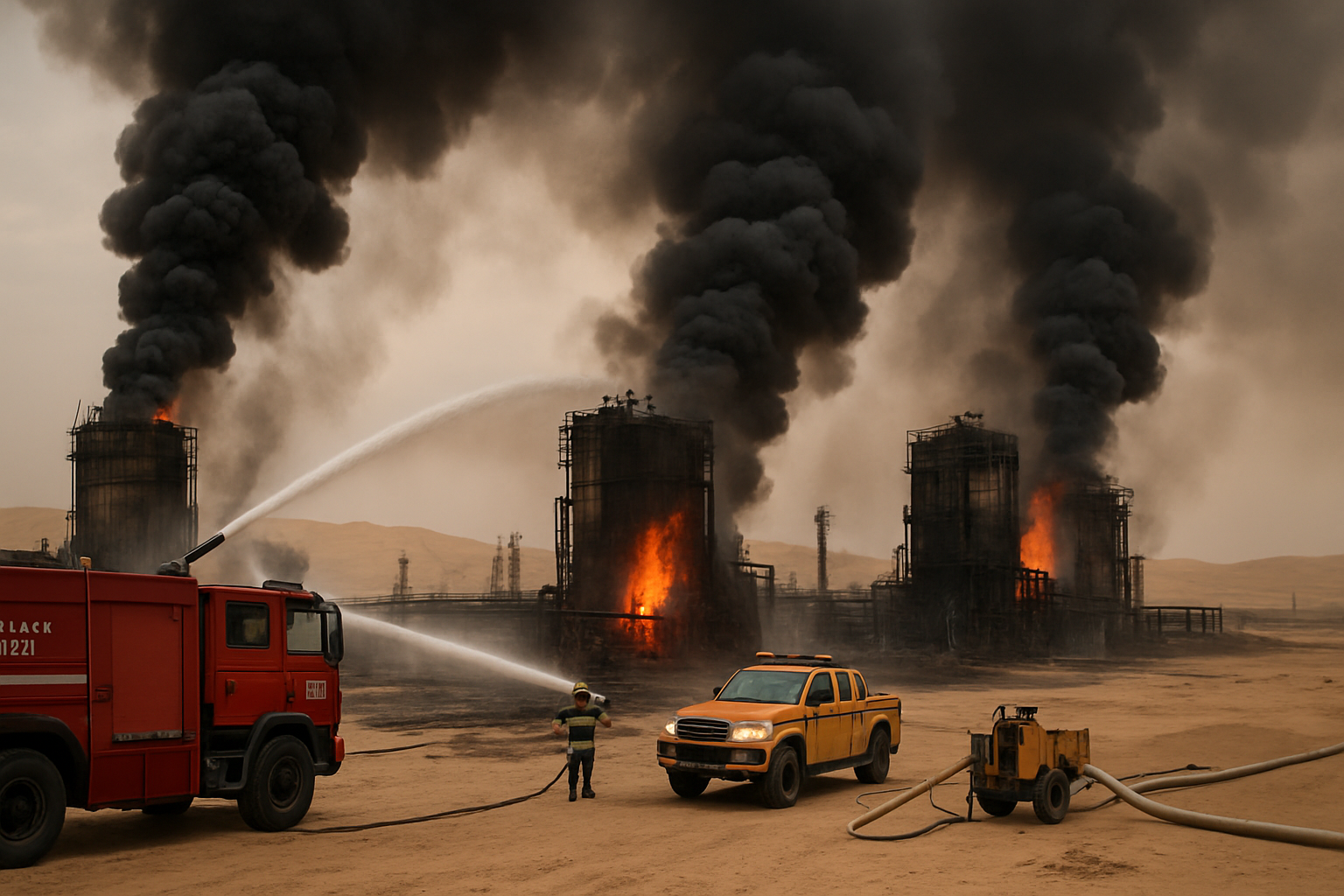
Iranian Revolutionary Guard forces have launched the most devastating attacks yet on Kuwait's critical infrastructure, targeting oil facilities, power generation plants, and government complexes in a dramatic escalation that threatens to further destabilize the global energy market amid the ongoing Iran-US conflict.
The coordinated strikes, which began in the early hours of April 5, 2026, mark a significant expansion of Iran's "Operation True Promise 4" campaign that has already wreaked havoc across the Gulf region for over a month. According to Kuwaiti authorities, Iranian drones and missiles struck multiple strategic targets, including the Kuwait Petroleum Corporation's Shuwaikh oil complex, major power and water desalination facilities, and government ministry buildings.
Systematic Targeting of Energy Infrastructure
The Kuwait Petroleum Corporation confirmed that a fire broke out at its Shuwaikh oil sector complex, which houses both the oil ministry headquarters and KPC's main facilities. The attack demonstrates Iran's strategic shift toward targeting economic infrastructure rather than purely military assets, following a pattern established in previous strikes across Qatar, UAE, and Saudi Arabia.
Two power generation units were taken out of service after Iranian drones targeted power and water desalination plants, causing what Kuwait's Ministry of Electricity, Water, and Renewable Energy described as "significant material damage." The attacks forced authorities to implement emergency protocols to maintain essential services for Kuwait's population.
"The Iranian regime has crossed all red lines by systematically targeting civilian infrastructure across the Gulf states."
— Senior Gulf Official, speaking on condition of anonymity
Iranian state media reported that the attacks involved a complex combination of 7 ballistic missiles, 2 cruise missiles, and 26 drones launched against Kuwait alone in a 24-hour period, representing one of the most intensive bombardments the country has faced since the 1990-1991 Gulf War.
Regional Pattern of Infrastructure Warfare
The Kuwait attacks are part of Iran's broader strategy to target energy infrastructure across the Gulf region. Previous strikes have hit Qatar's Ras Laffan Industrial City, which handles approximately 20% of global LNG exports, and UAE facilities including the Habshan gas complex. This systematic targeting represents a dangerous evolution from military confrontation to economic warfare.
The Iranian Revolutionary Guard's declaration that Gulf energy facilities are "legitimate targets" under their expanded interpretation of "no red lines remain" has fundamentally altered the nature of the conflict. What began as a nuclear dispute between Iran and the United States has transformed into a regional energy crisis affecting global supply chains.
Kuwait's response included diplomatic protests to international bodies and enhanced coordination with fellow Gulf Cooperation Council members. The attacks have particularly strained relationships within the traditionally cohesive Gulf alliance, as member states face the choice between supporting US policy toward Iran or protecting their own territories from retaliation.
Global Economic Implications
The latest attacks have sent shockwaves through international energy markets already reeling from over a month of regional conflict. Oil prices remain elevated above $100 per barrel, with analysts warning that sustained attacks on Gulf infrastructure could push prices toward the $150-200 range that Qatar's Energy Minister previously warned could "bring down the economies of the world."
Iran's effective closure of the Strait of Hormuz through naval mining operations continues to block 40% of global seaborne oil transit, stranding over 150 oil and LNG tankers worth billions in cargo. Major shipping companies including Maersk and MSC have suspended all Persian Gulf operations, creating bottlenecks that are rippling through global supply chains.

The International Energy Agency has deployed the largest strategic petroleum reserve release in its 50-year history—400 million barrels from 32 countries—in an attempt to stabilize markets. However, experts warn that these emergency reserves provide only temporary relief if the conflict continues to escalate.
Escalating Humanitarian Crisis
While Kuwaiti authorities reported no casualties in the latest attacks, the broader regional conflict has created a mounting humanitarian crisis. The Iranian Red Crescent has documented over 787 civilian casualties from US-Israeli strikes, while attacks across Gulf states have killed dozens and displaced hundreds of thousands.
The targeting of water desalination plants in Kuwait is particularly concerning, as these facilities are critical for the country's water security in the arid Gulf region. Experts warn that attacks on such dual-use infrastructure blur the lines between military and civilian targets, potentially violating international humanitarian law.
International evacuations continue on a scale not seen since the Arab Spring in 2011, with Australia reporting 115,000 nationals trapped in the region and Germany working to evacuate 30,000 stranded tourists and residents.
Historical Context and Regional Dynamics
The current escalation represents the culmination of tensions that began with the collapse of US-Iran nuclear negotiations in February 2026. Despite achieving what diplomats described as "broad agreement on guiding principles"—the most significant progress since the 2018 JCPOA collapse—fundamental disagreements over the scope of any agreement proved insurmountable.
Iran's position that ballistic missiles and regional proxy relationships were "red lines" excluded from nuclear-only discussions clashed with US demands for comprehensive agreements covering missiles, armed groups, and human rights issues. The diplomatic breakdown led directly to Operation Epic Fury, the largest coordinated US-Israeli military operation since the 2003 Iraq invasion.
The death of Supreme Leader Ali Khamenei on March 1, 2026, marked a historic turning point, ending his 37-year rule and creating a succession crisis that saw his son Mojtaba Khamenei become the first hereditary Supreme Leader in the Islamic Republic's history. This transition has consolidated Revolutionary Guard control over Iranian decision-making during the active conflict.
International Response and Diplomatic Efforts
The latest attacks on Kuwait have prompted urgent diplomatic consultations among regional and international powers. Pakistan has emerged as a potential mediator, with Foreign Minister Ishaq Dar confirming "indirect talks" between the US and Iran through a "message relay system," though fundamental positions remain far apart.
European allies face increasing pressure to contribute military assets to protect Gulf shipping lanes, though many have been reluctant to fully commit to what some view as an American-led military campaign. The attack on RAF Akrotiri in Cyprus—the first attack on European territory since World War II—has created unprecedented unity among European naval forces in the Eastern Mediterranean.
"This crisis represents the greatest test of multilateral cooperation and crisis management in the modern era."
— UN Secretary-General António Guterres
Congressional opposition in the United States continues to mount, with senators from both parties demanding answers about strategy, costs, and the potential for ground troop deployment. The conflict's unpopularity—with only 25% public support—represents what experts describe as "almost unprecedented" opposition to a military operation in its early stages.
Looking Ahead: Critical Juncture
The attacks on Kuwait represent a critical juncture in what has become the most dangerous international crisis since the end of the Cold War. The systematic targeting of civilian infrastructure marks a dangerous escalation that could set precedents for future conflicts involving non-state actors and regional powers.
Energy security experts warn that the current crisis exposes fundamental vulnerabilities in global supply chains overly dependent on single chokepoints like the Strait of Hormuz. The 21-mile waterway's closure has demonstrated how quickly regional conflicts can create global economic disruption, prompting calls for fundamental restructuring of international energy architecture.
As the conflict enters its second month, the stakes continue to rise. Regional war prevention, global energy security, nuclear governance credibility, and the effectiveness of international law enforcement are all being tested simultaneously. The outcome will likely establish precedents for 21st-century conflict resolution that extend far beyond the current crisis.
Template for Future Crisis Management
The rapid transition from diplomatic breakthrough to military confrontation demonstrates the fragility of crisis management in the multipolar era. Success in containing the current escalation could provide a framework for resolving future nuclear disputes through diplomatic means. Failure, however, may accelerate the trend toward military solutions, potentially encouraging nuclear proliferation globally and undermining diplomatic credibility worldwide.
The Kuwait attacks underscore that what began as a bilateral US-Iran nuclear dispute has evolved into a regional conflict with global implications affecting energy markets, aviation networks, supply chains, and international stability mechanisms. The resolution of this crisis will likely determine approaches to conflict resolution for decades to come, making April 2026 a watershed moment in international relations.
As emergency response teams continue to assess damage from the latest attacks and regional powers seek diplomatic solutions, the world watches to see whether this escalation represents a temporary spike in violence or a permanent shift toward more dangerous forms of interstate conflict in the 21st century.