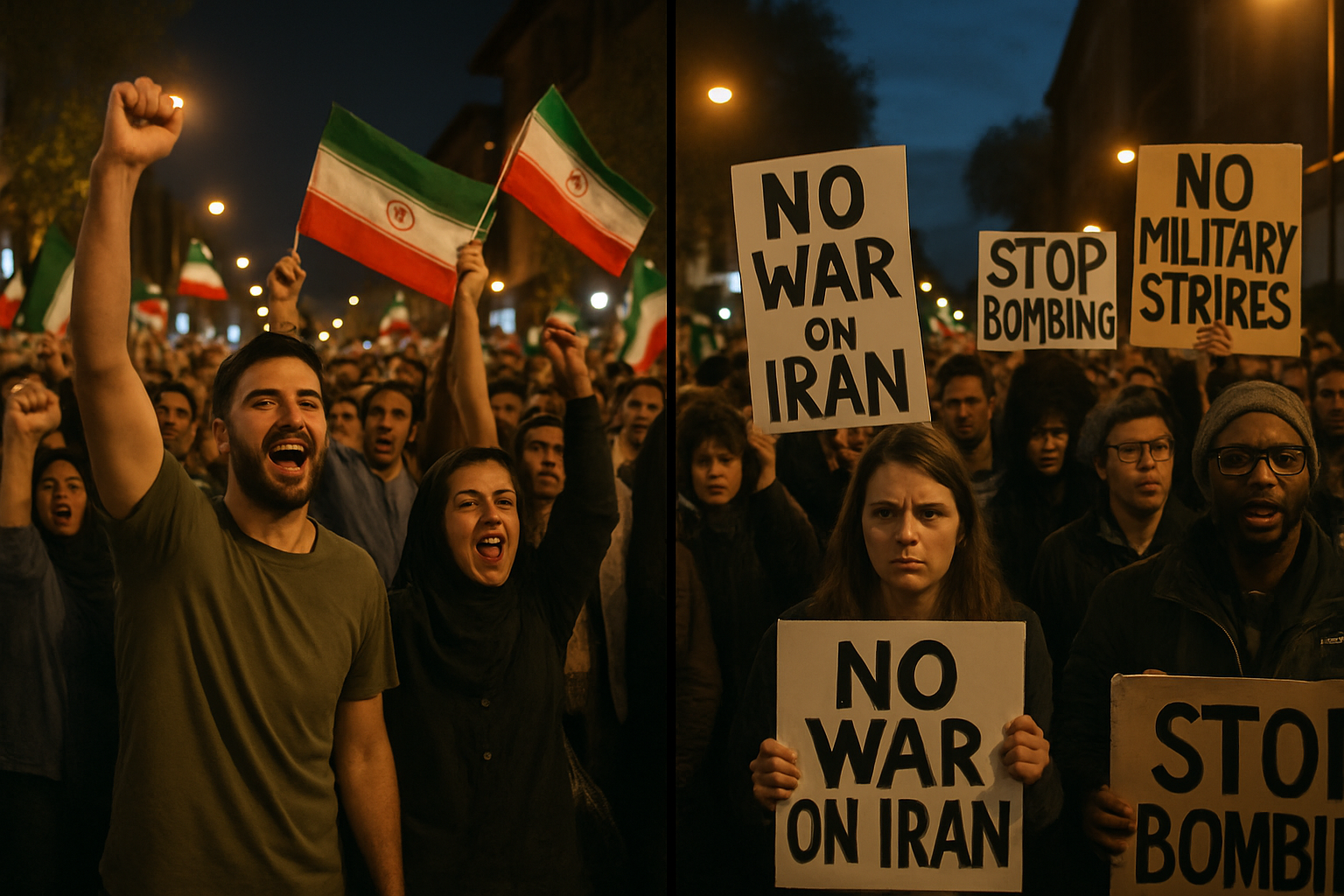
Iranian citizens erupted in spontaneous celebrations across Tehran and other cities following unverified reports of Supreme Leader Ali Khamenei's death, while protesters in New York, Rome, and Oslo condemned the US-Israeli military strikes that triggered the claims.
The dramatic scenes unfolded as reports emerged from Israeli sources claiming Iran's 85-year-old Supreme Leader was killed during coordinated US-Israeli "Operation Epic Fury" strikes. However, Iranian officials vehemently denied these reports, with Foreign Minister Abbas Araghchi stating Khamenei is "still alive as far as I know" and dismissing the claims as "psychological warfare."
Celebrations Erupt Across Iranian Cities
Despite the uncertain security situation, Iranians in Tehran were seen dancing at bus stops and participating in car parades, according to reports from Repubblica.it. The Italian outlet described explosions of joy in the capital, with residents coming out to their balconies to applaud and sing, chanting "The tyrant is no more."
The Revolutionary Guards reportedly told residents to leave the city, fearing mass street celebrations could spiral beyond control. Videos showed spontaneous gatherings with people expressing a mixture of disbelief and cautious hope, even as explosions from the ongoing military operations could be heard in the distance.
"The Pasdaran tell us to leave the city, they fear that everyone will take to the streets"
— Tehran resident, as reported by Repubblica.it
Similar celebrations were reported in Rome, where hundreds of young Iranians gathered in Piazza San Giovanni to celebrate what they called "the end of Khamenei." The demonstrations reflected the broader Iranian diaspora's reaction to the unconfirmed reports.
International Protests Against Military Action
While Iranians celebrated the unverified death reports, protesters in multiple countries condemned the military strikes that preceded them. In New York, hundreds of people marched through Manhattan and gathered outside the White House to protest President Trump's decision to order the coordinated attacks on Iran.
The protests occurred just hours after Trump announced the strikes, with demonstrators expressing opposition to what they viewed as an escalation of military confrontation in the Middle East. Al Jazeera reported that New Yorkers took to the streets in response to the "wave of deadly strikes" ordered by the US President.
In Oslo, Iranians gathered outside Iran's embassy in what Norwegian media VG described as "full celebration," with reports of people breaking into dance upon hearing news of the Supreme Leader's alleged death. The Norwegian outlet captured scenes of jubilant crowds congratulating Iran on the reported development.
Conflicting Reports and Information Warfare
The celebration and protest scenes unfolded against a backdrop of conflicting information about Khamenei's status. Israeli Prime Minister Netanyahu claimed there were "many signs" that Khamenei was "no longer with us" after strikes destroyed the Supreme Leader's compound. However, Iranian semi-official media outlets Tasnim and Mehr firmly denied the reports.
The information uncertainty highlighted what experts describe as modern information warfare challenges during active military operations. Iranian authorities implemented strict communications control in Tehran, disrupting mobile services and blocking roads, making independent verification extremely difficult.
Multiple Iranian family members of the Supreme Leader were confirmed killed during the strikes, including his daughter, son-in-law, and granddaughter, according to Fars news agency and sources close to Khamenei's office. However, his personal status remained disputed.
Regional and Global Implications
The dramatic events occurred following the complete breakdown of nuclear negotiations between the US and Iran, despite recent progress in Geneva talks. The strikes represented the largest coordinated US-Israeli military operation against Iran since 2003, involving unprecedented dual-carrier deployment of USS Gerald R. Ford and Abraham Lincoln.
Iran immediately retaliated with what the Islamic Revolutionary Guard Corps called "first wave" strikes, declaring that "no red lines remain" and all US-Israeli assets were "legitimate targets." The escalation disrupted an extraordinary regional coalition of Saudi Arabia, UAE, Qatar, and Egypt that had been supporting diplomatic efforts.
The global aviation industry faced massive disruptions as Iran, Iraq, Israel, UAE, and Qatar closed their airspace completely, affecting hundreds of thousands of passengers worldwide and disrupting the critical Europe-Asia air transit hub.
Historical Significance and Uncertain Future
If confirmed, Khamenei's death would mark the end of his rule since 1989, during which he transformed Iran into a regional anti-US power while extending military influence across the Middle East. The Supreme Leader's potential death would create an immediate succession crisis with no clear designated successor.
The simultaneous celebration by Iranians and international protests against military action reflected the complex nature of the crisis, where domestic opposition to the regime coincided with international concerns about military escalation in the Middle East.
As the international community awaited verification of the reports, the events highlighted the fragility of modern crisis management in a multipolar era, where the rapid transition from diplomatic framework to military confrontation could reshape Middle Eastern geopolitics for decades to come.
"This represents a template-setting moment for 21st-century conflict resolution versus military confrontation"
— Regional analyst speaking on condition of anonymity
The coming days will be crucial in determining whether the unverified reports prove accurate and how the international community responds to what could be one of the most significant geopolitical developments in the Middle East since the 1979 Iranian Revolution. The stakes extend far beyond the region, affecting global energy security, nuclear governance credibility, and the future of diplomatic versus military solutions to international crises.