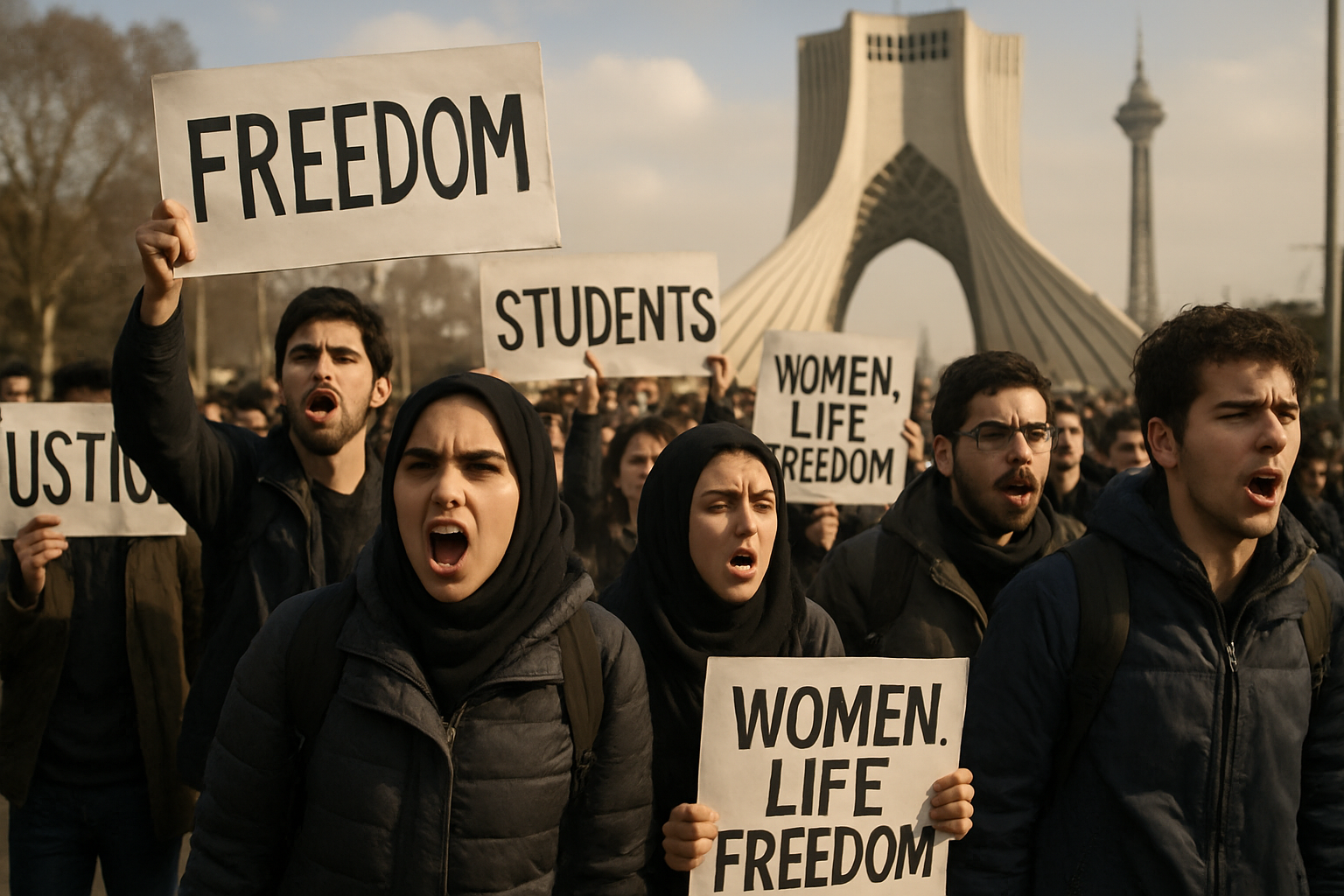
Iranian university students mounted fresh protests against the government in Tehran on Saturday, chanting anti-regime slogans and confronting pro-government forces, as ordinary citizens across the capital brace for the possibility of renewed military conflict with the United States amid stalled nuclear negotiations.
The latest demonstrations occurred as Tehran resident Hamid, like many in the Iranian capital, struggles with sleepless nights and mounting anxiety about potential warfare. "I don't sleep well at night even while taking pills," Hamid told international media, expressing deep concern for his "family's health... my kids and grandchildren."
The current tensions echo the devastating 12-day war between Iran and Israel that erupted from June 12-13, 2025, when Israel launched an unprecedented military campaign against Iranian nuclear facilities. The conflict, which later expanded to include limited US participation, resulted in thousands of Iranian casualties and dozens of Israeli deaths, leaving lasting psychological scars on Tehran's population.
Student Movement Defies Government Crackdown
Saturday's student protests in Tehran mark the latest chapter in an ongoing resistance movement that has persisted despite severe government repression. According to intelligence reports, Iranian authorities have arrested more than 42,000 protesters since the nationwide uprising began in 2022, with thousands killed in violent crackdowns.
The demonstrations coincided with memorial gatherings honoring victims of previous government violence, creating a dual purpose of political resistance and commemoration. French media reports indicated students were "chanting anti-government slogans at rallies commemorating thousands killed during last month's demonstrations."
The resilience of Iran's student movement has drawn international attention, particularly as it continues operating despite systematic oppression. University campuses have historically served as centers of political activism in Iran, and the current protests demonstrate the persistence of opposition sentiment among the country's youth.
Nuclear Diplomacy at Breaking Point
The domestic unrest unfolds against the backdrop of increasingly fragile nuclear negotiations between Iran and the United States. Following talks in Geneva that achieved what Iranian Foreign Minister Abbas Araghchi described as "broad agreement on guiding principles," fundamental disagreements persist that threaten the diplomatic process.
Iran continues enriching uranium at 60% purity—significantly above the 3.67% limit established in the 2015 Joint Comprehensive Plan of Action (JCPOA) and approaching the 90% threshold required for weapons-grade material. Despite diplomatic progress, Araghchi has maintained Iran's hardline position, declaring the country will "never abandon uranium enrichment even if war is imposed."
"We will not yield to excessive demands on uranium enrichment while remaining open to verification mechanisms that prove we are not seeking nuclear weapons."
— Abbas Araghchi, Iranian Foreign Minister
The scope of negotiations remains a critical stumbling block. Iran insists on limiting talks to nuclear issues only, excluding its ballistic missile program and support for regional proxy groups as "red lines." However, US Secretary of State Marco Rubio demands a comprehensive agreement addressing missiles, armed groups, and human rights—the same structural disagreement that has prevented breakthrough agreements for over a decade.
Military Tensions Escalate
The diplomatic stalemate occurs amid unprecedented military escalation in the Persian Gulf. The United States has deployed a dual-carrier strike force consisting of the USS Gerald R. Ford and USS Abraham Lincoln, creating the largest American naval presence in the Middle East in years. Positioned approximately 800 kilometers from Iran's coast, this represents roughly one-third of the active US Navy fleet concentrated in the region.
Recent military incidents have heightened tensions further. An F-35C fighter jet from the USS Abraham Lincoln shot down an Iranian Shahed-139 drone in the Arabian Sea after the unmanned aircraft aggressively approached the carrier. Simultaneously, Iranian Revolutionary Guard Corps (IRGC) vessels harassed a US-flagged tanker in the strategically vital Strait of Hormuz, through which 40% of global oil transit passes.
These incidents have contributed to oil price volatility, with markets rising more than $1 per barrel on escalation fears. The economic implications extend well beyond the immediate region, as any disruption to Persian Gulf shipping lanes could affect global energy supplies and consumer prices worldwide.
Regional Coalition Supports Diplomacy
Despite the mounting tensions, an unprecedented regional coalition has emerged to support continued diplomatic engagement. Saudi Arabia, the United Arab Emirates, Qatar, and Egypt—traditionally opposing powers in Middle Eastern politics—have all endorsed the negotiation framework, representing remarkable consensus among regional actors.
Oman has proven essential in this diplomatic architecture, leveraging its historical role as a neutral mediator from the successful 2015 JCPOA negotiations. The sultanate's facilitation has enabled structured dialogue despite the significant trust deficit between Iranian and American negotiators.
This regional investment in conflict prevention reflects shared energy security concerns, given that Persian Gulf stability is crucial for global oil markets and regional economic prosperity.
Domestic Repression Continues During Talks
The Iranian government's response to ongoing protests has remained severe even as it engages in nuclear diplomacy. Most notably, Nobel Peace Prize laureate Narges Mohammadi was sentenced to an additional 7.5 years in prison during the current round of negotiations, drawing international condemnation.
Mohammadi, imprisoned for her human rights activism, represents the broader crackdown on civil society that has accompanied Iran's nuclear standoff. Her continued detention despite international pressure demonstrates the regime's prioritization of domestic control over diplomatic progress.
The systematic suppression has not diminished protest activities, however. University students continue organizing demonstrations that serve both as political action and memorial events for previous victims of government violence. Videos from recent protests show students directly confronting pro-government Basij militia forces at multiple campuses, including the prestigious Sharif University of Technology in Tehran.
International Stakes Mount
The current crisis occurs within a broader context of global nuclear governance challenges. The New START treaty between the United States and Russia expired on February 5, 2026, marking the first time in over 50 years that the two nuclear superpowers operate without bilateral arms control constraints. Meanwhile, China's nuclear expansion adds additional complexity to multilateral non-proliferation efforts.
Israeli coordination with the Trump administration has emphasized comprehensive security requirements, with Prime Minister Netanyahu insisting that any agreement must include "limiting ballistic missiles and ending Iranian axis support." Nuclear-only frameworks are viewed as insufficient for addressing what Israel considers existential security threats from Iran's integrated missile and proxy network, including Hezbollah, Hamas, and the Houthis.
UN Secretary-General António Guterres has warned that current nuclear risks are "higher than they have been for decades," underscoring the global implications of the Iran crisis. Success in these negotiations could provide a template for 21st-century nuclear crisis resolution, while failure might accelerate military solutions that could reshape Middle Eastern geopolitics for decades.
Economic Warfare Alongside Diplomacy
The Trump administration has maintained its "maximum pressure" campaign even while engaging diplomatically, threatening 25% tariffs on countries that trade with Iran. This dual-track approach of economic coercion combined with selective engagement reflects the administration's strategy of negotiating from a position of strength.
For Iran, domestic economic pressures from sanctions create a regime survival imperative for sanctions relief. However, the government appears to prioritize maintaining nuclear capabilities over immediate economic benefits, calculating that strategic leverage may ultimately provide better long-term security than compromise.
Verification Challenges Loom
Any eventual agreement would face unprecedented technical challenges. Iran's nuclear infrastructure has expanded significantly since the 2018 JCPOA collapse, including advanced centrifuge technology, sophisticated facilities, and 60% enrichment capabilities that did not exist during the original framework.
Intelligence assessments indicate Iran now possesses sufficient enriched uranium for multiple weapons if it chooses to weaponize its program. The monitoring mechanisms required would far exceed the complexity of the original JCPOA, requiring years of implementation and trust-building between historically antagonistic parties.
Critical Juncture Ahead
The coming weeks represent a decisive test of whether innovative diplomatic solutions can bridge decade-old fundamental disagreements or whether military confrontation becomes inevitable. Both sides have demonstrated willingness for sustained engagement despite significant trust deficits and ongoing military tensions.
The framework progress achieved in Geneva represents genuine advancement in establishing continued negotiation structures. However, substantive positions on uranium enrichment, missile capabilities, regional activities, and sanctions relief remain largely unchanged from the challenges that have prevented breakthrough agreements since 2018.
For ordinary Iranians like Hamid in Tehran, caught between domestic repression and international conflict risks, the stakes could not be higher. The student protesters courageously taking to the streets represent not only resistance to authoritarian rule but also the hopes of a generation for a different future—one where political expression is possible and military conflict can be avoided through diplomatic engagement.
As the international community watches this critical juncture unfold, the success or failure of these efforts will likely set precedents for nuclear crisis resolution in an increasingly multipolar world, with implications extending far beyond the current administration and affecting global governance mechanisms for years to come.