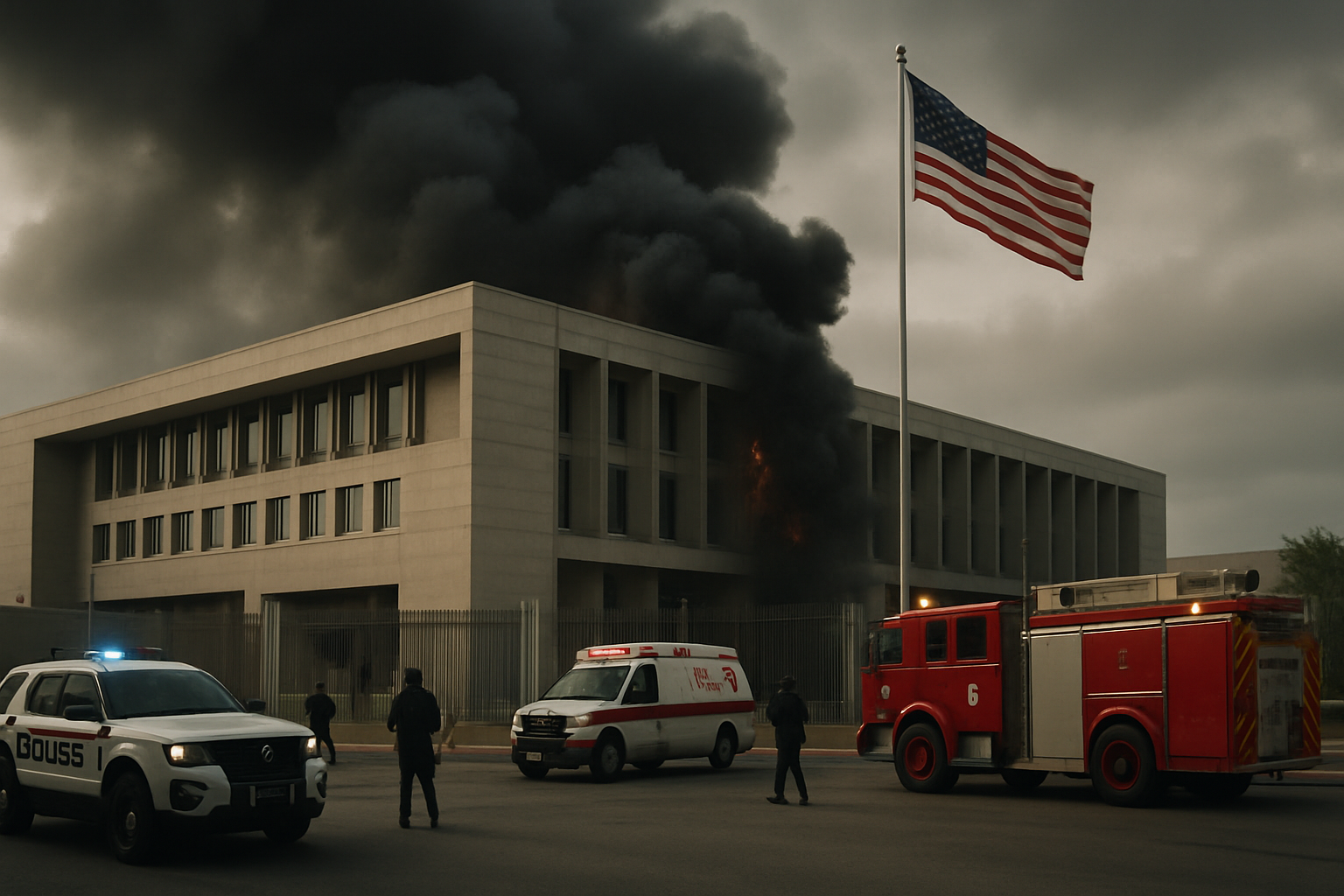
Iranian Revolutionary Guard forces launched coordinated drone attacks against US diplomatic facilities across the Gulf region on March 3, 2026, marking the most significant targeting of American diplomatic infrastructure in the Middle East since the collapse of nuclear negotiations despite achieving "broad agreement on guiding principles."
The attacks, part of Iran's expanded "Operation True Promise 4" retaliation campaign, struck the US consulate in Dubai, embassy in Riyadh, and consular facilities in Kuwait, representing a dangerous escalation from military installations to civilian and diplomatic targets. The Islamic Revolutionary Guard Corps (IRGC) declared "no red lines remain" following the largest US-Israeli coordinated military operation since 2003.
Confirmed Attacks Across Multiple Nations
Saudi Arabia's Ministry of Defense reported two Iranian drones struck the US embassy compound in Riyadh at 5:30 AM local time, causing limited fire and material damage but no casualties. US Secretary of State Marco Rubio confirmed that all personnel at the diplomatic mission were accounted for, with local emergency teams successfully extinguishing the resulting blaze.
In Dubai, an unmanned aerial vehicle struck a parking lot adjacent to the United States Consulate, sparking a limited fire but resulting in no casualties. Witnesses reported seeing smoke rising from the area, while Dubai authorities quickly contained the incident. The strike occurred as thousands of international travelers remained stranded at Dubai International Airport following its complete shutdown due to missile damage from earlier Iranian strikes.
Kuwait International Airport Terminal 1 was hit by Iranian drones, causing employee injuries and forcing the suspension of all flights. Three military personnel were wounded at the nearby Ali Al Salem Air Base, according to Kuwaiti officials. The US Embassy in Kuwait was subsequently closed "until further notice," citing "ongoing regional tensions," with all consular appointments cancelled.
"This represents a significant escalation from military installations to civilian and diplomatic targets, crossing red lines in international law regarding diplomatic immunity."
— Senior US State Department Official
Operation True Promise 4 Expansion
The diplomatic facility attacks form part of Iran's broader "Operation True Promise 4" retaliation campaign launched following the confirmed death of Supreme Leader Ali Khamenei in US-Israeli strikes on March 1-2, 2026. The IRGC's declaration that "no red lines remain" has fundamentally altered the rules of engagement, with all US and Israeli assets now considered "legitimate targets."
The strikes represent a departure from traditional Middle Eastern conflict patterns, where diplomatic facilities have generally been considered off-limits despite broader military confrontations. International law experts note this targeting violates the Vienna Convention on Diplomatic Relations, which guarantees the inviolability of diplomatic premises.
Qatar successfully intercepted 65 missiles and 12 drones using Patriot defense systems, though eight people were injured by falling debris. The UAE reported one civilian killed in Abu Dhabi from missile fragments, while Bahrain's Fifth Fleet headquarters was targeted in the expanding regional campaign.
Nuclear Diplomacy Collapse Context
The attacks followed the complete breakdown of the most promising US-Iran diplomatic engagement in years. Geneva talks had achieved what Iranian Foreign Minister Abbas Araghchi described as "broad agreement on guiding principles" - the most significant progress since the 2018 JCPOA collapse.
However, fundamental scope disagreements proved insurmountable. Iran maintained ballistic missiles and regional proxy activities as "red lines" excluded from nuclear-only talks, while US Secretary Rubio insisted on comprehensive agreements addressing missiles, armed groups, and human rights. Iran continues enriching uranium at 60% purity with over 400kg of material, approaching the 90% weapons-grade threshold.
The rapid transition from diplomatic framework to military escalation demonstrates the fragility of modern crisis management in the multipolar era. Despite months of intensive negotiations achieving unprecedented progress, structural obstacles dating back decades ultimately prevented breakthrough solutions.
Regional Coalition Under Strain
The unprecedented Saudi Arabia, UAE, Qatar, and Egypt consensus supporting diplomatic processes now faces severe strain as Iranian attacks have directly targeted member territories. Egyptian President Abdel Fattah al-Sisi condemned attacks on "sisterly Arab countries," warning of "comprehensive chaos" if the escalation continues.
This coalition had represented extraordinary Middle Eastern unity in preventing military confrontation, with the Persian Gulf handling 40% of global oil transit creating massive energy security stakes. The UAE's civilian casualty and Kuwait's airport strikes have fundamentally tested this diplomatic consensus.
Oil prices surged 10% to over $80 per barrel as Iran declared the Strait of Hormuz "unsafe," effectively closing the critical chokepoint. Major shipping companies Maersk and MSC suspended operations, with over 150 oil tankers stranded in the Persian Gulf representing billions in cargo value.
Global Aviation and Economic Crisis
The diplomatic facility attacks occurred amid the most comprehensive aviation disruption since COVID-19, with over 18,000 flights cancelled worldwide as Iran, Iraq, Israel, UAE, Qatar, Syria, Kuwait, and Bahrain simultaneously closed airspace. Dubai International Airport, the world's busiest, remains completely shut down following missile damage.
Natural gas prices jumped 24% in Europe and 78% in the United States, while stock markets crashed globally. Pakistan's KSE-100 index suffered its largest single-day decline in history, dropping over 8.97%, while Dow futures fell 400-570 points as energy security concerns dominated trading.
Multiple nations have activated emergency evacuation protocols for their citizens across 15 Middle Eastern countries, representing the largest coordinated international evacuation effort since the Arab Spring in 2011. Sweden and Serbia ordered immediate evacuations from Iran citing "extremely uncertain" security conditions.
"We are witnessing the most dangerous international crisis since the Cold War, with implications extending far beyond the Middle East to global energy security and nuclear governance."
— UN Secretary-General António Guterres
Nuclear Governance Crisis Context
The crisis unfolds against the backdrop of broader nuclear governance breakdown. The New START treaty expired on February 5, 2026 - the first time in over 50 years without US-Russia nuclear constraints. Combined with China's nuclear expansion, UN Secretary-General Guterres warns nuclear risks are at their "highest in decades."
Iran's possession of sufficient enriched uranium for multiple weapons, combined with the collapse of diplomatic frameworks, creates urgency around preventing nuclear proliferation acceleration. The template-setting nature of this crisis affects how future territorial and nuclear disputes may be resolved globally.
International Response
The UN Security Council has convened emergency sessions, with Russia condemning what it calls "reckless actions by Washington and West Jerusalem" as violations of international law. China issued its strongest condemnation in years, describing the targeting of Iran's leadership as a "serious violation of sovereignty."
The European Union activated unprecedented crisis response mechanisms, with Cyprus implementing its national ESTIA evacuation plan for the first time since the protocol was established. Multiple European governments have issued comprehensive travel warnings and emergency protocols.
Historical Significance and Implications
March 3, 2026, represents the most significant direct targeting of US diplomatic facilities in Gulf states since nuclear talks collapsed. The expansion beyond military targets to civilian and diplomatic infrastructure affects international law enforcement credibility and regional security architecture evolution.
This marks a watershed moment in Middle East geopolitics with global implications extending decades beyond current events. The rapid transition from diplomatic breakthrough to military confrontation demonstrates multipolar era crisis management fragility, setting precedents for how territorial sovereignty enforcement and nuclear proliferation prevention mechanisms operate in the 21st century.
The success or failure of containing this escalation will provide a framework for future nuclear crisis resolution or may accelerate military solutions over diplomatic engagement globally, reshaping international approaches to conflict resolution for generations to come.
Current Status and Outlook
The US State Department has urged American citizens across the region to shelter and consider immediate commercial departure while flights remain available. Embassy closures in Kuwait remain indefinite, with multiple European nations following suit with comprehensive evacuations.
The targeting of diplomatic facilities represents what experts describe as crossing a fundamental red line in international relations, potentially triggering broader applications of diplomatic immunity protections and international law enforcement mechanisms. The coming phase will determine whether this remains a contained regional confrontation or escalates into broader Middle Eastern warfare with worldwide implications for energy markets, supply chains, and fundamental principles governing post-WWII international order.