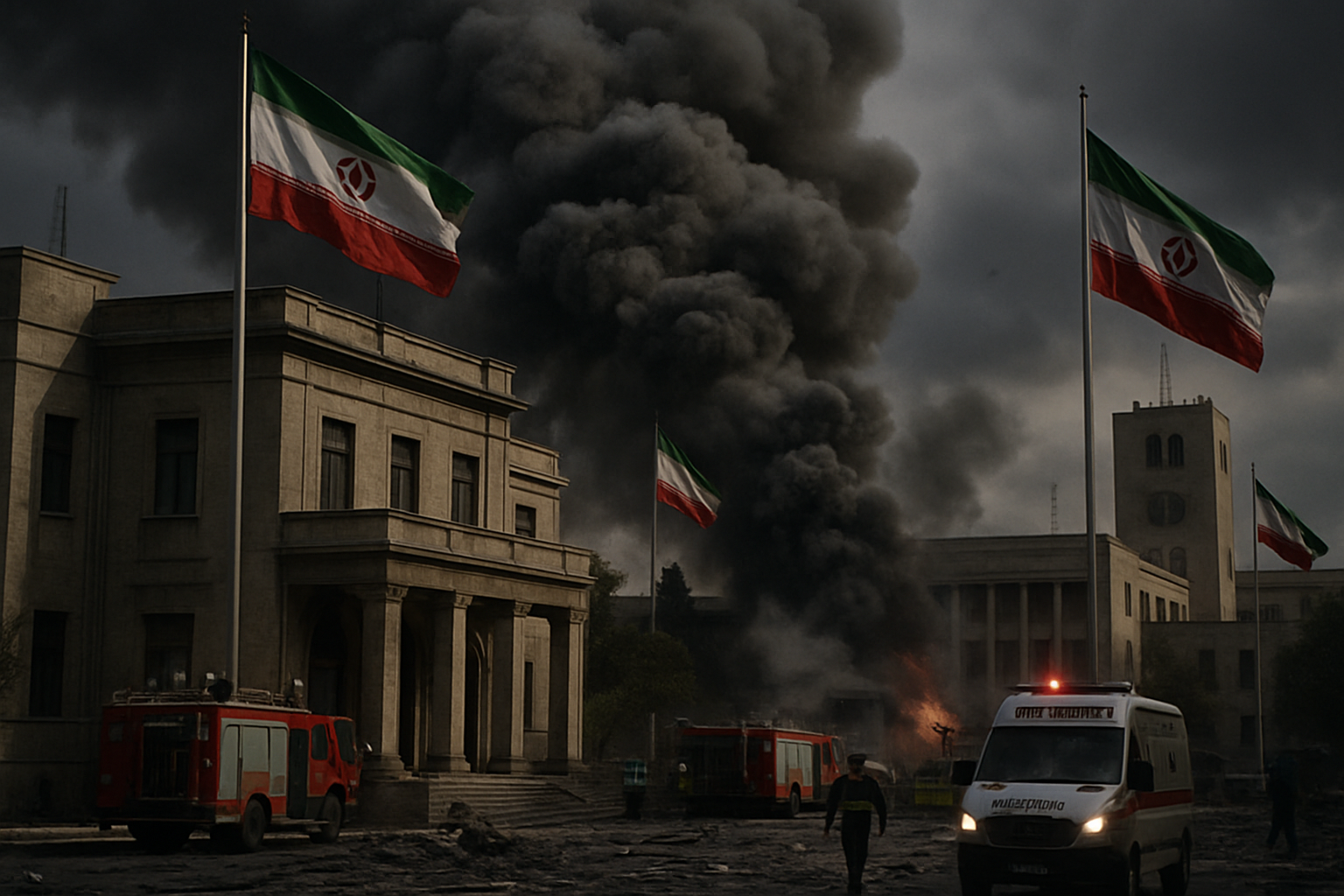
Senior Iranian officials including Supreme Leader Ali Khamenei and Defense Minister Amir Nasirzadeh may have been killed or targeted in coordinated US-Israeli military strikes on Iranian facilities, according to multiple reports from international sources, though Iranian officials strongly deny the claims regarding Khamenei's fate.
Israeli television Channel 12 reported "growing indications" that Iran's 86-year-old Supreme Leader was likely killed in Saturday's strikes, citing unnamed Israeli sources. The broadcaster said its assessment was not based on satellite imagery but on information from undisclosed sources, though no official confirmation has been provided.
Confirmed High-Level Casualties
Iranian Defense Minister Amir Nasirzadeh and Revolutionary Guards Corps (IRGC) commander Mohammed Pakpour are believed to have been killed in the Israeli attacks, according to three sources familiar with Israel's military operations cited by Reuters. These deaths would represent the most significant targeting of Iranian leadership since the Islamic Revolution in 1979.
The strikes followed the complete breakdown of nuclear negotiations between the United States and Iran, despite achieving what Iranian Foreign Minister Abbas Araghchi had called "broad agreement on guiding principles" - the most significant diplomatic progress since the JCPOA collapse in 2018.
"As far as I know, the Supreme Leader is still alive."
— Abbas Araghchi, Iranian Foreign Minister
In an interview with NBC News, Iran's Foreign Minister Abbas Araghchi denied reports of Khamenei's death, stating the Supreme Leader was alive "as far as I know." However, Araghchi acknowledged Iran "may have lost one or two commanders" in the attacks, lending credence to reports about military leadership casualties.
Operation Epic Fury Escalation
The strikes came after President Trump launched what he termed "Operation Epic Fury" - coordinated US-Israeli military operations targeting Iranian government facilities and military infrastructure. Israeli Defense Minister Israel Katz announced "preemptive strikes to eliminate threats against the State of Israel," marking the most significant military escalation in the region since the devastating 12-day Iran-Israel conflict in June 2025.
The operations followed Trump's unprecedented 10-day ultimatum to Iran, warning "bad things will happen" if no meaningful nuclear agreement was reached. The United States had deployed an unprecedented dual-carrier strike force - the USS Gerald R. Ford and USS Abraham Lincoln - representing approximately one-third of the active US Navy fleet positioned 800 kilometers from Iran's coast.
Contact Lost with Iranian Leadership
Israeli officials report that contact has been lost with Iran's Supreme Leader, with his whereabouts and condition unknown. Israeli media have promised to release footage of Khamenei soon, though no such evidence has yet been provided. Iranian security forces have reportedly blocked roads in areas of Tehran where government facilities are located.
Iran's National Security Council has ordered residents of Tehran and other major cities to remain in secure, protected locations until further notice. Mobile phone services in Tehran have been disrupted, and Iran has closed its airspace to civilian traffic completely.
Regional Aviation Crisis
The strikes triggered a massive aviation crisis across the Middle East, with Iran, Iraq, Israel, UAE, and Qatar all closing their airspace to civilian traffic. Major airlines including Emirates, Air France-KLM, Wizz Air, and Bulgarian Air have suspended flights to key Middle Eastern destinations, affecting hundreds of thousands of passengers worldwide.
Nuclear Diplomacy Collapse Context
The military escalation comes despite recent breakthrough progress in nuclear negotiations mediated by Switzerland and Oman. Iran had been enriching uranium at 60% purity - approaching the 90% weapons-grade threshold - while maintaining that ballistic missiles and regional proxy support remained "red lines" excluded from nuclear-only talks.
The fundamental scope disagreement that has prevented agreements for over a decade remained unchanged: Iran demanded nuclear-only talks while the US insisted on comprehensive agreements addressing missiles, armed groups, and human rights issues. Former IAEA inspector Dr. Yusri Abu Shadi had confirmed Iran possessed over 400 kilograms of enriched uranium, making weapons development "easily achievable."
Iranian Retaliation Threats
Iranian officials have declared that "no red lines remain" following the strikes, with Foreign Ministry sources warning that all US and Israeli assets in the region are now considered "legitimate targets." This represents a significant escalation in rhetoric that could herald broader regional retaliation.
The Islamic Revolutionary Guard Corps (IRGC) has claimed to have launched a "first wave" of retaliatory strikes, though details remain limited. Iran had previously warned through its UN Ambassador Amir Saeid Iravani that all US military bases in the Middle East would be considered legitimate targets if Iran was attacked.
Regional Coalition Disrupted
The strikes have severely disrupted an unprecedented regional coalition that included Saudi Arabia, UAE, Qatar, and Egypt - all of whom had been supporting the diplomatic process. This extraordinary Middle Eastern consensus for preventing military confrontation through dialogue now faces severe strain following direct military action.
Global Nuclear Governance Implications
The collapse of intensive diplomatic negotiations into military escalation occurs against the backdrop of a broader nuclear governance crisis. The New START treaty between the US and Russia expired on February 5, marking the first time in over 50 years without US-Russia nuclear constraints. Combined with China's nuclear expansion, UN Secretary-General António Guterres has warned that nuclear risks are at their "highest in decades."
The Iran crisis represents a critical test case for 21st-century diplomatic crisis resolution, with the framework-to-military transition occurring within days of achieving negotiation breakthroughs. The template-setting implications affect global governance mechanisms, territorial sovereignty enforcement, and international law credibility in the multipolar era.
Economic and Energy Security Impact
Oil prices have risen immediately on news of the strikes, with the Strait of Hormuz - through which 40% of global oil transits - now potentially threatened. The Persian Gulf region's stability is crucial for worldwide oil supply chains, and a broader regional conflict could destabilize energy markets globally.
Multiple countries have issued urgent travel warnings, with European allies including the UK, France, Germany, and Poland advising against travel to the region. China has urged its citizens to leave Iran "as soon as possible," while embassy evacuations are underway across the region.
Trump's Regime Change Appeal
In an unprecedented diplomatic move, President Trump directly addressed the Iranian people, urging them to "take control of your country" after military operations conclude. His declaration that "your moment of freedom has arrived" represents a dramatic departure from traditional diplomacy toward explicit political transformation objectives.
This represents the most direct regime change advocacy since Trump took office, signaling a policy evolution from nuclear-focused negotiations to comprehensive political transformation goals. The appeal for popular uprising marks an extraordinary breach of diplomatic norms.
Verification Challenges and Next Steps
The reports of high-level Iranian casualties remain unverified by independent sources, with much of the information coming from Israeli intelligence assessments. Iran's state media has consistently denied reports about Supreme Leader casualties while acknowledging some military commander losses.
The situation remains highly fluid, with the UN Security Council scheduling an emergency session requested by France, Bahrain, China, Russia, and Colombia. Russia has condemned what it terms "reckless actions by Washington and West Jerusalem" as violations of international law.
The coming hours and days will be crucial in determining whether the reported targeting of Iran's highest leadership marks a turning point toward broader regional warfare or represents a calculated escalation designed to force political change in Tehran. The unprecedented nature of the claims, if verified, would represent the most significant targeting of senior Iranian leadership since the 1979 Islamic Revolution.