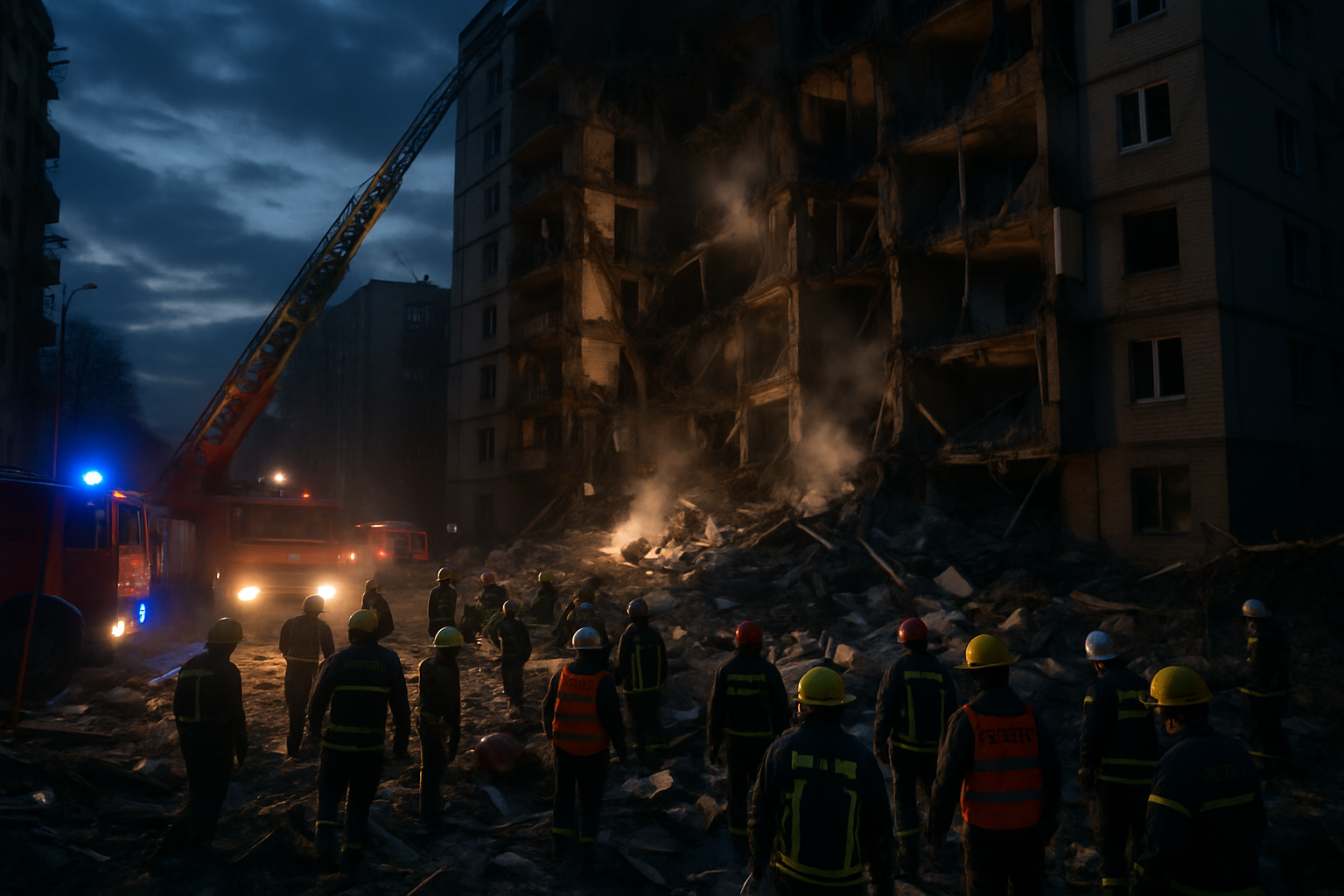
An Iranian missile directly hit a residential building in Haifa, Israel, on Sunday evening, leaving four people trapped under rubble and injuring at least eleven others, including one person in critical condition, as emergency rescue operations continue into the night.
Israeli emergency services Magen David Adom confirmed they are treating an 82-year-old man with serious injuries from falling debris, along with three other people with minor injuries from explosions and shrapnel. Four additional people were treated for acute anxiety following the attack, while search and rescue teams continue working through the night to locate four missing persons believed to be buried under the collapsed sections of the building.
Escalation in Month-Long Conflict
The strike represents one of the most significant direct hits on civilian infrastructure since the Iran-Israel conflict began in February 2026. The attack was part of what Iran's Revolutionary Guard calls "Operation True Promise 4," with Iranian officials maintaining their policy of "no red lines remain" in targeting Israeli territory.
According to Palestinian sources, this latest assault killed at least one Israeli civilian and wounded 14 others, with significant damage reported to residential areas including homes, vehicles, and a children's playground. Despite Israel's Iron Dome defense system intercepting the majority of incoming projectiles, several missiles managed to penetrate the defenses.
International Context and Broader Crisis
The Haifa strike occurs within the context of the most dangerous international crisis since the Cold War, which began with the confirmed death of Iranian Supreme Leader Ali Khamenei on March 1, 2026, during the US-Israeli "Operation Epic Fury." The conflict has since expanded far beyond its original bilateral scope, with devastating global implications.
The wider crisis has resulted in unprecedented disruptions worldwide, including over 18,000 flight cancellations globally - the most severe aviation crisis since COVID-19. Oil prices have surged past $100 per barrel as Iran has effectively closed the Strait of Hormuz through naval mining operations, affecting 40% of global oil transit.
Regional Coalition Under Strain
The escalating conflict has severely strained the unprecedented regional coalition of Saudi Arabia, UAE, Qatar, and Egypt that had previously supported diplomatic solutions. Iranian retaliation has directly targeted these coalition member territories, with Egyptian President Sisi condemning attacks on "sisterly Arab countries" and warning of "comprehensive chaos" spreading across the region.
The succession crisis following Khamenei's death has resulted in his son, Mojtaba Khamenei, becoming the first hereditary Supreme Leader in the Islamic Republic's 47-year history, consolidating Revolutionary Guard control over Iranian governance during active warfare.
Humanitarian and Diplomatic Concerns
International humanitarian organizations have documented mounting civilian casualties throughout the conflict. Iran's Red Crescent reports over 787 civilian casualties from US-Israeli strikes, while attacks like the one in Haifa demonstrate the expanding civilian toll on all sides.
Nuclear diplomacy between Iran and the US has completely collapsed despite what had been described as "broad agreement on guiding principles" - the most significant progress since the JCPOA collapse in 2018. The fundamental disagreement remains Iran's exclusion of ballistic missiles and regional proxies as "red lines" in nuclear-only talks versus US demands for comprehensive agreements including missiles, armed groups, and human rights.
Global Economic Impact
The conflict has triggered unprecedented global economic disruptions. The International Energy Agency has released a record 400 million barrels from strategic petroleum reserves - the largest intervention in the agency's 50-year history. Natural gas prices have surged 24% in Europe and 78% in the United States, while major shipping companies Maersk and MSC have suspended Persian Gulf operations, leaving over 150 tankers stranded with billions in cargo.
Aviation networks worldwide have been severely impacted, with eight Middle Eastern countries maintaining simultaneous airspace closures. Dubai International Airport, the world's busiest, remains completely shut down due to missile damage, while major carriers including Emirates, Air France-KLM, and Wizz Air have suspended operations indefinitely.
European Security Implications
The crisis has expanded beyond Middle Eastern boundaries for the first time since World War II, with Iranian drones striking RAF Akrotiri in Cyprus. This attack prompted an unprecedented naval coalition response, with HMS Dragon and Spanish frigates joined by vessels from Italy, France, the Netherlands, and Greece to protect European territory. The European Union activated its ESTIA evacuation protocol for the first time in the bloc's history.
Congressional and International Response
In the United States, Congressional opposition to the conflict has reached unprecedented levels, with only 25% public support for military operations. Senator Richard Blumenthal expressed being "more concerned than ever" about potential ground troop deployments, while Pentagon operations are now planned through September, far beyond the initial 4-6 week timeline.
Operation Epic Fury has cost $11.3 billion in its first week alone, with 150 US troops wounded and three confirmed killed - the first American deaths in the largest Middle East operation since 2003.
Looking Ahead
As rescue operations continue in Haifa and diplomatic channels remain severed, the international community faces what UN Secretary-General António Guterres has called "the greatest test of multilateral cooperation in the modern era." The crisis represents a template-setting moment for 21st-century international relations, determining whether diplomatic or military solutions will serve as the precedent for future territorial and nuclear disputes worldwide.
The stakes extend far beyond the immediate participants, affecting global energy security, nuclear governance credibility, and the enforcement of international law principles established after World War II. Success in containing the crisis could provide a framework for future nuclear crisis resolution, while failure may accelerate military solutions and encourage proliferation globally, undermining diplomatic credibility worldwide.