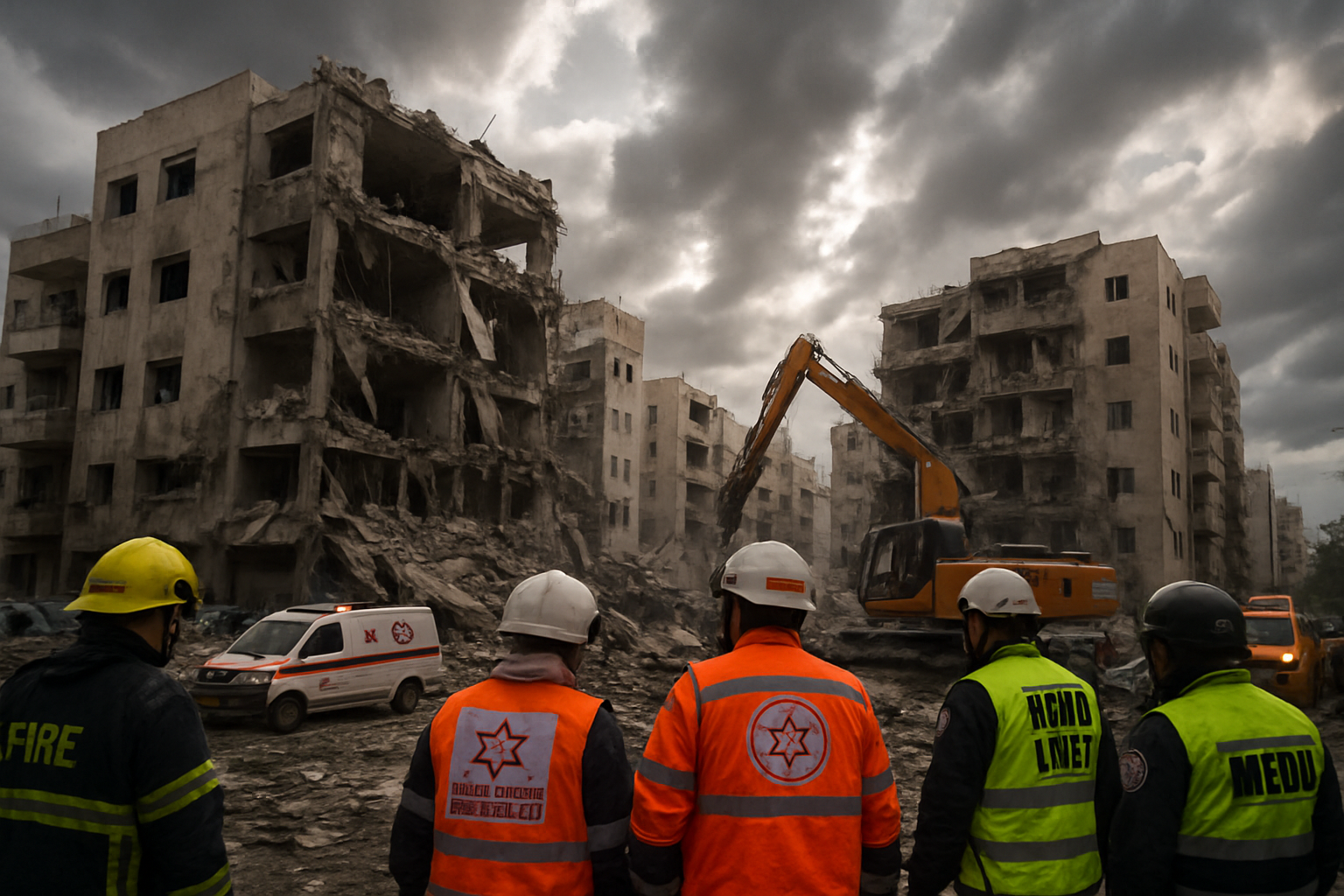
Iran launched devastating hypersonic missile strikes on the Israeli cities of Dimona and Arad Saturday evening, injuring over 180 people in what marks the most dangerous escalation of the three-week Middle East conflict. The strikes near Israel's primary nuclear research facility represent an unprecedented crossing of red lines in nuclear infrastructure targeting.
According to multiple international sources, at least 75 people were injured in Arad with 10 in serious condition, while 33 were wounded in Dimona. The attacks occurred Saturday evening as part of Iran's ongoing "Operation True Promise 4" systematic retaliation campaign following the death of Supreme Leader Ali Khamenei on March 1.
Nuclear Facility Proximity Raises Global Alarm
The strike near Dimona is particularly significant as the city houses Israel's Shimon Peres Negev Nuclear Research Center, the country's primary nuclear installation since the 1960s. While the International Atomic Energy Agency (IAEA) confirmed no damage to the nuclear reactor itself, Director General Rafael Grossi called for "maximum restraint" to avoid nuclear accidents.
"This represents the first time Iranian missiles have penetrated Israeli air defense systems in the area around a key nuclear site," according to Al Jazeera's reporting from the scene. The targeting pattern demonstrates a dangerous escalation from conventional military strikes to threats against critical nuclear infrastructure.
Iranian forces used advanced Khorramshahr-4 and Qadr missiles equipped with cluster warheads carrying half-ton explosive payloads. The hypersonic capabilities and unconventional flight patterns successfully penetrated Israeli air defenses, marking a significant technological achievement for Iranian missile forces.
Broader Regional War Context
The strikes are part of a broader three-week conflict that began with "Operation Epic Fury," the largest US-Israeli coordinated military campaign since the 2003 Iraq invasion. The war has already claimed over 1,300 casualties and triggered the most severe global crisis since the Cold War.
"This was one of the most dramatic escalations since the beginning of the war,"
— Iranian State Television, describing Saturday's attacks
Iranian state television justified the attacks as a "response" to what it termed an earlier strike on Iran's uranium enrichment complex at Natanz. The Islamic Revolutionary Guard Corps has declared "no red lines remain" in its systematic targeting of Israeli and allied positions across the region.
Global Crisis Intensifies
The missile strikes occur amid an unprecedented global crisis affecting energy markets, aviation networks, and international stability. Over 18,000 flights have been canceled worldwide—the most extensive disruption since COVID-19—as eight Middle Eastern countries maintain simultaneous airspace closures.
Oil prices have surged past $100 per barrel, heading toward warnings of $200, as Iran has effectively closed the Strait of Hormuz with naval mines, blocking 40% of global oil transit. The International Energy Agency released a record 400 million barrels from strategic reserves, the largest intervention in the agency's 50-year history.
The conflict has also seen the first attack on European territory since World War II, with Iranian drones striking RAF Akrotiri in Cyprus. This prompted an unprecedented naval coalition response, with HMS Dragon and vessels from Spain, Italy, France, the Netherlands, and Greece deploying to protect Europe.
Humanitarian and Political Implications
The humanitarian toll continues to mount, with Iran's Red Crescent reporting 787 civilian casualties from US-Israeli strikes. International evacuations are underway on a scale not seen since the Arab Spring of 2011, with Australia reporting 115,000 nationals trapped and Germany 30,000 stranded tourists.
In the United States, Congressional scrutiny is intensifying with bipartisan lawmakers demanding answers about strategy, costs, and potential ground troop deployment. Senator Richard Blumenthal stated he was "more concerned than ever" about the prospect of "boots on the ground." The conflict's unpopularity stands at "almost unprecedented" levels for early-stage military operations, with only 25% American public support.
Nuclear Governance Crisis
The crisis unfolds amid a broader nuclear governance breakdown. The New START treaty expired in February 2026—the first time in over 50 years without US-Russia nuclear constraints—while China expands its nuclear capabilities. UN Secretary-General António Guterres has declared nuclear risks are at their "highest in decades."
Iran continues uranium enrichment at 60% purity with over 400kg of weapons-grade material, sufficient for multiple weapons. The current military confrontation emerged from the complete breakdown of Geneva negotiations despite achieving "broad agreement on guiding principles"—the most progress since the 2018 JCPOA collapse.
International Responses
President Trump has demanded Iran's "unconditional surrender" and claims the right to personally choose Iran's next Supreme Leader, rejecting Mojtaba Khamenei (the late Supreme Leader's son) as a "lightweight." This represents the most direct assertion of American control over Iranian affairs since 1979.
The regional coalition of Saudi Arabia, UAE, Qatar, and Egypt that had supported diplomacy is severely strained as Iranian retaliation targets their territories. Egyptian President Sisi condemned attacks on "sisterly Arab countries," warning of "comprehensive chaos" spreading across the region.
Looking Ahead
UN Secretary-General Guterres has called this "the greatest test of multilateral cooperation and crisis management in the modern era." The rapid transition from diplomatic breakthrough to military escalation demonstrates the fragility of crisis management in the multipolar era.
The stakes include regional war prevention, global energy security, nuclear governance credibility, and international law enforcement of post-WWII order principles—all tested simultaneously. Success in containing the crisis could provide a nuclear crisis resolution framework for the future; failure may accelerate military solutions for decades, encouraging proliferation globally and undermining diplomatic credibility worldwide.
As the conflict enters its fourth week, the targeting of nuclear infrastructure proximity represents a watershed moment in 21st-century conflict resolution, with implications extending far beyond the Middle East to affect international relations for decades to come.