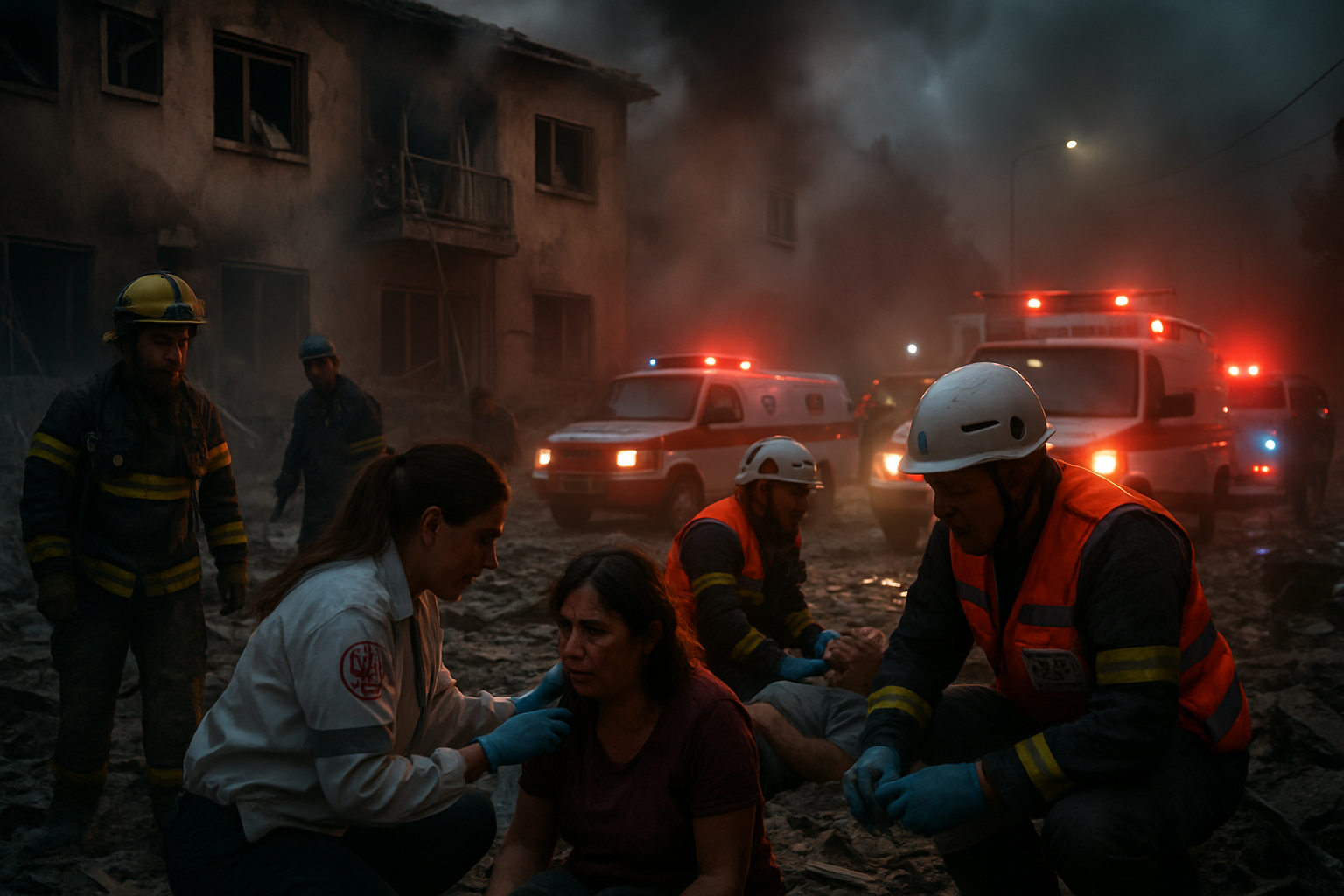
Iranian forces launched devastating missile strikes on two southern Israeli cities Saturday evening, injuring over 175 people in what has become the most destructive attack of the ongoing three-week Middle East conflict.
The strikes targeted the towns of Arad and Dimona, with one missile hitting directly near Israel's nuclear research facility in Dimona, raising unprecedented concerns about the escalation toward critical infrastructure. The attack represents a significant escalation in Iran's "Operation True Promise 4" campaign, which has systematically targeted Israeli cities and U.S. military installations across the region.
Devastation in Arad and Dimona
According to first responders and Israeli media reports, 75 people were injured in Arad, with 10 in serious condition. The Iranian ballistic missile created a massive crater between residential buildings, tearing open facades and leaving entire blocks with heavy damage. Hours earlier, 33 people were wounded in nearby Dimona when another missile gouged a large hole into the ground next to piles of rubble and twisted metal.
Seventeen-year-old Ido Franky, who was sheltering with his family during the attack on Arad, described hearing "terrifying" blasts like nothing he had experienced before. "There was a 'boom, boom!' and my mother was screaming," he recounted, reflecting the trauma experienced by civilians across the affected areas.
Italian media sources reported the total casualty count at 175 injured across both cities, with 11 in grave condition. The proximity of the Dimona strike to Israel's primary nuclear research facility - the Shimon Peres Negev Nuclear Research Center - has drawn international concern about potential nuclear safety risks.
Three-Week War Context
These attacks come as part of the broader Iran-Israel conflict that began on March 1, 2026, following the death of Iranian Supreme Leader Ali Khamenei in a coordinated U.S.-Israeli operation codenamed "Operation Epic Fury." The conflict has since expanded into what experts describe as the most dangerous international crisis since the Cold War ended.
The war has already claimed over 1,300 lives according to various sources, with Iran's Red Crescent reporting 787 civilian casualties from U.S.-Israeli strikes. The conflict has disrupted global aviation with over 18,000 flights cancelled worldwide, caused oil prices to surge past $100 per barrel, and prompted the largest international evacuation since the Arab Spring of 2011.
"We are witnessing the most dangerous moment since the Cold War ended. This crisis affects not just the Middle East but global energy security, nuclear governance, and international stability mechanisms."
— UN Secretary-General António Guterres
Nuclear Infrastructure Concerns
The strike near Dimona's nuclear facility has raised alarm among international observers. While the International Atomic Energy Agency (IAEA) confirmed no damage to the actual nuclear reactor, the targeting of areas near critical nuclear infrastructure represents an unprecedented escalation in modern warfare.
IAEA Director General Rafael Mariano Grossi called for "maximum restraint" to avoid nuclear accidents, emphasizing the importance of protecting civilian nuclear facilities during armed conflict. The Dimona facility, operational since the 1960s, houses Israel's primary nuclear research center and has been a closely guarded strategic asset.
Regional and Global Impact
The Iranian missile campaign has extended far beyond bilateral Israeli-Iranian hostilities. Under what Tehran calls "no red lines remain" policy, Iran has struck targets across the Gulf region, including:
- UAE: 1 civilian killed in Abu Dhabi, Dubai International Airport shut down
- Kuwait: 32 foreign nationals injured in airport drone strikes
- Qatar: 8 injured despite successfully intercepting 65 missiles and 12 drones
- Cyprus: RAF Akrotiri base attacked - the first European territory struck since World War II
The expansion to European territory prompted an unprecedented naval coalition response, with HMS Dragon and Spanish frigates joining vessels from Italy, France, Netherlands, and Greece in protecting Cyprus waters.
Economic and Energy Crisis
The conflict has triggered a global energy crisis as Iran has effectively closed the Strait of Hormuz - through which 40% of global seaborne oil transits - by deploying thousands of naval mines. Over 150 oil tankers worth billions of dollars remain stranded in the Persian Gulf as major shipping companies Maersk and MSC have suspended operations.
The International Energy Agency has released a record 400 million barrels from strategic petroleum reserves in its largest intervention in the agency's 50-year history. Natural gas prices have surged 24% in Europe and 78% in the United States, while airlines are implementing emergency fuel surcharges as jet fuel costs have jumped from $85-90 per barrel to $150-200.
Diplomatic Breakdown and Military Response
The current military escalation emerged from the complete collapse of nuclear negotiations in Geneva, despite achieving what diplomats described as a "broad agreement on guiding principles" - the most progress since the 2018 JCPOA breakdown. The fundamental sticking point remained Iran's exclusion of ballistic missiles and regional proxy groups as "red lines" versus U.S. demands for comprehensive agreements.
President Trump has demanded Iran's "unconditional surrender" and claimed the right to personally choose Iran's next Supreme Leader, rejecting the hereditary succession of Mojtaba Khamenei as "lightweight." This represents the most direct assertion of American control over Iranian affairs since the 1979 revolution.
Operation Epic Fury, the ongoing U.S.-Israeli campaign, has cost $11.3 billion in its first week and involved the largest Middle East naval deployment since 2003, with two aircraft carriers representing approximately one-third of the active U.S. Navy fleet positioned near Iranian waters.
Congressional Scrutiny and Public Opposition
The conflict faces mounting opposition in the U.S. Congress, with bipartisan lawmakers demanding answers about strategy, costs, and potential ground troop deployment. Senator Richard Blumenthal has expressed being "more concerned than ever" about the possibility of American boots on the ground.
Public support for the military operation remains historically low at just 25% among Americans, while the Pentagon has quietly prepared operations extending through September - far beyond the initial 4-6 week timeline outlined by the White House.
International Response and Nuclear Governance Crisis
The crisis occurs against the backdrop of a broader nuclear governance breakdown, with the New START treaty between the U.S. and Russia having expired on February 5, 2026 - marking the first time in over 50 years without bilateral nuclear constraints between the superpowers.
Iran continues enriching uranium to 60% purity with over 400 kilograms of weapons-grade material, sufficient for multiple nuclear weapons if weaponized. The collapse of the most promising diplomatic opening in years raises fundamental questions about the viability of negotiated solutions to modern nuclear crises.
Looking Ahead
As the conflict enters its fourth week, experts warn that the current trajectory could lead to a broader regional war with global implications extending decades beyond the immediate crisis. The template-setting nature of this confrontation will likely influence international approaches to conflict resolution, energy security, and nuclear governance for years to come.
The humanitarian toll continues mounting, with the largest international evacuation effort since the Arab Spring of 2011 underway. Australia has 115,000 nationals trapped in the region, while Germany has 30,000 stranded tourists, highlighting the global reach of this Middle Eastern crisis.
What began as a bilateral confrontation has evolved into what UN Secretary-General Guterres has called "the greatest test of multilateral cooperation and crisis management in the modern era," with implications that will reshape international relations and conflict resolution mechanisms well into the 21st century.