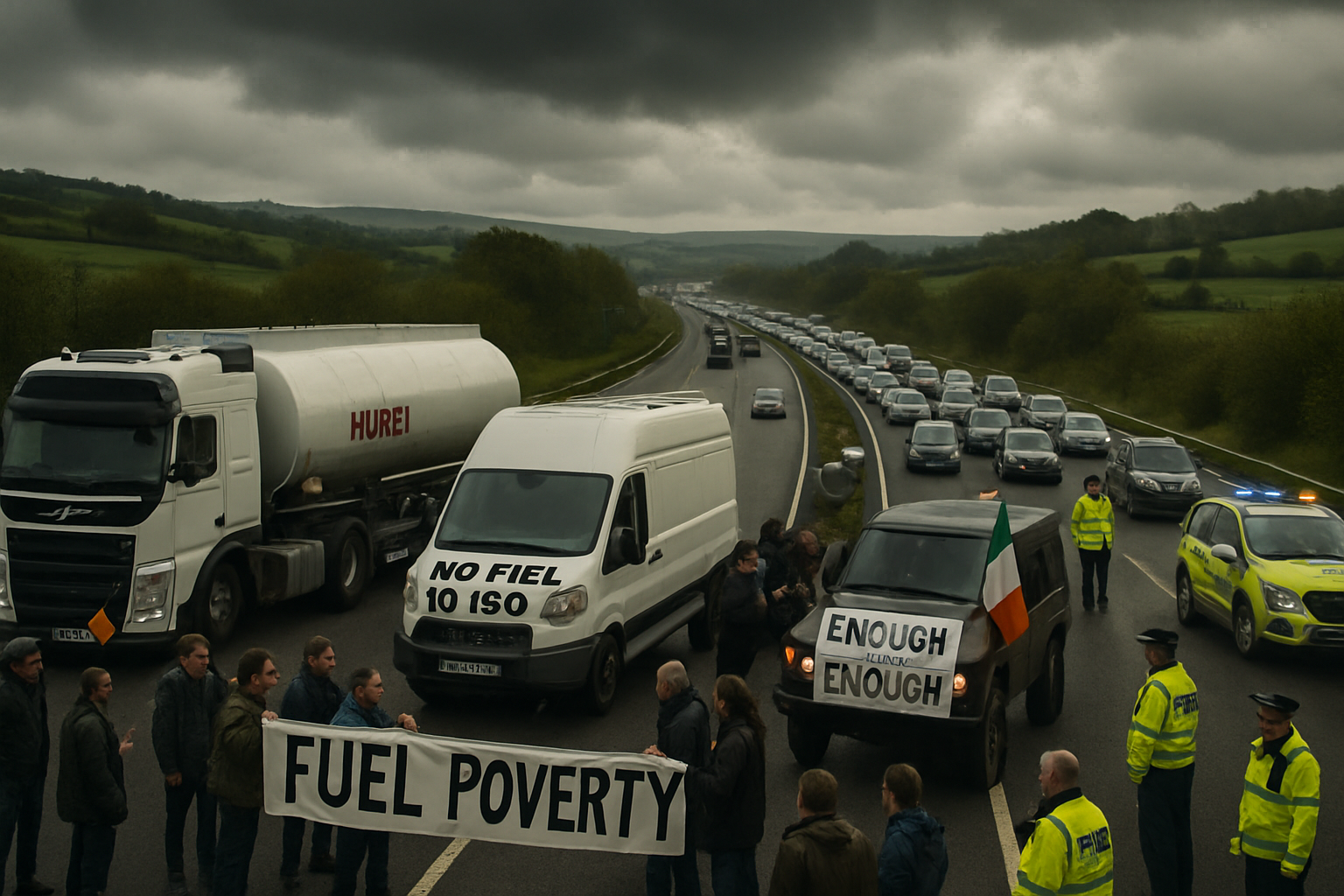
Ireland's fuel crisis has reached unprecedented levels as coordinated blockades at major refineries have forced widespread closure of service stations across the country, with protesters demanding immediate government action on soaring energy costs.
The crisis, now in its fourth consecutive day, has brought major Irish motorways to a virtual standstill, with protesters blocking the M50, M1, M7, M8, and M18 routes in what represents the largest civil unrest over energy costs since the 1970s oil crisis. Over a third of Ireland's approximately 1,500 service stations have run dry, creating critical supply shortages that are affecting essential services and emergency response capabilities.
Government Emergency Response Insufficient
Despite the Irish government's emergency €235 million fuel relief package announced in March 2026 - which included cuts of 20 cents per liter for diesel and 15 cents for petrol - protesters argue the measures are wholly inadequate to address the scale of the crisis. The package, described by transport operators as "a drop in the ocean," has failed to stem the mounting anger over fuel costs that have reached nearly €2 per liter for heating oil.
Transport industry representatives report that fuel costs for commercial operators have skyrocketed from €120-130 to €190 per tank fill, adding between €2,000-3,000 in weekly business expenses. The financial pressure has forced many operators to consider shutting down services entirely, threatening the collapse of Ireland's public transport and logistics networks.
"We are facing the complete breakdown of our transport system. What the government has offered is nowhere near enough to keep businesses alive,"
— Transport Industry Representative
Critical Infrastructure Under Pressure
The fuel shortages are having cascading effects across critical infrastructure. Dublin Bus services have experienced severe delays, while Luas tram services face significant disruptions. Hospital appointments are being delayed, creating what officials describe as "unnecessary heartache" for families attempting to access medical services.
The An Garda Síochána has declared the situation an "exceptional event," with emergency services struggling to maintain normal operations as fuel supplies dwindle. The protests have effectively curtailed the delivery of vital goods, including medical supplies and food, across affected regions.
Global Energy Crisis Context
Ireland's fuel crisis cannot be divorced from the broader global energy emergency that has gripped the world since Iran's Revolutionary Guard declared the Strait of Hormuz "unsafe for shipping" in February 2026. The closure of this critical waterway, through which 40% of global oil transit passes, has triggered the most severe energy crisis since the 1970s oil shocks.
Oil prices reached historic peaks of $119.50 per barrel for Brent crude and $108.15 for WTI - a record 18.98% single-day jump that marked the first time prices breached $100 per barrel since 2022. The International Energy Agency responded with the largest strategic petroleum reserve release in its 50-year history, deploying 400 million barrels from 32 countries, but these emergency measures have provided only limited relief to consumer prices.
European Coordination Efforts
Ireland's crisis mirrors similar situations across Europe, where governments have implemented unprecedented emergency interventions. Hungary imposed immediate price caps to protect consumers from "war-driven explosions" in fuel costs, while France deployed 500 fuel station inspectors to prevent price manipulation. Romania developed five comprehensive scenarios to prevent diesel from exceeding 10 lei per liter, and Slovakia activated its strategic petroleum reserves for the first time under current protocols.
Public Support Despite Personal Impact
Despite the significant personal inconvenience caused by the blockades, polling suggests a complex public response to the protests. Many Irish citizens express understanding for the protesters' grievances, even as they struggle with the practical impacts of fuel shortages on their daily lives.
The demonstrations have attracted support from farmers, truckers, taxi drivers, and bus operators - sectors that have been disproportionately affected by the surge in energy costs. However, the government has maintained its position that while it respects the right to peaceful protest, the blockades preventing access to essential services cross legal boundaries.
Economic Implications
The fuel crisis comes at a time when Ireland's economy is already under significant pressure from global inflation and supply chain disruptions. Lower-income households are being disproportionately affected, as heating oil approaches €2 per liter - costs that industry critics describe as "brazen rip-offs."
The broader economic implications extend beyond immediate fuel costs. The disruption to transport networks threatens Ireland's position as a logistics hub for multinational companies, while tourism - a crucial sector for the Irish economy - faces potential long-term damage if the crisis continues through the critical summer season.
International Ramifications
Ireland's fuel crisis is part of a worldwide pattern of energy-related civil unrest that has emerged since the global oil supply disruption began. Countries across Europe, Asia, and Africa have witnessed similar protests, with governments implementing emergency measures ranging from fuel rationing to comprehensive price controls.
The crisis has exposed what energy security experts describe as dangerous vulnerabilities in global supply chains that depend heavily on strategic chokepoints. Samuel Ciszuk, a leading energy analyst, characterizes the current situation as "the most severe energy security crisis in decades, exposing single-chokepoint vulnerabilities that were previously assumed away."
Government Negotiations and Future Prospects
Behind closed doors, the Irish government is reportedly in intense negotiations with protest leaders, though both sides acknowledge significant distrust. Opposition parties are calling for the government to engage more constructively with demonstrators, while Cabinet ministers condemn the blockades as preventing mobility and threatening livelihoods.
The protesters have secured preliminary meetings with government officials and announced they would ease some blockades while maintaining pressure for comprehensive fuel tax reform. However, the fundamental demand for substantial reductions in excise duties and carbon taxes remains a major sticking point for a government committed to climate change targets.
Long-Term Energy Security Questions
The crisis has raised fundamental questions about Ireland's energy security and its heavy dependence on imported fuels. Unlike countries such as Norway, which benefit from domestic oil production, Ireland's exposure to global energy market volatility leaves it particularly vulnerable to supply disruptions.
Energy experts are calling for accelerated investment in renewable energy infrastructure and enhanced strategic fuel reserves to reduce Ireland's vulnerability to future crises. However, the transition to renewable energy systems requires years or decades of implementation, leaving Ireland dependent on global fossil fuel markets for the foreseeable future.
Resolution Uncertain
As the crisis enters its fourth day, resolution remains uncertain. The government faces a delicate balancing act between providing sufficient relief to end the protests and maintaining fiscal discipline in the face of competing demands for public spending.
The protest movement shows no signs of weakening, with organizers warning that blockades could continue indefinitely unless the government provides "meaningful" relief. The situation represents a critical test of Ireland's crisis management capabilities and could set precedents for how European governments respond to energy-related civil unrest.
With over 600 of Ireland's 1,500 service stations now dry and essential services under increasing strain, the coming days will be crucial in determining whether negotiation or escalation defines the path forward. The resolution of Ireland's fuel crisis may well serve as a template for addressing similar energy-related challenges across Europe in an era of increasing global instability.