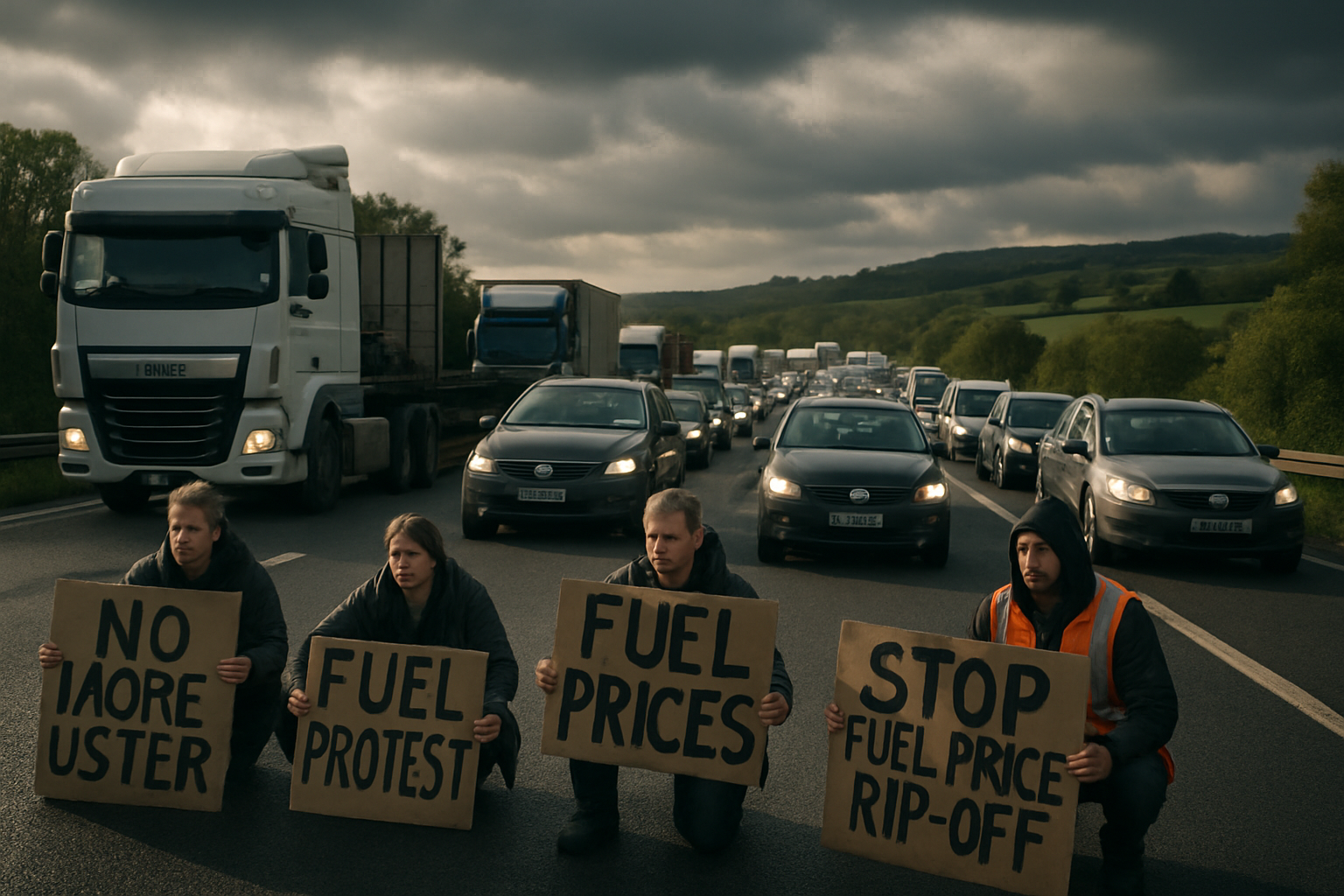
Ireland faces its most significant fuel-related civil unrest in decades as protesters enter their fourth consecutive day of blockades across major motorways, causing severe transport disruption while the government scrambles to negotiate an end to the crisis.
The protests, which began Monday morning, have paralyzed key transport arteries including the M50, M18, M9, M8, and M7/N7, as demonstrators demand immediate action on fuel costs that have reached what many describe as "brazen rip-off" levels. Dublin Bus has warned of severe delays throughout the capital, while Luas services face significant disruption as protesters maintain their blockades despite government calls for dialogue.
Crisis Reaches Breaking Point
The scale of public anger became evident as protests spread from rural Ireland to major urban centers, with heating oil approaching €2 per liter and diesel costs forcing transport operators to the brink of collapse. The Taoiseach announced Friday that the government is open to talks with fuel protesters, but insisted that roadblocks must end first before formal negotiations can begin.
"Further relief measures are possible, but only through established channels," a government spokesperson stated, indicating willingness to expand on the emergency €235 million package implemented in March, which provided cuts of 20 cents on diesel and 15 cents on petrol.
However, protesters have secured what they describe as a breakthrough meeting with government officials, announcing they will ease some blockades while maintaining pressure for comprehensive fuel tax reform. The development comes as petrol stations across the country report running low on supply, with some forecourts completely dry in affected regions.
Transport Networks Under Strain
The impact on Ireland's transport infrastructure has been severe, with Dublin Bus reporting its worst disruption since the height of the COVID-19 pandemic. Passengers face delays of up to several hours on major routes, while cargo transport has ground to a halt in some areas, affecting supply chains for essential goods.
The protests have highlighted the broader economic pressures facing Irish families and businesses. Transport operators report fuel costs rising from €120-130 to €190 per fill, adding €2,000-3,000 to weekly business expenses - increases many describe as unsustainable.
Public sentiment appears divided, with many expressing sympathy for the protesters despite being caught in traffic for hours. Readers contacted by Irish media outlets report supporting the blockades even while experiencing personal inconvenience, citing the desperate need for government action on fuel costs.
Global Energy Crisis Context
The Irish protests unfold against the backdrop of what experts describe as the most severe global energy crisis since the 1970s oil shocks. Ireland's fuel crisis is part of a worldwide pattern of energy-related civil unrest that has affected countries from the Philippines to Kenya, all struggling with the aftermath of disruptions to global oil supply chains.
The crisis was triggered by Iran's closure of the Strait of Hormuz, through which 40% of the world's seaborne oil transit passes. This led to oil prices breaching $100 per barrel for the first time since 2022, with Brent crude peaking at $119.50 and WTI reaching a record $108.15 in March.
While a Pakistan-mediated ceasefire in early April brought some relief to global markets, Irish consumers have yet to see significant price reductions at the pump. "The old diesel is still in the tanks - it's just a damn game," one Swedish observer noted, reflecting widespread consumer skepticism about how quickly price relief reaches end users.
Government Response Strategy
The Irish government faces a delicate balancing act between maintaining public order and addressing legitimate concerns about fuel costs. The Taoiseach has emphasized respect for peaceful protest rights while condemning blockades that prevent access to essential services and livelihoods.
The March emergency package represented one of Europe's most comprehensive responses to the fuel crisis, alongside measures by governments across the continent. France deployed 500 fuel station inspectors to prevent price manipulation, while Hungary implemented immediate price caps on gasoline and diesel to combat "war-driven explosions" in costs.
However, protesters argue that the government measures, while welcome, remain insufficient to address the fundamental drivers of fuel price inflation. They point to Ireland's complex tax structure on fuel, which includes excise duties and carbon taxes that compound the impact of wholesale price increases.
Economic and Social Impact
The protests have highlighted delayed hospital appointments and what observers describe as "unnecessary heartache" for families trying to access essential services. The disruption extends beyond immediate transport inconvenience to affect Ireland's broader economic stability, with businesses reporting difficulty maintaining operations and workers struggling to reach their jobs.
Transport industry representatives have warned of potential industry collapse if fuel costs continue at current levels. The haulage sector, already facing pressure from post-Brexit trade complications and supply chain disruptions, describes the current fuel crisis as an existential threat.
The social dimension of the crisis is equally concerning, with lower-income households disproportionately affected by fuel cost increases. Essential workers who cannot work from home bear the greatest burden, facing a choice between paying unsustainable transport costs or potentially losing employment.
International Precedent
Ireland's fuel protests are part of a global pattern of energy-related civil unrest that emerged during what experts call the most dangerous international crisis since the Cold War's end. The crisis has tested multilateral cooperation and crisis management mechanisms across multiple continents.
Similar protests have erupted from the Philippines, where jeepney drivers launched nationwide strikes over diesel approaching 100 pesos per liter, to Kenya, where the Transporters Association warned of paralyzing fuel shortages. Even countries with domestic energy production, like Norway, have seen fuel costs exceed 30 kroner per liter despite being major oil producers.
The International Energy Agency deployed the largest strategic petroleum reserve release in its 50-year history - 400 million barrels from 32 countries - in an attempt to stabilize global markets. However, experts note that strategic reserves provide only temporary relief when fundamental supply routes remain disrupted.
Looking Ahead
As negotiations between protesters and government officials continue, the outcome will likely influence not just Ireland's immediate fuel policy but broader approaches to energy security across Europe. The crisis has exposed dangerous vulnerabilities in global energy architecture that experts say require fundamental transformation to reduce dependence on geopolitically volatile regions.
Energy security analyst Samuel Ciszuk describes the current situation as "the most severe energy security crisis in decades, exposing single-chokepoint vulnerabilities that were assumed away." The crisis has accelerated discussions about supply diversification and renewable energy transitions, though experts acknowledge such transformations require years or decades to implement fully.
For now, Irish protesters maintain that their actions represent a necessary response to government inaction on fuel costs that threaten livelihoods across the country. Whether the promised negotiations can bridge the gap between public demands and policy constraints will determine if Ireland can resolve this crisis without the prolonged disruption seen in other countries facing similar energy-related unrest.
The protests continue to test Ireland's capacity for managing social tensions during economic transformation, with implications extending far beyond transport disruption to questions of energy independence, social solidarity, and the government's ability to protect citizens from global economic volatility.