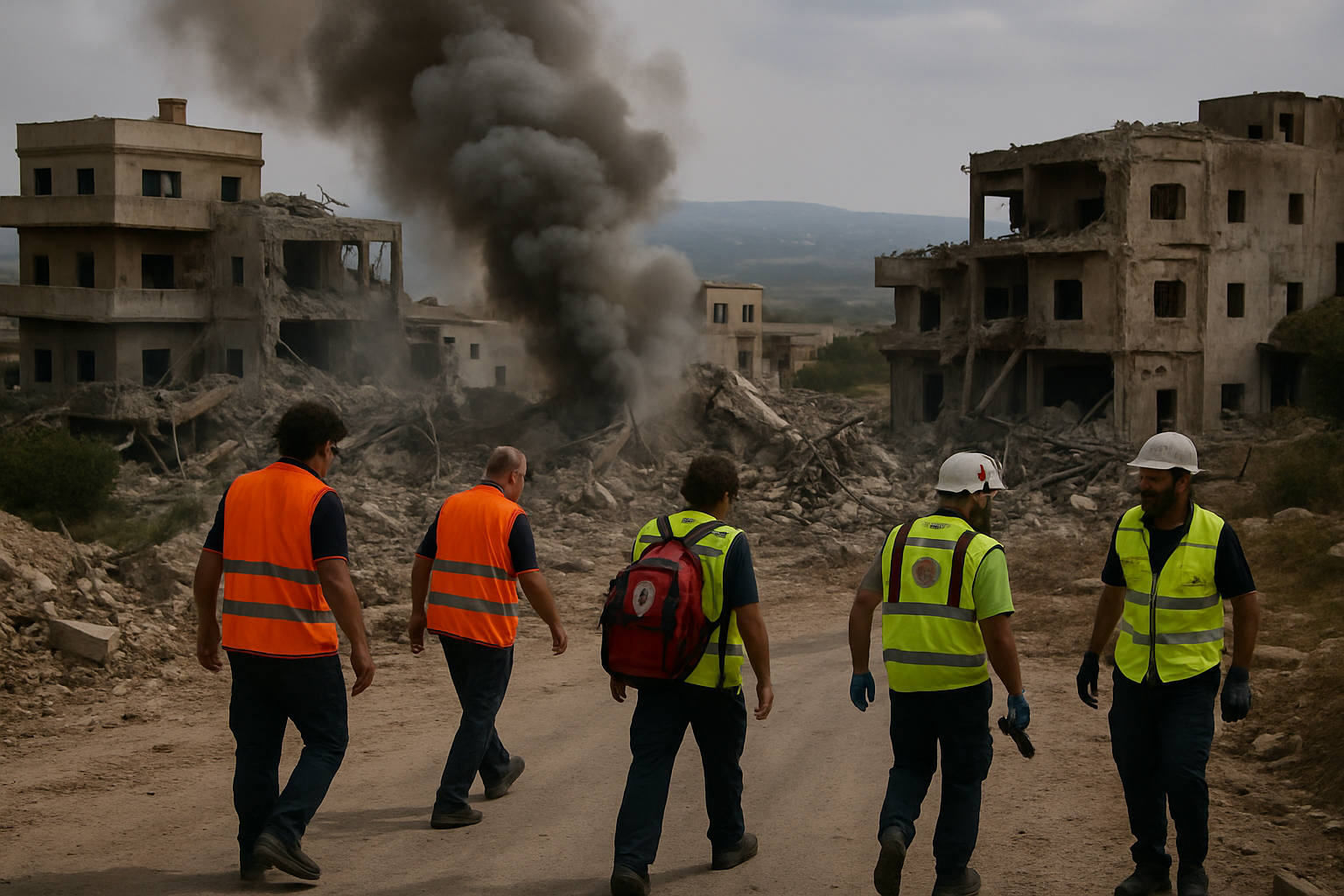
Israeli military operations killed at least 12 people across Gaza and Lebanon on Friday, continuing a systematic pattern of ceasefire violations that has resulted in more than 680 Palestinian deaths since the October 2025 truce agreement, according to multiple international sources and health authorities.
An Israeli airstrike in the southern Lebanese village of Touline killed two people on Friday, Lebanon's Health Ministry confirmed, as Israel's army simultaneously ordered residents to evacuate another southern Lebanese town. The attack occurred just one day after Israel and Lebanon extended their fragile ceasefire by three weeks following high-level diplomatic talks in Washington.
In Gaza, Palestinian health authorities reported that 10-12 people were killed in Israeli strikes, including operations targeting Al-Nuseirat camp and other civilian areas. The casualties add to what international observers describe as one of the most systematically violated ceasefires in recent history, with over 1,600 documented breaches since the October 10, 2025 agreement.
Lebanon Ceasefire Extension Under Immediate Strain
The Lebanon casualties come despite President Trump's announcement of a three-week ceasefire extension following "excellent conversations" with Israeli Prime Minister Netanyahu and Lebanese President Joseph Aoun at the White House. The talks represented the most significant Israel-Lebanon diplomatic engagement in over three decades.
However, violations began within hours of the extension announcement. Lebanese military sources documented Israeli "acts of aggression" including artillery shelling of southern villages, while Israeli forces warned civilians against moving south of the Litani River despite ceasefire terms.
"The situation remains precarious and volatile, affecting both peacekeepers and civilians forced to evacuate southern Lebanon areas."
— Kandice Ardiel, UNIFIL Spokeswoman
The humanitarian toll in Lebanon has reached catastrophic proportions since fighting resumed in March 2026. Over 1.2 million Lebanese—representing 25% of the population—have been displaced, with emergency shelters overwhelmed and thousands sleeping on Beirut streets. The systematic targeting of medical personnel has killed 26 paramedics and wounded 51 others since March 2, including a devastating attack on the Burj Qalaouiyah healthcare center that killed 12 medical workers.
Gaza's Systematic Ceasefire Violations
The situation in Gaza represents an even more troubling pattern of systematic violations. Since the October 2025 ceasefire, international monitors have documented over 1,600 separate incidents resulting in more than 680 Palestinian deaths during what was supposed to be a peace period.
Dr. Mohamed Abu Selmiya, Director of Al-Shifa Hospital, has repeatedly questioned "Where is the ceasefire?" as medical facilities struggle with fuel shortages that have forced the complete shutdown of Gaza's Civil Defense services, hampering emergency response capabilities.
The humanitarian crisis in Gaza has reached unprecedented levels. The Rafah crossing, Gaza's only non-Israeli controlled access point, has been severely restricted with only 27 people allowed to cross daily versus the agreed quota of 200. Hamas officials condemn this as "systematic harassment" that has left over 20,000 Palestinians awaiting medical evacuation.
Health Ministry Director Zaher al-Wahidi reports that 6-10 critically ill patients are dying daily while awaiting evacuation, with approximately 1,400 patients having died since Israel's occupation of the Rafah crossing in May 2024.
International Condemnation Reaches Historic Levels
The scale of violations has prompted unprecedented international condemnation. Eighty-five UN member states have issued a joint statement condemning Israeli actions—the most comprehensive diplomatic opposition since the 1967 occupation began. Eight Arab nations, including countries with normalized relations with Israel such as the UAE and Saudi Arabia, have condemned the violations as breaches of international law.
Over 400 European Union diplomats have petitioned for increased pressure on Israel to comply with ceasefire agreements, while a European civil society petition against EU-Israel partnerships has exceeded 400,000 signatures.
UN Secretary-General António Guterres has called the situation "the greatest test of multilateral cooperation in the modern era," warning that the systematic breakdown of negotiated agreements threatens the credibility of international conflict resolution mechanisms.
The Critical Lebanon Loophole
A fundamental weakness in current diplomatic efforts has emerged regarding Lebanon's status. Prime Minister Netanyahu explicitly excluded Lebanon from the Pakistan-mediated "Islamabad Accord" between the US and Iran, creating what Vice President Vance acknowledged as a "legitimate misunderstanding" by Iran regarding comprehensive ceasefire enforcement.
Iran has threatened to withdraw from regional talks unless comprehensive ceasefire enforcement covers all fronts, including Lebanon. This loophole threatens to undermine broader peace frameworks that have temporarily stabilized the Strait of Hormuz and global energy markets.
French President Emmanuel Macron and Spanish Prime Minister Pedro Sánchez have insisted that Lebanon's inclusion is essential for any "credible and durable" ceasefire, while offering to host direct Israel-Lebanon talks in Paris—the first such diplomatic initiative since the November 2024 ceasefire collapsed in March 2026.
Hezbollah's Categorical Rejection
Hezbollah Secretary-General Naim Qassem has called the Washington talks "pointless" and "futile," demanding that the Lebanese government take a "historic heroic stance" by withdrawing from negotiations. The organization has documented over 10,000 Israeli violations resulting in 500+ civilian deaths.
The group's rejection reflects its strategic choice of "Iranian solidarity over Lebanese sovereignty" following the death of Iran's Supreme Leader Khamenei in March 2026. Hezbollah's estimated 20,000 fighters have conducted over 40 operations targeting northern Israeli sites, reaching as far as Haifa, marking a significant operational escalation.
Global Crisis Implications
The ongoing conflicts have created global economic and security disruptions on a scale comparable to the COVID-19 pandemic. Over 18,000 flights have been cancelled worldwide, oil prices have surged past $100 per barrel for the first time since 2014, and the closure of the Strait of Hormuz has affected 40% of global oil transit.
The International Energy Agency has coordinated the largest strategic petroleum reserve release in 50 years—400 million barrels from 32 countries—to stabilize energy markets. Natural gas prices have surged 24% in Europe and 78% in the United States, threatening household costs globally.
Medical Targeting and War Crimes Concerns
International humanitarian law experts have raised serious concerns about the systematic targeting of medical personnel and facilities. The World Health Organization has issued a $30.3 million emergency appeal supporting health systems across five Middle East countries, warning that healthcare is "under severe strain."
The deliberate targeting of clearly marked medical facilities and personnel constitutes potential violations of the Geneva Conventions. Israeli military spokesmen have threatened to strike ambulances and medical facilities, claiming Hezbollah use without providing evidence—claims that Hezbollah categorically denies.
"Attacks on healthcare are attacks on humanity itself. The international community must ensure the protection of medical workers and facilities under all circumstances."
— WHO Director-General Tedros Adhanom Ghebreyesus
Historical Context and Future Implications
The current crisis stems from the complete collapse of the November 2024 US-French brokered Israel-Hezbollah ceasefire, which had held for over a year. The agreement required Israeli forces and Hezbollah to withdraw from southern Lebanon with a Lebanese army and UN peacekeepers buffer zone.
Hezbollah faced an "impossible choice" between maintaining the ceasefire versus responding to Iranian pressure for retaliation following Khamenei's death. The organization's decision to choose "Iranian solidarity" has pulled Lebanon into the broader Iran-Israel confrontation, affecting regional stability mechanisms.
The systematic nature of ceasefire violations represents what analysts describe as a "template-setting moment" for 21st-century conflict resolution. The success or failure of international diplomatic pressure will influence how territorial sovereignty disputes and humanitarian law enforcement are handled globally for decades to come.
Reconstruction Efforts in Jeopardy
The ongoing violations threaten major reconstruction initiatives, including President Trump's "Board of Peace" pledge of $17 billion from 27 nations for Gaza reconstruction. Hamas has categorically rejected disarmament demands, maintaining an estimated 20,000 fighters and insisting that armed resistance is justified under international law while territories remain under occupation.
The systematic breakdown of negotiated agreements demonstrates the challenges of maintaining peace without addressing underlying political and security issues that drive these conflicts. Traditional post-conflict reconstruction models require stable security environments—conditions that remain absent despite formal ceasefire agreements.
The Path Forward
The coming weeks will be crucial in determining whether diplomatic intervention can prevent broader regional warfare. The fragility of current agreements, demonstrated by immediate violations of even extended ceasefires, highlights the need for comprehensive frameworks that address root causes rather than temporary pauses in violence.
Pakistan's innovative "message relay system" mediation between the US and Iran demonstrates that middle-power diplomacy can bridge major adversaries when traditional mechanisms fail. However, the Lebanon loophole and systematic violations show that partial agreements cannot contain conflicts that span multiple theaters.
As UN Peacekeepers come under attack—including the recent killing of French Staff Sergeant Florian Montorio—the international community faces a critical test of its commitment to civilian protection and humanitarian principles. The systematic targeting of medical personnel, deliberate infrastructure destruction, and continued displacement of millions of civilians represent comprehensive challenges to post-World War II international order principles.
The current crisis affects over 15 million people across the region and threatens global energy security, aviation networks, and international stability mechanisms. Success in containing and resolving these conflicts will establish precedents for conflict resolution, civilian protection, and multilateral cooperation effectiveness in an increasingly volatile and interconnected world.