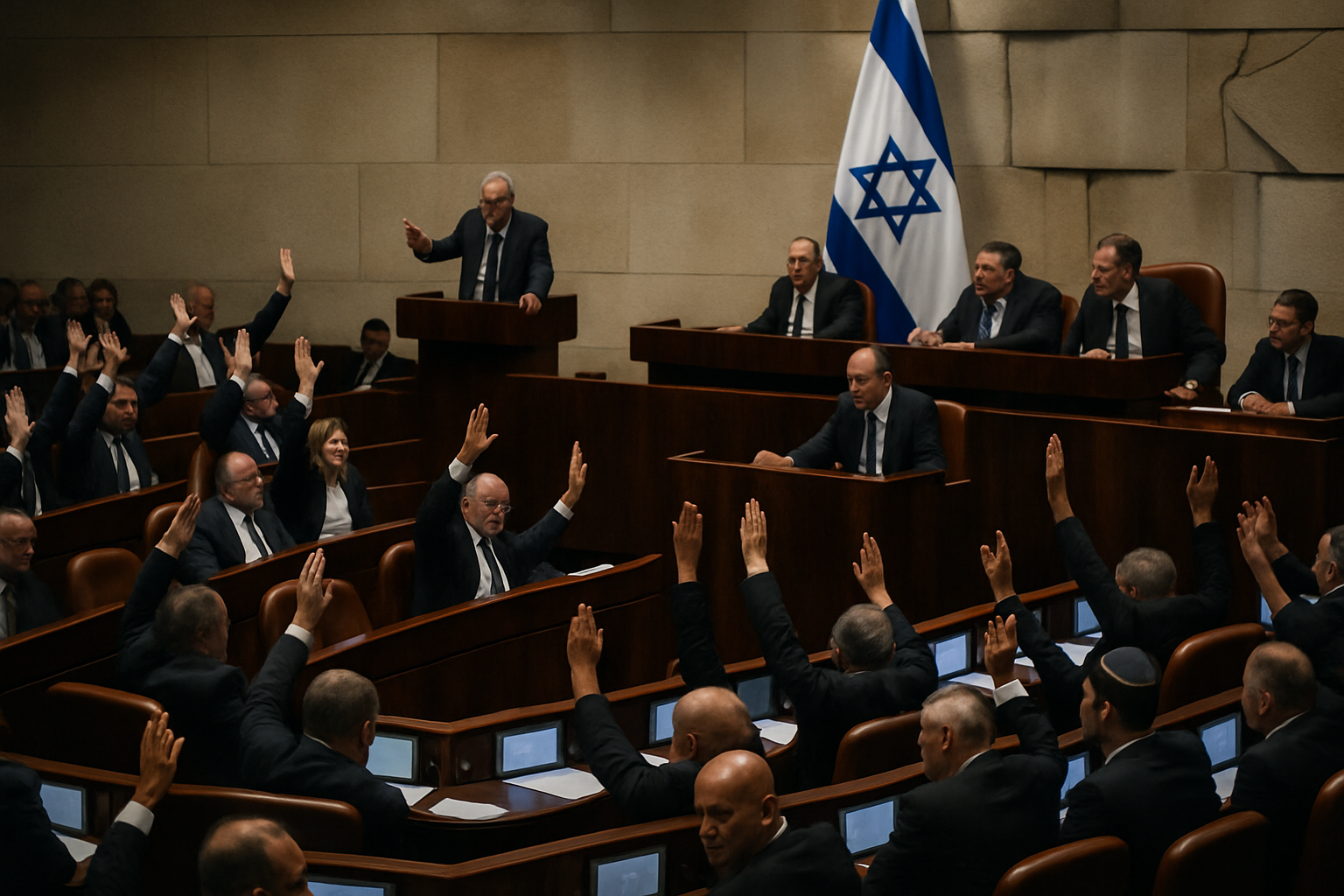
The Israeli Knesset has passed controversial legislation mandating the death penalty by hanging for Palestinians convicted of terrorism-related offenses, triggering the most comprehensive international condemnation since Israel's 1967 occupation began and raising fundamental questions about human rights and international law.
The bill passed by a narrow margin of 62-48 votes after intense 12-hour parliamentary debates, with Prime Minister Benjamin Netanyahu casting his vote in person alongside National Security Minister Itamar Ben-Gvir, the driving force behind the legislation. The law specifically targets Palestinians in West Bank military courts while explicitly exempting Israeli citizens and residents from its provisions.
Discriminatory Framework Sparks Global Outrage
The legislation establishes what critics describe as a dual justice system based on ethnicity, making death by hanging the default sentence for Palestinians convicted of "intentionally causing death within the terrorism framework." Implementation is scheduled within 90 days, with executions to be carried out within 90 days of sentencing, offering no appeal rights and severely limited clemency options.
United Nations High Commissioner for Human Rights Volker Türk immediately called for the "immediate repeal of this discriminatory law," warning it would "undoubtedly accelerate dispossession and forced displacement of Palestinians." The unprecedented international response includes condemnation from 85 UN member states, representing the most unified diplomatic opposition since Israel's occupation began in 1967.
"With God's help, we will kill our enemies," Ben-Gvir declared following the vote, as parliamentary members cheered the passage while he brandished a bottle in celebration.
— Itamar Ben-Gvir, Israel's National Security Minister
Historical Context and Legal Implications
This marks a dramatic departure from Israeli legal precedent. Israel abolished the death penalty for murder in 1954 and has only executed one person since its founding – Nazi war criminal Adolf Eichmann in 1962. Military courts have never imposed capital punishment during the 57-year occupation of the West Bank, making this legislation historically unprecedented.
International legal experts cite multiple violations of UN Security Council resolutions and Geneva Conventions governing occupied territories. The systematic extension of Israeli criminal law into occupied territory meets international legal definitions of annexation, regardless of formal declarations.
Regional and International Response
Eight Arab nations, including countries that have normalized relations with Israel such as the UAE and Bahrain, issued a joint statement condemning the measures as violations of international law "aimed at imposing unlawful Israeli sovereignty." The coalition includes Saudi Arabia, Jordan, Egypt, UAE, Qatar, Indonesia, Pakistan, and Turkey.
European Union officials characterized the legislation as a "step in the wrong direction" that is "illegal under international law," while over 400 EU diplomats separately demanded increased pressure on Israeli authorities. A European Left Coalition petition opposing the law has gathered more than 400,000 signatures.
Palestinian Authority President Mahmoud Abbas condemned what he called "dangerous decisions" that systematically violate international law and undermine the possibility of a viable Palestinian state. Hamas dismissed the law as "null and void," while the Palestinian Council of Scholars described it as a "grave crime and blatant aggression" requiring urgent international intervention.
Implementation and Opposition
The law faces immediate challenges from multiple quarters. Israeli security officials and former Shin Bet chiefs have expressed unprecedented opposition, describing the legislation as potentially destabilizing. Legal experts warn of violence cycle escalation and predict challenges through international courts.
In Gaza, thousands participated in protests organized by families of Palestinian prisoners, demonstrating outside the International Committee of the Red Cross headquarters. Released Palestinian prisoners showed visible signs of what human rights groups describe as systematic torture and starvation, particularly during Ramadan, highlighting deteriorating conditions in Israeli detention facilities.
Broader Context of Escalation
The passage comes amid a documented pattern of systematic ceasefire violations. Over 1,600 violations have been recorded since the October 2025 Gaza truce, resulting in more than 600 Palestinian deaths during what was supposed to be a peace period. Gaza's Civil Defense has been shut down due to fuel shortages, while the Rafah crossing operates at only 27 of its 200-person daily quota.
Simultaneously, Israeli authorities have approved the most comprehensive West Bank land registration since 1967, with Finance Minister Bezalel Smotrich declaring policies will "continue to kill the idea of a Palestinian state." Energy Minister Eli Cohen has acknowledged these measures constitute "factual sovereignty" implementation.
International Law and Human Rights Concerns
Human rights organizations warn the legislation creates dangerous precedents for international humanitarian law. The Euro-Mediterranean Human Rights Observatory has accused Israel of exploiting international focus on other conflicts to intensify policies that effectively amount to ethnic cleansing.
The timing is particularly significant, occurring during the ongoing Iran-Israel conflict that has dominated global attention. Critics argue this represents a calculated effort to advance controversial policies while international focus is diverted elsewhere.
Global Implications
The legislation represents a template-setting moment for international law enforcement in the 21st century. Success or failure of the international community's response will influence territorial sovereignty disputes globally and affect precedents for occupied territories worldwide.
UN Secretary-General António Guterres has expressed "grave concern" about what he terms a "dangerous escalation" that threatens the viability of a two-state solution. The Arab League has announced an emergency meeting to address what they characterize as "illegal decisions" affecting home demolitions, land seizures, and ownership transfers.
As implementation approaches, the international community faces a critical test of its commitment to upholding legal principles in occupied territories. The unprecedented scale of opposition – spanning traditional regional divisions and including countries with normalized relations with Israel – demonstrates the gravity with which the international community views these developments.
The coming weeks will determine whether sustained diplomatic pressure can reverse these policies or if they will proceed, potentially making a two-state solution technically unfeasible through systematic demographic and geographic alterations backed by the ultimate legal sanction – state execution.