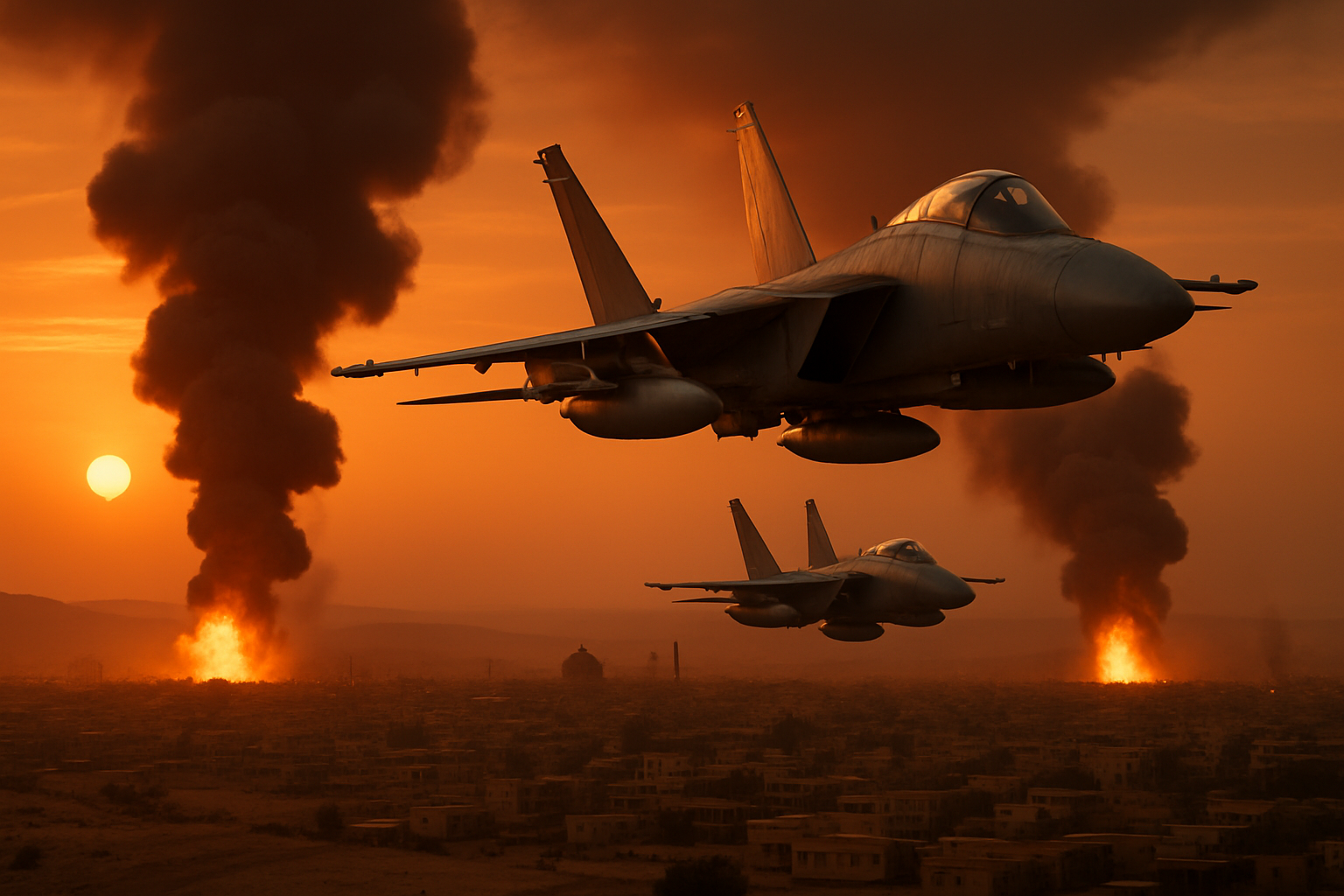
Israel launched a new "wide scale wave of strikes" against Iranian infrastructure across Tehran and Hezbollah strongholds in Beirut on Tuesday morning, as the devastating Middle East conflict enters its third week with no end in sight, according to multiple international sources.
The Israeli Defense Forces (IDF) confirmed the escalation came as Iran simultaneously fired missiles at Israel overnight, demonstrating Tehran's continued capacity for long-range strikes despite more than two weeks of intensive bombardment by U.S. and Israeli forces. The coordinated attacks mark a dangerous new phase in what has become the most serious international crisis since the Cold War ended.
Simultaneous Strikes Across Multiple Fronts
According to reports from Chinese state media CGTN, the IDF announced targeting "Iranian regime infrastructure" across Tehran while conducting parallel operations against Hezbollah positions in Beirut. The strikes occurred as Iranian forces launched fresh attacks on the United Arab Emirates, the kind of retaliatory strikes on U.S. Gulf allies that sources indicated had been anticipated by intelligence officials.
Three quarters of Beirut were struck by Israeli missiles Tuesday morning, while an oil installation on the eastern coast of the UAE was simultaneously targeted by Iranian forces, French media Le Monde reported. The complex, multi-front nature of the current escalation demonstrates how the conflict has expanded far beyond the original Iran-Israel confrontation.
Massive Attack on U.S. Embassy in Baghdad
In a dramatic expansion of the conflict, the U.S. Embassy in Baghdad came under what Bulgarian media described as the "most intensive strike since the war started." According to multiple European sources, three drones and four rockets attacked the embassy, with at least one drone crashing inside the heavily fortified compound.
The attack targeted Baghdad's Green Zone, where government buildings and diplomatic missions are located, marking the first major assault on American diplomatic facilities since the current crisis began with Operation Epic Fury on March 1st. Iraqi security sources described the scale of the attack as surpassing all previous incidents since the war commenced.
Global Aviation Crisis Reaches Breaking Point
The conflict has triggered the worst aviation crisis since COVID-19, with over 18,000 flights cancelled worldwide as eight Middle Eastern countries maintain simultaneous airspace closures. Dubai International Airport, the world's busiest with 86 million annual passengers, remains completely shut down from missile damage sustained in earlier Iranian strikes.
Major international carriers including Emirates, Air France-KLM, and Wizz Air have suspended operations indefinitely, affecting hundreds of thousands of passengers globally. The paralysis of Middle Eastern aviation hubs has severely disrupted critical Asia-Europe flight corridors, with airlines struggling to find alternative routing through already-congested airspace.
Energy Markets in Unprecedented Crisis
Oil prices have surged past $100 per barrel for the first time since 2014, heading toward warnings of $200 per barrel as Iran continues mining the Strait of Hormuz with an estimated 2,000-6,000 naval mines. The strait, through which 40% of global seaborne oil transits, has been effectively closed by Iranian forces, stranding over 150 tankers worth billions of dollars in the Persian Gulf.
The International Energy Agency has released a record 400 million barrels from strategic reserves - the largest intervention in the agency's 50-year history - in an attempt to stabilize global markets. Natural gas prices have spiked 24% in Europe and 78% in the United States, while Qatar has halted LNG production, threatening European energy supplies.

Historical Context: From Diplomacy to Warfare
The current crisis emerged from the complete collapse of nuclear negotiations between the U.S. and Iran, despite what had been described as the most promising diplomatic breakthrough since 2018. Geneva talks had achieved "broad agreement on guiding principles," but fundamental disagreements over scope proved insurmountable, with Iran demanding nuclear-only discussions while the U.S. insisted on comprehensive agreements covering missiles and regional proxies.
The military escalation began with Operation Epic Fury on February 28, the largest coordinated U.S.-Israeli military operation since the 2003 Iraq invasion. The operation resulted in the confirmed death of Iranian Supreme Leader Ali Khamenei on March 1, ending his 37-year rule and triggering a succession crisis that has elevated his son Mojtaba Khamenei to power in the Islamic Republic's first hereditary succession.
Regional Coalition Under Strain
The unprecedented coalition of Saudi Arabia, UAE, Qatar, and Egypt that had backed diplomatic efforts is now severely strained as Iranian retaliation has directly targeted member territories. Egyptian President Abdel Fattah el-Sisi condemned attacks on "sisterly Arab countries," warning of "comprehensive chaos spreading across the region."
Kuwait has been forced to relocate Jazeera Airways operations to Saudi Arabia due to repeated drone attacks, while the UAE has suffered its first civilian casualty with one killed in Abu Dhabi from missile debris. Qatar intercepted 65 missiles and 12 drones using Patriot systems, with 8 people injured from fragments.
European Territory Under Attack
In a dramatic escalation with global implications, Iranian drones struck RAF Akrotiri in Cyprus - marking the first attack on European territory since World War II. The strike prompted an unprecedented naval response, with HMS Dragon joining Spanish frigates and vessels from Italy, France, the Netherlands, and Greece in protecting European interests.
The European Union activated its ESTIA evacuation plan for Cyprus for the first time in the bloc's history, while multiple EU member states have ordered emergency evacuations of their nationals from the region. The attack on European soil has fundamentally altered the conflict's scope and drawn NATO allies directly into defensive preparations.
Humanitarian Crisis Mounting
The Iran Red Crescent reports over 787 civilian casualties from U.S.-Israeli strikes, including the devastating attack on Minab elementary school that killed between 53-85 students and staff during regular school hours. International human rights organizations have called for Geneva Conventions investigations into potential war crimes.
The conflict has triggered the largest coordinated international evacuation since the Arab Spring in 2011, with Australia reporting 115,000 nationals trapped and Germany attempting to extract 30,000 stranded tourists. Multiple countries have issued urgent evacuation orders citing "extremely uncertain" security conditions.
Lebanon Drawn Into Broader Conflict
Hezbollah's entry into the conflict following Khamenei's death has completely shattered the November 2024 U.S.-French brokered ceasefire that had held for over a year. Lebanese Health Ministry reports indicate 826 killed and over 832,000 displaced in what has become an unprecedented humanitarian crisis.
Israeli forces have systematically targeted medical personnel, with 26 paramedics killed and 51 wounded since March 2. The deadliest single attack at Burj Qalaouiyah primary healthcare center killed 12 medical workers, raising serious concerns about violations of international humanitarian law.
"This represents the greatest test of multilateral cooperation and crisis management in the modern era."
— UN Secretary-General António Guterres
Congressional Scrutiny Intensifies
Bipartisan pressure is mounting in the U.S. Congress as lawmakers demand answers about strategy, costs, and the potential for ground troop deployment. Senator Richard Blumenthal stated he is "more concerned than ever" about the possibility of American boots on the ground, while the conflict's unpopularity has reached "almost unprecedented" levels for early-stage military operations, with only 25% public support.
Operation Epic Fury has cost $11.3 billion in its first week alone, with the Pentagon reportedly preparing operations through September - far beyond the initial 4-6 week timeline suggested by the White House. The financial markets have emerged as a potential "ultimate constraint" on further escalation, with Pakistan's stock exchange suffering its largest single-day decline in history at -8.97%.
Nuclear Governance in Crisis
The current crisis unfolds against the backdrop of broader nuclear governance breakdown, with the New START treaty having expired on February 5 - the first time in over 50 years without U.S.-Russia nuclear constraints. Iran continues uranium enrichment at 60% purity with over 400kg of material approaching weapons-grade levels, sufficient for multiple nuclear weapons if weaponized.
The collapse of promising diplomatic engagement raises fundamental questions about the viability of negotiated solutions to modern nuclear crises, potentially encouraging military approaches over diplomatic solutions in future territorial and security disputes globally.
Template-Setting Historical Significance
UN Secretary-General António Guterres has characterized the crisis as "the greatest test of multilateral cooperation and crisis management in the modern era." The rapid transition from diplomatic breakthrough to military confrontation demonstrates the fragility of crisis management in the multipolar era.
The stakes extend far beyond the Middle East, affecting global energy security, nuclear governance credibility, international law enforcement, and post-World War II order principles. Success in containing the crisis could provide a template for future international interventions, while failure might accelerate military approaches to conflict resolution for decades to come.
Global Economic Disruption
Supply chains have been severely disrupted across manufacturing sectors dependent on Gulf logistics networks, particularly automotive, electronics, and textiles industries. Airlines have implemented emergency fuel surcharges as jet fuel costs have jumped from $85-90 per barrel to $150-200 per barrel.
The Persian Gulf's role as a critical trade hub connecting Asia and Europe has been completely compromised, exposing fundamental vulnerabilities in global systems to geopolitical shocks. Qatar's halt of LNG production threatens European energy supplies, while natural gas price increases are forcing significant household energy cost increases across the UK and Europe.
Looking Forward: Critical Juncture
As the conflict enters its third week with no diplomatic resolution in sight, the international community faces unprecedented challenges in crisis management. Trump's demands for Iran's "unconditional surrender" and his claims of the right to personally choose Iran's next Supreme Leader have eliminated possibilities for negotiated solutions.
The appointment of Mojtaba Khamenei as Iran's new Supreme Leader - the first hereditary succession in the Islamic Republic's 47-year history - has consolidated Revolutionary Guards control over governance during active warfare, likely ensuring continued hardline resistance to American demands.
Regional war prevention, global energy security, nuclear governance credibility, and international law enforcement are all being tested simultaneously in what has become the most consequential international crisis affecting Middle East stability with implications extending decades beyond current events.
The decisions made in the coming days and weeks will reverberate through international relations for decades, determining whether diplomatic or military solutions become the precedent for resolving 21st-century territorial and nuclear disputes worldwide.