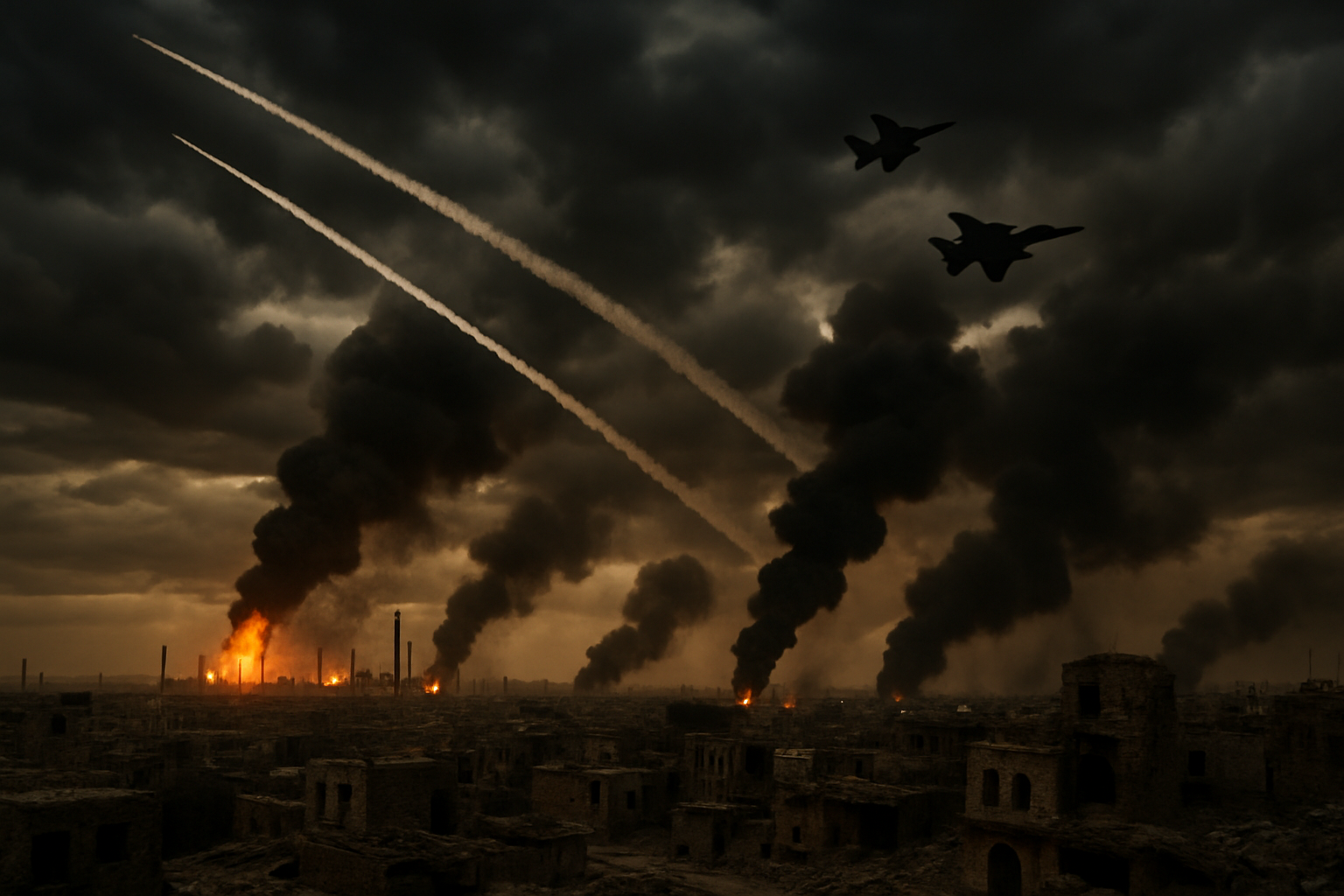
The Israel-Iran war has entered its third week, marking the most dangerous international crisis since the Cold War as fighting intensifies across multiple fronts with unprecedented global consequences affecting energy markets, aviation networks, and diplomatic relations worldwide.
Multiple international sources report that the conflict, which began February 28, 2026 with US-Israeli "Operation Epic Fury," has evolved into a regional war involving multiple nations and threatening global stability. Iranian officials confirmed that Supreme Leader Ali Khamenei was killed March 1, ending his 37-year rule and triggering a constitutional succession crisis during active warfare.
Trump Demands Unconditional Surrender
President Donald Trump escalated rhetoric dramatically, declaring via Truth Social that there would be "no deal with Iran except UNCONDITIONAL SURRENDER!" The president claimed the right to personally choose Iran's next Supreme Leader, rejecting Mojtaba Khamenei as "lightweight" in the most direct assertion of American control over Iranian affairs since 1979.
This represents a complete policy evolution from nuclear-focused negotiations to comprehensive political transformation, effectively eliminating diplomatic solution possibilities. The stance marks a dramatic departure from earlier hints at negotiation, with Trump now demanding complete capitulation.
"The single greatest chance for the Iranian people to take back their country has arrived. We will continue until they surrender completely."
— Donald Trump, President of the United States
Massive Military Operations Continue
Operation Epic Fury, described as the largest US-Israeli coordinated campaign since 2003, utilizes an unprecedented dual-carrier deployment with USS Gerald R. Ford and Abraham Lincoln representing approximately one-third of the active US Navy fleet. The operation has cost $11.3 billion in its first week, with Pentagon sources indicating preparations for operations extending through September.
Iranian retaliation through "Operation True Promise 4" has caused regional casualties across Gulf states. The Islamic Revolutionary Guard Corps declared "no red lines remain," systematically targeting US installations and allied territories. Casualties include civilians killed in Abu Dhabi, dozens injured in Kuwait airport strikes, and damage to Cyprus RAF Akrotiri marking the first European territory attacked since World War II.
US submarine USS Charlotte made history by sinking Iranian frigate IRIS Dena off Sri Lanka, killing over 80 crew members in the first enemy vessel destroyed by US submarine since World War II, according to Defense Secretary Pete Hegseth.
Global Aviation Crisis Reaches Peak
The conflict has created an unprecedented global aviation crisis with over 18,000 flights cancelled worldwide - the most extensive disruption since COVID-19. Eight Middle Eastern countries have simultaneously closed their airspace, including Iran, Iraq, Israel, UAE, Qatar, Syria, Kuwait, and Bahrain.
Dubai International Airport, the world's busiest with 86 million annual passengers, remains completely shut down due to missile damage. Major carriers including Emirates, Air France-KLM, and Wizz Air have suspended Middle Eastern operations indefinitely, stranding hundreds of thousands of passengers globally.
The closures have effectively severed critical Asia-Europe flight corridors, forcing complex international rerouting with uncertain recovery timelines unlike weather-related disruptions.
Energy Markets in Crisis
Oil prices have surged past $100 per barrel, with warnings of potential increases toward $200 as Iran has effectively closed the Strait of Hormuz through mining operations. The strategic waterway handles 40% of global seaborne oil transit, and its closure has stranded over 150 tankers worth billions in the Persian Gulf.
Major shipping companies Maersk and MSC have suspended Persian Gulf operations indefinitely. Natural gas prices have increased 24% in Europe and 78% in the US, with Qatar halting LNG production representing approximately 20% of global exports.
The International Energy Agency responded by releasing a record 400 million barrels from strategic reserves - the largest intervention in the agency's 50-year history. UK households face potential £160 annual energy increases, while airlines implement emergency fuel surcharges as jet fuel costs jumped from $85-90 to $150-200 per barrel.
Iranian Leadership Transition
Following Ali Khamenei's confirmed death, Iran faces its first hereditary succession in the Islamic Republic's 47-year history. Mojtaba Khamenei, the deceased leader's son, has emerged as the favored successor, representing a fundamental shift from clerical to military governance as the Revolutionary Guards consolidate unprecedented control over state apparatus.
CIA assessments suggest Revolutionary Guards members will likely control the new leadership structure, indicating a hardline military shift during wartime conditions. The Assembly of Experts faces the unprecedented challenge of selecting a new Supreme Leader under active warfare.
European Territory Attacked
Iranian drone strikes on RAF Akrotiri in Cyprus marked the first attack on European territory since World War II, prompting an unprecedented naval coalition response. HMS Dragon, Spanish frigates, and vessels from Italy, France, Netherlands, and Greece are protecting European interests in the eastern Mediterranean.
The European Union activated its ESTIA evacuation plan for Cyprus for the first time in the bloc's history, while French President Emmanuel Macron made an emergency visit to Cyprus with warship deployments to the region.
Nuclear Diplomacy Collapse
The current military confrontation emerged from the complete breakdown of Geneva negotiations despite achieving "broad agreement on guiding principles" - the most promising diplomatic opening in years since the 2018 JCPOA collapse.
Fundamental scope disagreements proved insurmountable, with Iran maintaining ballistic missiles and regional proxies as "red lines" excluded from nuclear-only talks, while the US demanded comprehensive agreements including missiles, armed groups, and human rights issues.
Iran continues uranium enrichment at 60% purity with over 400kg of material approaching weapons-grade levels, sufficient for multiple weapons if weaponized. The crisis occurs amid broader nuclear governance breakdown following the February 5 expiration of New START - the first time in over 50 years without US-Russia nuclear constraints.
International Response and Evacuations
The international community has launched the largest coordinated evacuation effort since the Arab Spring in 2011, with Australia reporting 115,000 nationals trapped and Germany evacuating 30,000 stranded tourists. Multiple countries have ordered immediate evacuations from Iran citing "extremely uncertain" security conditions.
UN Secretary-General António Guterres called the crisis the "greatest test of multilateral cooperation in crisis management of the modern era." The UN Security Council has held multiple emergency sessions, with Russia condemning "reckless actions by Washington and West Jerusalem" while China issued its strongest condemnation in years citing "serious sovereignty violations."
Congressional Opposition Mounts
Bipartisan congressional lawmakers are demanding comprehensive answers about strategy, costs, and potential ground troop deployment. Senator Richard Blumenthal expressed being "more concerned than ever" about boots on the ground, while the conflict's unpopularity remains "almost unprecedented" for early-stage military operations with only 25% American public support.
Financial markets have emerged as the "ultimate constraint" on conflict escalation, with Pakistan's KSE-100 experiencing its largest single-day decline in history at -8.97%. The Pentagon is reportedly preparing operations extending through September, far beyond the initial 4-6 week White House timeline.
Humanitarian Crisis Deepens
Iran's Red Crescent reports over 787 civilian casualties from US-Israeli strikes, including the devastating Minab girls' school attack that killed 53-85 students and staff during regular school hours. International human rights organizations are demanding Geneva Conventions violation investigations.
The Pentagon has confirmed US responsibility for an elementary school strike that killed 165-185 students using "outdated targeting data," while Lebanon reports 394 casualties including 83 children from Israeli strikes with over 500,000 displaced persons overwhelming shelter systems.
Global Economic Disruption
Supply chains dependent on Gulf logistics networks have been severely impacted, affecting manufacturing in automotive, electronics, and textiles sectors worldwide. The Persian Gulf's role as a critical Asia-Europe trade hub has been completely compromised, demonstrating fundamental vulnerabilities in global economic systems to geopolitical shocks.
PayPal postponed its $1.1 billion IPO due to market volatility, while stock markets worldwide continue declining as safe-haven assets surge amid the worst international crisis since the Cold War.
Template-Setting Historical Significance
The rapid transition from diplomatic breakthrough to military confrontation demonstrates the fragility of crisis management mechanisms in the multipolar era. UN Secretary-General Guterres emphasized this represents the greatest test of multilateral cooperation in modern crisis management.
The March 2026 events are establishing precedents for 21st-century international relations, determining whether diplomatic or military solutions will dominate future territorial and nuclear disputes globally. Success in containing the escalation could provide frameworks for future crisis resolution, while failure may accelerate military approaches for decades, encouraging proliferation globally and undermining diplomatic credibility worldwide.
The crisis affects fundamental aspects of international order including regional war prevention, global energy security, nuclear governance credibility, and post-WWII legal enforcement mechanisms - all tested simultaneously in an unprecedented convergence of global challenges.
Looking Ahead
As the conflict enters its third week, the international community faces critical decisions determining whether this remains a contained regional confrontation or escalates into broader Middle Eastern warfare with global implications extending decades beyond current events.
The outcome will fundamentally reshape approaches to international conflict resolution, energy security architecture, nuclear proliferation prevention, and diplomatic versus military solution precedents for future disputes worldwide, making this the most consequential international crisis affecting Middle East stability and global order since the Cold War's end.