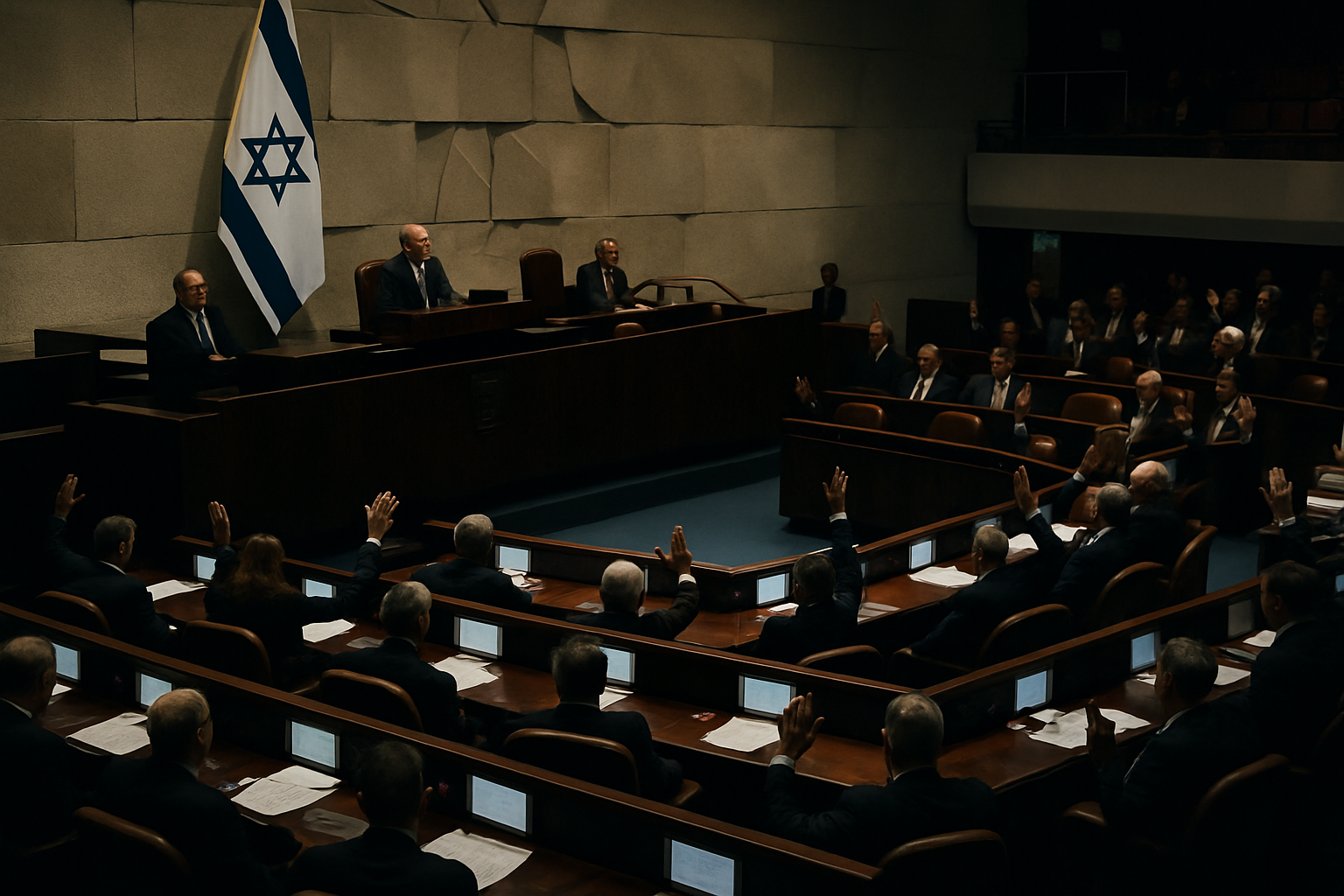
Israel's Knesset passed controversial legislation on Monday making death by hanging the default sentence for Palestinians convicted of deadly attacks in military courts, fulfilling demands from far-right coalition partners and igniting fierce international condemnation over its discriminatory nature.
The law, passed by a 62-48 margin after a heated 12-hour parliamentary debate, specifically targets individuals convicted of "intentionally causing the death of a person within the framework of an act classified as terrorism" in the occupied West Bank. Under the legislation, executions must be carried out within 90 days of sentencing, with no right of appeal and limited grounds for clemency.
Discriminatory Legal Framework
The legislation applies exclusively to Palestinians tried in Israeli military courts, creating what critics describe as a discriminatory dual justice system based on ethnicity. Israeli citizens and residents are explicitly excluded from the law's provisions, maintaining their right to civilian court trials where the death penalty remains abolished for murder cases since 1954.
National Security Minister Itamar Ben-Gvir, whose Jewish Power party spearheaded the legislation, celebrated the passage with inflammatory rhetoric. "With God's help, we will kill our enemies," Ben-Gvir declared, prompting cheers from supporters in the Knesset gallery.
"This law represents a dangerous escalation and a flagrant violation of international humanitarian law that creates a discriminatory system targeting a specific ethnic group."
— Palestinian Authority President Mahmoud Abbas
Prime Minister Benjamin Netanyahu personally attended the vote, underscoring the legislation's political significance for his governing coalition. The bill's passage fulfills a key demand from the religious nationalist parties that provide Netanyahu's narrow parliamentary majority.
International Outcry and Legal Concerns
The law has triggered unprecedented international condemnation, with 85 UN member states issuing joint criticism described as the most comprehensive response to Israeli legislation since the 1967 occupation began. Eight Arab nations, including normalized partners Saudi Arabia, UAE, Qatar, and Egypt, condemned the measures as violations of international law.
European Union officials characterized the legislation as "a step in the wrong direction" that violates international legal principles. More than 400 EU diplomats separately demanded increased pressure on Israel, while a European Left Coalition petition against EU-Israel partnerships has exceeded 400,000 signatures.
UN Secretary-General António Guterres expressed "grave concern" about what he termed a "dangerous escalation," while international legal experts cited violations of UN Security Council resolutions and Geneva Conventions governing occupied territories.
Historical Context and Precedent
The legislation marks a dramatic departure from Israeli legal tradition. The country abolished the death penalty for murder in 1954 and has executed only one person in its history—Nazi war criminal Adolf Eichmann in 1962. Military courts have never implemented capital punishment during the 57-year occupation of the West Bank.
Palestinian officials and human rights organizations describe the law as part of a broader pattern of discriminatory policies. The Palestinian Presidency condemned it as a "breach of international law" and a "doomed bid" to intimidate Palestinians through state terror.

Implementation and Legal Challenges
The new law mandates that the Israel Prison Service carry out executions by hanging within 90 days of military court sentencing. While technically allowing life imprisonment in "special circumstances," legal experts note that the legislation establishes death as the default punishment, reversing traditional legal presumptions.
Former Palestinian prisoner officials have called for urgent international intervention to prevent the law's implementation. Qadoura Fares, former chairman of the Palestinian Prisoners' Affairs Authority, warned that the legislation "targets anyone who resists occupation" and represents an expansion beyond current detainees to future arrests.
International legal scholars argue that the systematic extension of Israeli criminal law to occupied territory meets legal definitions of annexation, regardless of formal declarations. The policy creates concerning precedents for territorial control and civilian protection in occupied areas worldwide.
Regional and Strategic Implications
The law's passage occurs during a particularly volatile period in Middle East relations, coinciding with ongoing violations of Gaza ceasefire agreements and systematic West Bank settlement expansion. Over 1,600 documented ceasefire violations since October 2025 have resulted in more than 600 Palestinian deaths during the supposed peace period.
The legislation threatens to undermine regional diplomatic initiatives, including the Trump administration's "Board of Peace" reconstruction pledges exceeding $17 billion. Hamas leadership categorically rejected the law as "null and void," while the Islamic Jihad warned of comprehensive retaliation against what it termed "judicial terrorism."
"This legislation represents the institutionalization of apartheid through legal mechanisms, creating separate and unequal justice systems based solely on ethnic identity."
— International human rights lawyer Sarah Chen
Prison Conditions and Systematic Abuse
The death penalty law comes amid documented reports of systematic abuse in Israeli detention facilities. Palestinian prisoners face what human rights organizations describe as deliberate psychological torture campaigns, with conditions particularly worsening during religious observances like Ramadan.
Recent testimonies from released detainees reveal deteriorating health conditions and potential mistreatment in Israeli prisons. Medical personnel have documented signs of "oppressive conditions" among Palestinian prisoners, raising additional concerns about the justice system's treatment of detainees who could face capital punishment.
Constitutional and Democratic Concerns
The legislation has faced criticism from within Israeli society, including former Shin Bet intelligence chiefs who issued unprecedented condemnations of government attacks on security institutions. Legal experts warn that the law's ethnic-based distinctions violate fundamental principles of equal justice and due process.
Opposition lawmakers and civil society organizations argue that the legislation undermines Israel's democratic character by institutionalizing discriminatory justice. The Association for Civil Rights in Israel has indicated plans to challenge the law through the Supreme Court, though the current judicial climate raises questions about potential intervention.
International Response Mechanisms
The unprecedented scale of international opposition suggests potential diplomatic consequences. The European Union has initiated discussions about reviewing partnership agreements with Israel, while several countries are considering travel restrictions for officials involved in the law's implementation.
The African Union, Organization of Islamic Cooperation, and Arab League have all issued condemnations, with some calling for International Criminal Court investigations into systematic violations of international humanitarian law. These responses indicate growing international isolation over policies viewed as discriminatory.
Long-term Implications for Peace Processes
International observers warn that the death penalty law could effectively end prospects for negotiated peace solutions by institutionalizing permanent legal inequality. The legislation undermines the basic premise of equal citizenship rights that underlies sustainable conflict resolution frameworks.
Regional mediators, including Qatar and Egypt, have expressed concerns that such discriminatory legislation makes their peace facilitation efforts increasingly difficult. The law creates additional obstacles to prisoner exchanges and confidence-building measures essential for diplomatic progress.
The timing of the legislation, amid broader settlement expansion and systematic violations of international agreements, suggests a strategic shift away from negotiated solutions toward unilateral approaches that could reshape the conflict's trajectory for decades.
Global Precedent and Rule of Law
Legal experts emphasize that the law's implementation could set dangerous precedents for occupied territories worldwide, potentially encouraging similar discriminatory legislation in other conflict zones. The international community's response will test mechanisms for enforcing humanitarian law and protecting civilian populations under military occupation.
The legislation represents what UN officials describe as the most serious challenge to post-World War II international legal principles in decades. Success or failure in preventing its implementation will influence global governance mechanisms, territorial sovereignty disputes, and the credibility of international law enforcement in the 21st century.
As international pressure mounts and legal challenges proceed through various forums, the coming weeks will prove decisive in determining whether diplomatic intervention can reverse this unprecedented institutionalization of discriminatory justice, or whether the international community will witness the implementation of what many consider a fundamental violation of human rights and international law.