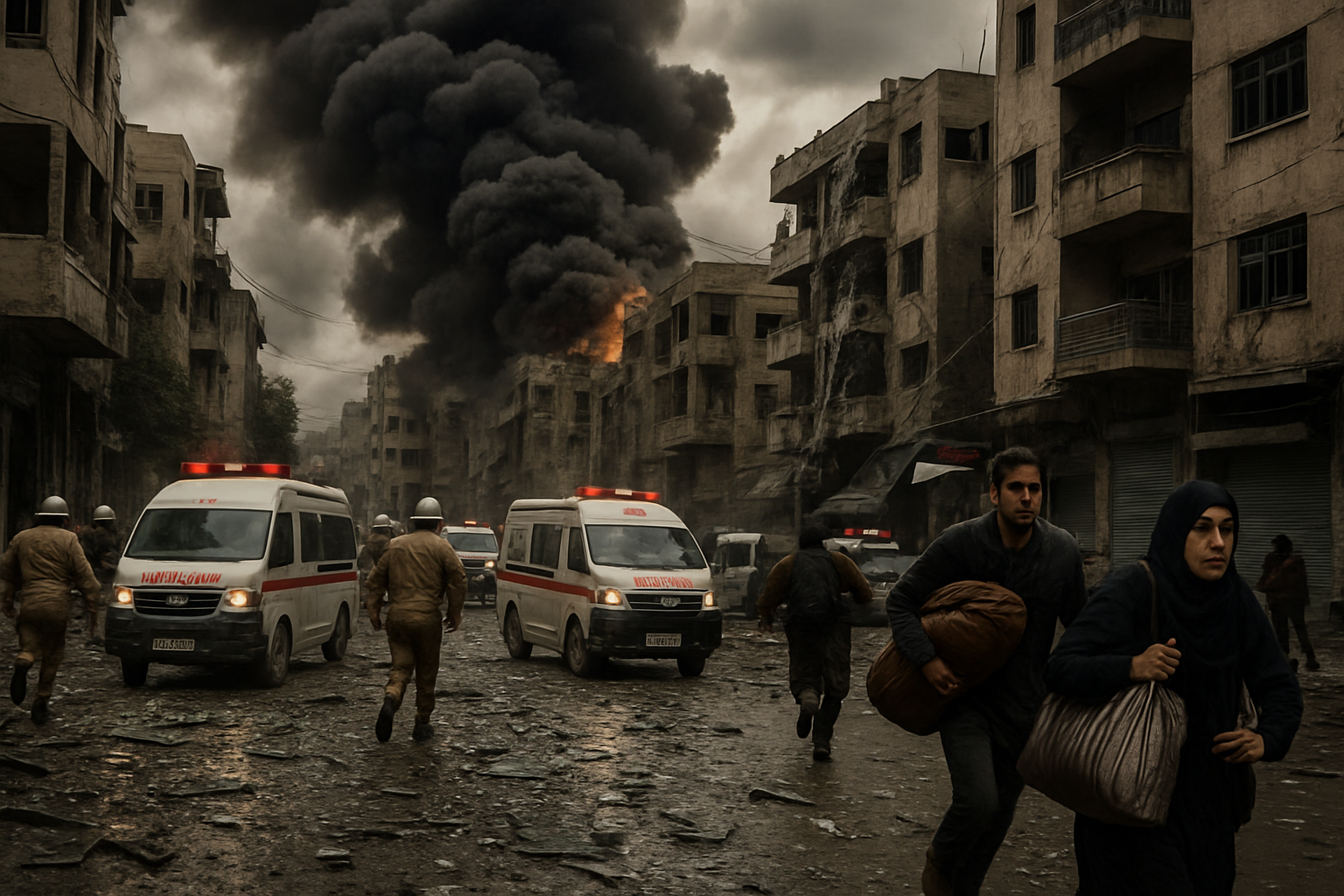
Israeli forces launched their heaviest bombardment of Lebanon since the conflict with Hezbollah began, killing at least 254 people in a single day despite a fragile US-Iran ceasefire agreement brokered just days earlier.
The massive assault on Wednesday marks the most intensive Israeli campaign against Lebanese territory since the broader Middle East crisis erupted following the death of Iranian Supreme Leader Ali Khamenei on March 1, 2026. The strikes have displaced over 1.2 million Lebanese civilians and raised urgent questions about the viability of the recently negotiated ceasefire between Washington and Tehran.
Scale of the Israeli Offensive
Israeli military officials described the operation as their largest coordinated strike of the war, targeting more than 100 Hezbollah administrative and military sites across Beirut, the Bekaa Valley, and southern Lebanon. Continuous explosions struck the Lebanese capital as the Israel Defense Forces (IDF) said they were conducting systematic operations against Iranian-backed Hezbollah infrastructure.
"This represents the heaviest bombardment we have witnessed since the start of the conflict," confirmed Lebanese civil protection authorities, who reported that at least 254 people were killed and hundreds more wounded across multiple governorates.
"We must work to ensure the security and safety of our northern border. The situation will be fundamentally changed,"
— Israeli Prime Minister Benjamin Netanyahu
The Lebanese Health Ministry provided varying casualty figures, with some reports indicating 89 to 112 killed and up to 837 wounded. Among the dead were 12 medical personnel in southern Lebanon, raising serious concerns about potential violations of international humanitarian law.
Ceasefire Under Strain
The timing of the Israeli offensive has placed enormous strain on the US-Iran ceasefire agreement mediated by Pakistan just days earlier. The "Islamabad Accord" was hailed as a historic breakthrough that ended the most dangerous international crisis since the Cold War, with Iran agreeing to reopen the Strait of Hormuz in exchange for a temporary halt to hostilities.
However, Israeli officials have maintained that the ceasefire agreement between the United States and Iran does not extend to their operations against Hezbollah in Lebanon. Netanyahu explicitly stated that Lebanon is not covered by the ceasefire arrangement, creating a critical loophole in what was supposed to be a comprehensive regional peace initiative.
Iranian officials have responded with alarm to the continued violence. Foreign Ministry spokesman Abbas Araghchi warned that Israel's actions "threaten to undermine the diplomatic progress achieved through extensive multilateral efforts."
Humanitarian Catastrophe Deepens
The humanitarian situation in Lebanon has reached catastrophic proportions, with the United Nations describing it as one of the most severe displacement crises in the region since the Arab Spring of 2011. Emergency shelters across the country are overwhelmed, with thousands of families forced to sleep on the streets of Beirut and other major cities.
Particularly concerning is the systematic targeting of medical personnel and facilities. Since March 2, at least 26 paramedics have been killed and 51 wounded in what appears to be a coordinated campaign against emergency responders. The deadliest single incident occurred at the Burj Qalaouiyah primary healthcare center in the Bint Jbeil district, where 12 medical workers—including doctors, nurses, and paramedics—were killed in a direct strike.
Israeli military spokesman Avichai Adraee has threatened additional strikes against ambulances and medical facilities, claiming without evidence that Hezbollah uses these vehicles for military purposes. Hezbollah officials have categorically denied these allegations, while international humanitarian organizations have condemned the targeting of protected medical assets under the Geneva Conventions.

Collapse of Previous Ceasefire Arrangements
The current escalation represents the complete breakdown of the November 2024 US-French brokered ceasefire between Israel and Hezbollah, which had successfully maintained relative calm for over a year. That agreement required both Israeli forces and Hezbollah to withdraw from southern Lebanon, creating a buffer zone monitored by the Lebanese army and UN peacekeepers.
The ceasefire unraveled following the death of Iranian Supreme Leader Ali Khamenei on March 1, 2026, when Hezbollah faced what officials described as an "impossible choice" between maintaining the ceasefire and responding to Iranian pressure for retaliation. The organization ultimately chose solidarity with Iran, declaring that "resistance is the only option" and effectively pulling Lebanon into the broader Iran-Israel conflict.
This decision has had devastating consequences for Lebanese sovereignty and civilian population. Hezbollah, which maintains an estimated 20,000 fighters and substantial weapons stockpiles, has conducted more than 40 operations targeting northern Israeli military sites, including locations near Haifa, while declaring "direct confrontations" with Israeli forces in southern Lebanon.
International Response and Diplomatic Efforts
The international community has responded with a mixture of condemnation and urgent diplomatic initiatives. French President Emmanuel Macron has offered to host direct Israel-Lebanon talks in Paris, marking the first such negotiations proposed since the collapse of the November 2024 ceasefire.
UN Secretary-General António Guterres, who recently visited Beirut, called the overall regional situation "the greatest test of multilateral cooperation in the modern era." During his visit, Guterres urged all parties to pursue diplomatic solutions while emphasizing the protection of civilians.
Turkey has issued some of the strongest condemnations, with officials warning that Israel is committing a "new genocide" under the pretext of targeting Hezbollah. Meanwhile, Sweden has provided 65 million kronor in humanitarian aid to address the mounting crisis.
The situation has also affected UN peacekeeping operations, with a UNIFIL base near Mais al-Jabal coming under attack, resulting in one peacekeeper being wounded. UNIFIL spokeswoman Kandice Ardiel described the situation as "precarious and volatile," affecting both peacekeepers and civilians attempting to evacuate from southern Lebanon.
Regional and Global Implications
The Lebanese crisis is unfolding within the broader context of the most serious Middle Eastern conflict since the end of the Cold War. The regional war that began with the Iran-Israel confrontation has already caused unprecedented global disruptions, including the cancellation of over 18,000 flights worldwide and oil prices surging past $100 per barrel.
Iran's decision to close the Strait of Hormuz through naval mining operations has affected 40% of global oil transit, leading the International Energy Agency to authorize its largest strategic petroleum reserve release in 50 years—400 million barrels from 32 countries.
The conflict has created significant strains within the traditional Middle Eastern coalition of Saudi Arabia, the UAE, Qatar, and Egypt, which had maintained unprecedented consensus in supporting diplomatic solutions. Iranian retaliatory attacks on the territories of these coalition members have tested their unity, with Egyptian President Abdel Fattah el-Sisi condemning attacks on "sisterly countries" and warning of "comprehensive chaos" spreading throughout the region.
Template-Setting Crisis
Analysts describe the current situation as a template-setting moment for 21st-century international relations, testing the effectiveness of diplomatic crisis management in an increasingly multipolar world. The rapid transition from diplomatic breakthrough to military escalation demonstrates the fragility of even the most carefully negotiated agreements when underlying political tensions remain unresolved.
The success or failure of efforts to contain the Lebanese crisis while preserving the broader US-Iran ceasefire will have implications extending far beyond the Middle East. As UN Secretary-General Guterres noted, the stakes involve "regional war prevention, global energy security, nuclear governance credibility, and international law enforcement" with consequences that could reshape conflict resolution approaches for decades.
Looking Ahead
The coming days will be critical in determining whether the international community can prevent the Lebanese crisis from completely derailing the fragile US-Iran ceasefire and potentially igniting a broader regional war. The French proposal for direct Israel-Lebanon talks in Paris represents perhaps the most viable diplomatic avenue, though the conditions for such negotiations remain unclear given the ongoing violence.
For Lebanon, the immediate priority remains addressing the humanitarian catastrophe affecting over one million displaced civilians. The systematic targeting of medical personnel and infrastructure has severely compromised the country's emergency response capabilities, making international humanitarian intervention increasingly urgent.
"We are witnessing a humanitarian catastrophe of unprecedented scale. The international community must act decisively to protect civilians and restore respect for international humanitarian law,"
— Dr. Elias Slela, Head of Lebanese Doctors' Union
The Lebanese crisis serves as a stark reminder of how quickly diplomatic progress can unravel when regional proxy conflicts intersect with broader geopolitical tensions. While the US-Iran ceasefire remains technically in effect, its long-term viability will depend largely on whether the violence in Lebanon can be contained and whether all parties can return to the negotiating table before the two-week window for talks closes.
As the world watches events unfold in Lebanon, the fundamental question remains whether diplomatic solutions can prevail over military escalation in an era of increasingly complex international crises. The answer may well determine the trajectory of Middle Eastern stability and global conflict resolution mechanisms for years to come.