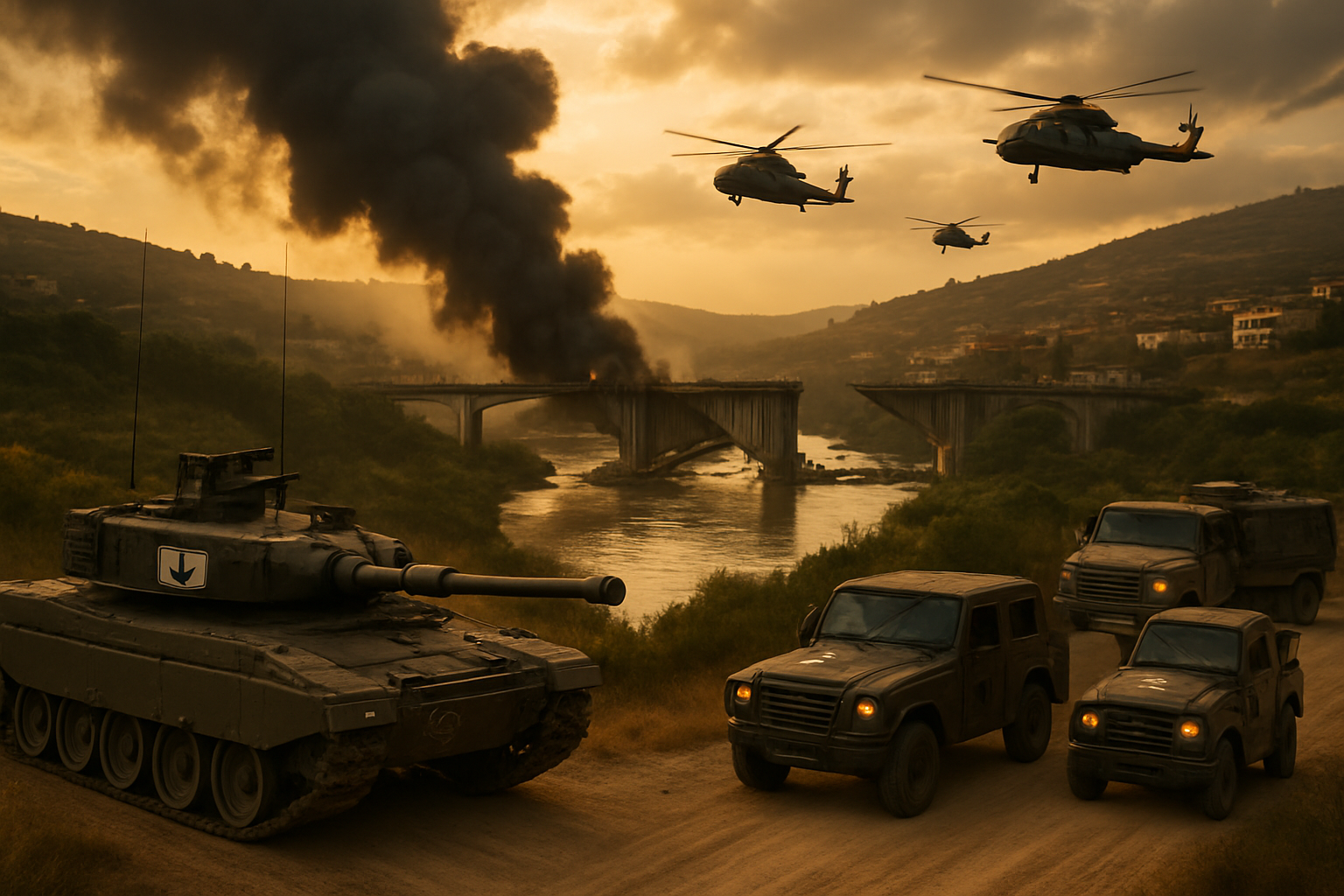
Israeli forces struck the strategic Qasmiyeh Bridge over Lebanon's Litani River while continuing expanded ground operations against Hezbollah positions, as missile intercepts across Kuwait and Saudi Arabia signal a dangerous escalation of the Middle East conflict that has now drawn multiple regional powers into the fray.
The destruction of critical infrastructure marks a significant escalation from previous military targets to civilian-use facilities, with Lebanese President Michel Aoun condemning the bridge strike as "collective punishment" and warning it could signal preparations for a large-scale ground invasion. The assault on the bridge, a vital transport link for southern Lebanese communities, represents Israel's most aggressive targeting of civilian infrastructure since operations began.
Regional Missile Defense Crisis Unfolds
Meanwhile, defense systems across the Gulf region worked around the clock to counter sustained Iranian missile attacks. Kuwait's air defense successfully intercepted one ballistic missile within its airspace over 24 hours, with no casualties or material damage reported. The Kuwaiti Ministry of Defense confirmed the interception while noting that explosive ordnance disposal teams responded to 14 separate incidents of falling debris from defensive operations.
Saudi Arabia's defense systems faced an even more intensive barrage, intercepting one ballistic missile over Riyadh while another fell harmlessly in an uninhabited area. The Kingdom's defense forces also successfully downed 13 drones over the Eastern Province and one over the Northern Borders region. According to Ministry of Defense spokesman Brigadier General Turki Al-Maliki, the defensive operations began overnight and continued through midday, demonstrating the sustained nature of the Iranian assault.
"Saudi Arabia's air defense systems successfully intercepted and destroyed hostile projectiles, maintaining the security of the Kingdom's airspace"
— Brigadier General Turki Al-Maliki, Saudi Defense Ministry
Lebanese Infrastructure Under Siege
The Israeli military's destruction of the Qasmiyeh Bridge over the Litani River has raised international concerns about potential violations of international humanitarian law. The bridge serves as a critical transport artery for southern Lebanese communities, and its destruction effectively cuts off several villages from essential services and supply routes.
According to reports from France 24's correspondent Claire Paccalin on the ground, the bridge strike has sparked fears of an imminent large-scale ground invasion. Lebanese officials describe the action as going beyond military necessity and constituting "collective punishment" of civilian populations.
The escalation comes as Israel has expanded its ground operations in southern Lebanon beyond the positions held since the November 2024 ceasefire, moving into what military officials describe as "new locations" targeting Hezbollah strongholds. IDF Chief Eyal Zamir declared the operation against Hezbollah is "just beginning" with "several weeks" of continued ground operations planned.
Humanitarian Crisis Deepens
The expanding conflict has created a humanitarian catastrophe of unprecedented scale in Lebanon. Over 800,000 Lebanese civilians have been displaced from their homes, with emergency shelters overwhelmed and thousands forced to sleep on Beirut's streets. The Lebanese Health Ministry reports more than 800 killed since the current escalation began, including systematic targeting of medical personnel with 26 paramedics killed and 51 wounded.
The targeting of medical facilities has drawn sharp international condemnation, with the Israeli military spokesperson threatening strikes against ambulances and medical facilities, claiming Hezbollah uses them for military purposes—allegations categorically denied by Hezbollah officials. Such actions potentially constitute serious violations of the Geneva Conventions' protections for medical personnel and facilities.
Broader Regional Context
The current escalation occurs within the context of a broader Middle East crisis that began with the death of Iran's Supreme Leader Ali Khamenei on March 1. The ensuing Iran-Israel war has created global disruptions, with over 18,000 flights cancelled worldwide and oil prices surpassing $100 per barrel as Iran has mined the strategically critical Strait of Hormuz.
Britain has responded to the regional missile threat by deploying short-range air defense systems to Gulf partners. Prime Minister Keir Starmer announced that the UK is "deploying short-range air defence systems to Bahrain at speed" and "doing the same with Kuwait and Saudi Arabia." The British government is working with industry to "distribute air defence missiles to Gulf partners" who have faced waves of Iranian missile barrages.
China has urged all parties, particularly the United States and Israel, to cease military operations, warning of a "vicious cycle" in the conflict. Chinese special envoy to the Middle East Zhai Jun stated that "the one who tied the bell must be the one to untie it," emphasizing the need for those who initiated the conflict to take responsibility for ending it.
International Diplomatic Response
The escalating crisis has prompted urgent diplomatic initiatives. French President Emmanuel Macron has offered to host direct Israel-Lebanon talks in Paris, marking the first such negotiations since the November 2024 ceasefire collapsed. UN Secretary-General António Guterres has called the situation "the greatest test of multilateral cooperation in the modern era."
The November 2024 US-French brokered ceasefire, which had held for over a year despite minor violations, has now completely collapsed. Hezbollah faced an impossible choice between maintaining the ceasefire and responding to Iranian pressure for retaliation following Khamenei's death. The organization ultimately chose Iranian solidarity, declaring that "resistance is the only option."
Economic and Security Implications
The conflict's economic ramifications extend far beyond the Middle East. The Iran-Israel war has resulted in the closure of the Strait of Hormuz, through which 40% of global oil transits, with Iran deploying an estimated 2,000-6,000 naval mines. This has prompted the International Energy Agency to authorize its largest strategic petroleum reserve release in 50 years—400 million barrels from 32 countries.
The aviation industry faces unprecedented disruption, with eight countries maintaining simultaneous airspace closures. Dubai International Airport, the world's busiest with 86 million passengers annually, remains completely shut down due to missile damage. Major carriers including Emirates, Air France-KLM, and Wizz Air have suspended operations indefinitely.
Nuclear Governance Crisis
The current crisis unfolds against the backdrop of a broader nuclear governance breakdown. The New START treaty between the United States and Russia expired on February 5, marking the first time in over 50 years without bilateral nuclear constraints between the superpowers. Iran continues uranium enrichment at 60% purity, approaching weapons-grade levels, with an estimated 400+ kilograms of enriched uranium—sufficient for multiple weapons if weaponized.
Despite previous diplomatic progress through Geneva talks that achieved a "broad agreement on guiding principles"—the most significant progress since the 2018 JCPOA collapse—fundamental scope disagreements proved insurmountable. Iran excluded ballistic missiles and regional proxies as "red lines" while the United States demanded comprehensive agreements including missiles, armed groups, and human rights issues.
Template-Setting Crisis
Military analysts and international relations experts describe the current crisis as "template-setting" for 21st-century conflict resolution. The rapid transition from intensive diplomacy to military confrontation demonstrates the fragility of crisis management mechanisms in the multipolar era.
The stakes extend far beyond the Middle East, affecting global energy security, nuclear governance credibility, international law enforcement, and post-World War II order principles. Success in containing the crisis could provide a framework for future nuclear crisis resolution, while failure may accelerate military solutions over diplomatic ones, potentially encouraging proliferation globally and undermining diplomatic credibility worldwide.
UN Secretary-General Guterres has characterized the situation as potentially reshaping Middle East geopolitics for decades, with implications extending to international approaches to territorial disputes, energy security architecture, and conflict resolution mechanisms that could influence global stability for generations.
As the crisis enters what military officials describe as a critical phase, the coming days and weeks will be decisive in determining whether diplomatic intervention can arrest the escalating violence or if the region faces a prolonged period of broader regional warfare with catastrophic humanitarian and economic consequences.