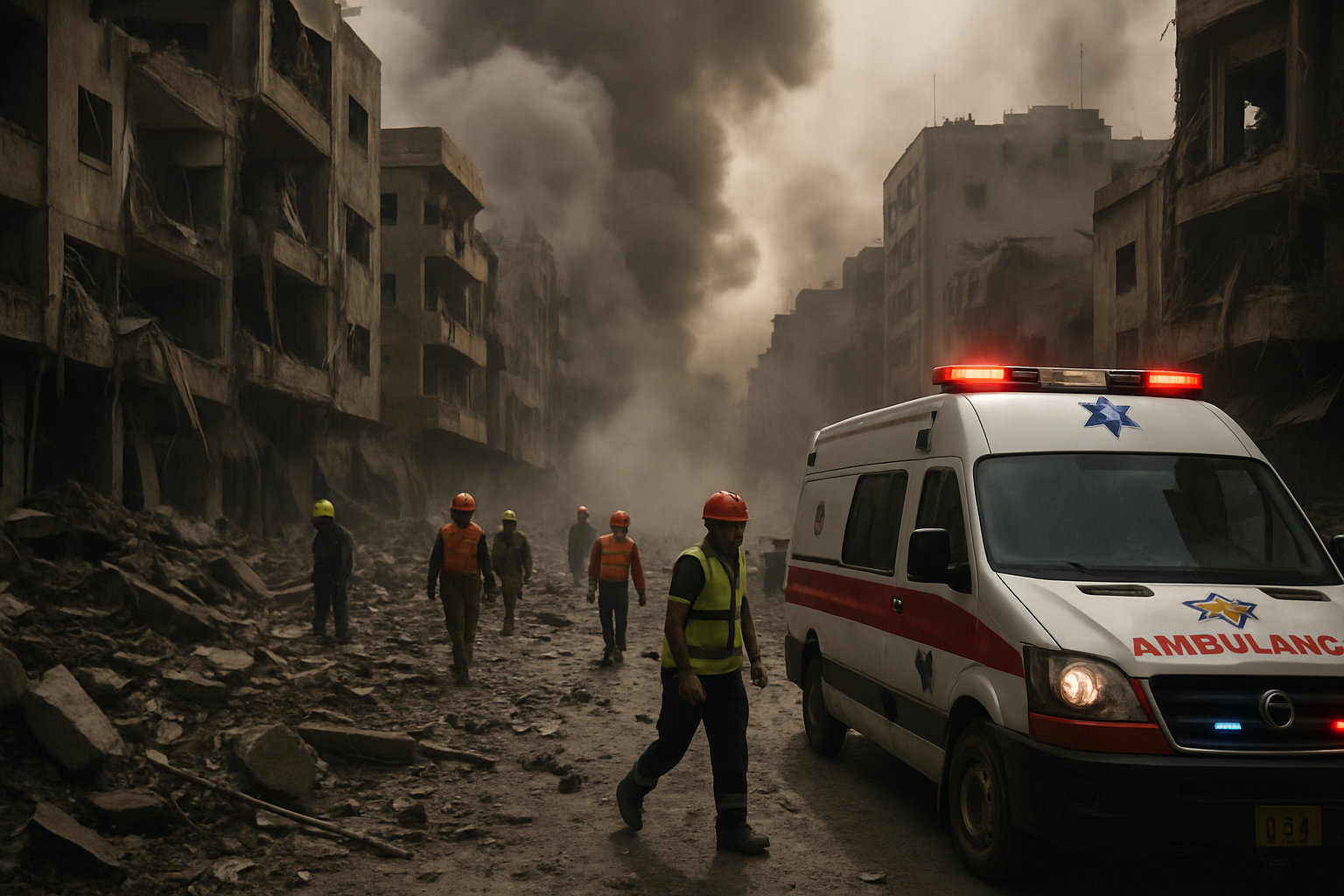
Israel conducted its heaviest bombardment of Lebanon since the conflict began in March 2026, killing at least 254 people in the deadliest single day of the war, as a fragile US-Iran ceasefire brokered by Pakistan just days earlier faces collapse amid accusations of violations from both sides.
The massive Israeli assault targeted over 100 Hezbollah sites across Beirut, the Bekaa Valley, and southern Lebanon on Wednesday, prompting Iran to threaten renewed hostilities and close the Strait of Hormuz to oil tanker traffic in retaliation for what Tehran called violations of the ceasefire agreement.
Deadliest Day Since War Began
Lebanese health authorities reported varying casualty figures, with initial reports of 89-112 killed rising to 254 by Wednesday evening, marking the highest single-day death toll since the Israel-Hezbollah war escalated in March. Nearly 900 people were wounded in the strikes, including 12 medical personnel in southern Lebanon.
"It's a catastrophe," said Aline, a chef running a food charity for displaced Lebanese families, as she witnessed the bombardment of Beirut from her position in the city. The strikes represent the biggest wave of airstrikes since the broader Middle East conflict began following the death of Iran's Supreme Leader Ali Khamenei on March 1, 2026.
Over 1.2 million Lebanese are now internally displaced—nearly one-quarter of the country's population—with emergency shelters overwhelmed and thousands sleeping on the streets of Beirut. The humanitarian crisis has reached unprecedented proportions, with systematic targeting of medical personnel resulting in 26 paramedics killed and 51 wounded since March 2.
Ceasefire Loophole Threatens Broader Agreement
The strikes occurred despite a fragile US-Iran ceasefire brokered by Pakistan just days earlier, known as the "Islamabad Accord." Israeli Prime Minister Benjamin Netanyahu explicitly stated that Lebanon was not covered by the ceasefire arrangement, creating what analysts describe as a critical loophole in the agreement.
"The US never once said the ceasefire applied to Lebanon"
— JD Vance, US Vice President
US Vice President JD Vance reiterated that Iran had a "legitimate misunderstanding" about Lebanon's inclusion in the ceasefire but maintained that Israel was not bound by the agreement regarding its operations in Lebanon. French President Emmanuel Macron and Spanish Prime Minister Pedro Sánchez have insisted that Lebanon must be included for the ceasefire to be "credible and durable."
Iran responded by temporarily suspending oil tanker traffic through the Strait of Hormuz, affecting approximately 40% of global oil transit. Iranian officials warned that continued Israeli operations in Lebanon would render peace negotiations "unreasonable" and threatened to resume full military operations.
Historical Context of Escalation
The current crisis stems from the complete collapse of the November 2024 US-French brokered ceasefire between Israel and Hezbollah, which had held for over a year. The agreement unraveled when Hezbollah faced an "impossible choice" between maintaining the ceasefire and responding to Iranian pressure for retaliation following Khamenei's death.
The organization chose what it called "Iranian solidarity over Lebanese sovereignty," declaring that "resistance is the only option" and pulling Lebanon into the broader Iran-Israel confrontation that began in March 2026.
Since then, the conflict has expanded beyond the Middle East, with Iranian drones striking European territory in Cyprus for the first time since World War II, prompting an unprecedented naval coalition response from European nations.
Systematic Targeting Raises Legal Concerns
International humanitarian organizations have documented systematic targeting of medical facilities and personnel, raising serious concerns about Geneva Conventions violations. The deadliest incident occurred at the Burj Qalaouiyah primary healthcare center in Bint Jbeil district, where 12 medical workers—including doctors, nurses, and paramedics—were killed.
Israeli military spokesman Avichai Adraee has threatened to strike ambulances and medical facilities, claiming Hezbollah uses them for military purposes without providing evidence. Hezbollah has categorically denied these allegations.
UN Peacekeepers Under Fire
The violence has also affected international peacekeeping efforts, with a UNIFIL base near Mais al-Jabal struck, wounding one peacekeeper. This represents the first major breach of peacekeeping arrangements since the November 2024 ceasefire implementation.
Italy condemned Israeli strikes against UNIFIL personnel, with Italian officials calling the attacks "irresponsible" and demanding that Israel cease targeting peacekeepers operating under UN mandates.
Global Economic and Security Implications
The resumption of hostilities has sent shockwaves through global markets and energy networks. Oil prices surged past $100 per barrel for the first time since 2014, with Brent crude reaching $119.50 as Iran's closure of the Strait of Hormuz raised fears of prolonged supply disruptions.
The International Energy Agency has authorized the largest strategic petroleum reserve release in its 50-year history—400 million barrels—to stabilize markets. However, natural gas prices have spiked 24% in Europe and 78% in the United States, threatening household energy costs globally.
Aviation disruptions continue with over 18,000 flights cancelled worldwide—the most severe since the COVID-19 pandemic. Dubai International Airport, the world's busiest, remains closed due to missile damage, while eight Middle Eastern countries maintain simultaneous airspace closures.
Diplomatic Efforts and International Response
French President Emmanuel Macron has offered to host direct Israel-Lebanon talks in Paris, marking the first such diplomatic initiative since the ceasefire collapse. UN Secretary-General António Guterres, who recently visited Beirut, has called the regional situation "the greatest test of multilateral cooperation in the modern era."
Turkey has warned that Israel is committing a "new genocide" under the pretext of fighting Hezbollah, while Sweden has provided 65 million kronor in humanitarian aid to address the displacement crisis.
The situation remains fluid, with Pakistan continuing its mediation efforts between the US and Iran through what officials describe as a "message relay system." However, the fundamental disagreement over Lebanon's inclusion in the ceasefire framework threatens to unravel the broader diplomatic progress achieved in recent days.
Regional Coalition Under Strain
The escalation has severely tested the unprecedented regional coalition that supported diplomatic solutions to the Iran-US crisis. Egypt's President Abdel Fattah el-Sisi condemned Iranian attacks on "sisterly Arab countries" and warned of "comprehensive chaos" spreading across the region.
Saudi Arabia, the UAE, Qatar, and Egypt had maintained remarkable consensus in supporting the diplomatic process, but Iranian retaliation targeting their territories during the broader conflict has strained these relationships. Kuwait relocated Jazeera Airways operations to Saudi Arabia due to repeated drone attacks, while the UAE suspended some operations under Iranian pressure.
Humanitarian Crisis Deepens
The World Health Organization has launched a $30.3 million emergency appeal to support health systems across five Middle Eastern countries affected by the escalating violence. WHO Director-General Tedros Adhanom Ghebreyesus warned that healthcare systems are "under severe strain" from the sustained violence.
In Lebanon alone, the systematic targeting of medical infrastructure has crippled emergency response capabilities. Healthcare workers describe civil war-era scenes as families desperately seek shelter anywhere possible, with traditional support systems—schools, religious institutions, and community centers—at capacity.
International Evacuation Efforts
Multiple countries have initiated large-scale evacuations of their citizens, with Australia reporting 115,000 nationals trapped in the region and Germany evacuating 30,000 stranded tourists. The European Union activated its ESTIA crisis mechanism for the first time in the bloc's history to coordinate evacuations from Cyprus.
Looking Ahead: Critical Juncture
The coming days represent a critical juncture for both regional stability and the broader international order. The success or failure of diplomatic efforts to contain the crisis will likely establish precedents for 21st-century conflict resolution, affecting how the international community responds to future territorial and nuclear disputes.
Military analysts warn that the current trajectory risks a prolonged regional war that could draw in additional Iranian proxy groups across the Middle East, potentially overwhelming diplomatic mechanisms and leading to a broader confrontation with global implications.
The template-setting nature of this crisis extends beyond the immediate humanitarian concerns. As UN Secretary-General Guterres noted, the international community faces "the greatest test of multilateral cooperation in the modern era," with stakes that include regional war prevention, global energy security, nuclear governance credibility, and international law enforcement.
The fragile ceasefire achieved through Pakistani mediation represents perhaps the last diplomatic opportunity to prevent a broader regional war that could affect millions more civilians across the Middle East and reshape the international order for decades to come.