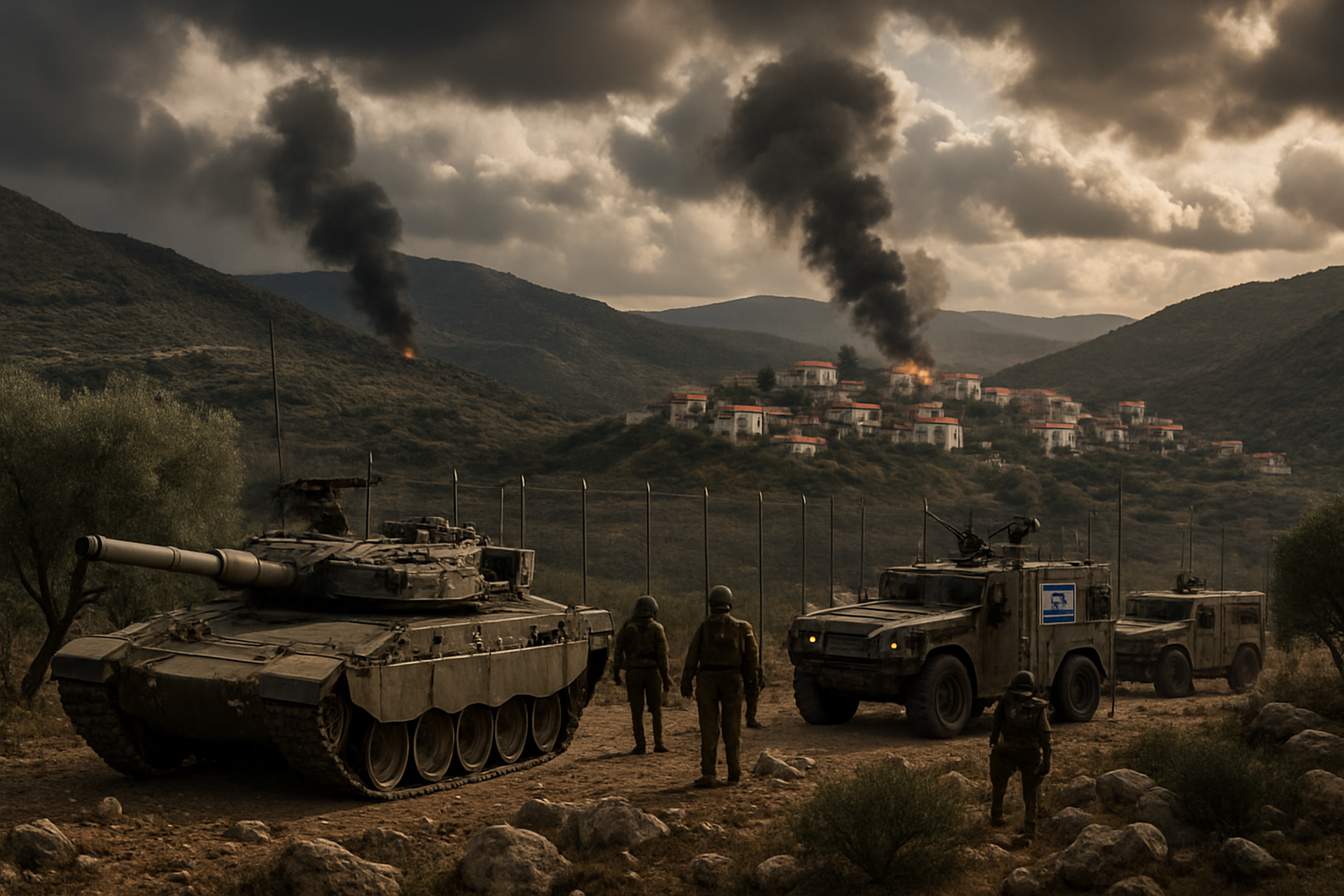
Israeli military forces issued fresh evacuation orders for seven Lebanese towns beyond their established "buffer zone" on Sunday, marking a dangerous escalation of the fragile ceasefire that has repeatedly failed to halt military operations despite recent diplomatic extensions.
The Israeli Defense Forces (IDF) directed residents of towns north of the Litani River to evacuate immediately, citing Hezbollah violations of the ceasefire agreement. This represents the most significant expansion of evacuation warnings since the three-week ceasefire extension announced by President Trump on April 23-24, following high-level talks with Israeli Prime Minister Netanyahu and Lebanese President Joseph Aoun.
Immediate Ceasefire Violations Escalate
The latest evacuation orders came as Israeli forces conducted multiple strikes across southern Lebanon, resulting in civilian casualties despite the supposedly active truce. Lebanese authorities reported that one civilian was killed and three others wounded in an Israeli airstrike on the village of Borj Qalaouiyah, with rescue teams continuing to search for missing persons.
According to Lebanese military sources, Israeli forces also conducted explosive demolitions of homes and infrastructure between the villages of Yarin and other border areas, systematically destroying civilian property. The Italian Ministry of Health reported that over 2,500 people have been killed in Israeli raids since March 2, with 7,755 wounded, highlighting the devastating human cost of the ongoing conflict.
Israeli military spokesperson confirmed strikes against "loaded rocket launchers" and "Hezbollah fighters preparing attacks," but provided no evidence directly linking these military targets to the civilian casualties reported by Lebanese authorities.
The Lebanon Loophole in International Diplomacy
A critical factor undermining the ceasefire's effectiveness is what experts term the "Lebanon loophole" - Netanyahu's explicit exclusion of Lebanon from the broader Pakistan-mediated "Islamabad Accord" between the United States and Iran. This creates a dangerous gap in regional peace efforts, as Iran maintains that comprehensive enforcement across all fronts is essential for lasting stability.
Vice President JD Vance has acknowledged Iran's "legitimate misunderstanding" about Lebanon's inclusion in broader ceasefire arrangements, but the U.S. position remains that Lebanon operations were never part of the Iran deal. This fundamental disagreement threatens to undermine the historic mediation success achieved by Pakistan's leadership.
"From our perspective, what obliges us is the security of Israel, the security of our soldiers, the security of our communities," Netanyahu stated at a cabinet meeting in Jerusalem, defending the continued military operations.
— Benjamin Netanyahu, Israeli Prime Minister
Humanitarian Crisis Reaches Breaking Point
The ongoing conflict has created an unprecedented humanitarian catastrophe across Lebanon. According to international monitoring organizations, 1.2 million Lebanese citizens - representing 25% of the country's population - have been displaced from their homes since the March 2026 escalation began.
Emergency shelters across the country are operating at breaking point, with thousands of families forced to sleep on Beirut's streets and in cars. The systematic targeting of medical personnel has created additional humanitarian concerns, with 26 paramedics killed and 51 wounded since March 2, according to Lebanese Health Ministry data.
The World Health Organization has issued a $30.3 million emergency appeal for five Middle Eastern countries, describing healthcare systems as being "under severe strain." The deadliest single attack on medical workers occurred at the Burj Qalaouiyah healthcare center, where 12 medical professionals - including doctors, nurses, and paramedics - were killed in what human rights organizations describe as potential Geneva Conventions violations.
Background: The Collapse of November 2024 Agreements
The current crisis stems from the complete breakdown of the November 2024 U.S.-French brokered Israel-Hezbollah ceasefire agreement, which had successfully maintained relative stability for over a year. The arrangement required both Israeli forces and Hezbollah to withdraw from southern Lebanon, establishing buffer zones monitored by Lebanese army units and UN peacekeepers.
This carefully constructed peace framework collapsed in March 2026 when Hezbollah faced what analysts describe as an "impossible choice" between maintaining the ceasefire and responding to Iranian pressure for retaliation following the death of Supreme Leader Ali Khamenei on March 1. The organization ultimately chose what it termed "Iranian solidarity over Lebanese sovereignty," declaring that "resistance was the only option."
Hezbollah's Military Response and Rejection of Talks
Hezbollah, estimated to maintain approximately 20,000 fighters, has conducted over 40 military operations targeting Israeli positions, with some reaching as far as Haifa. The organization declared "direct confrontations" with Israeli forces in southern Lebanon, marking a significant operational escalation from its previous restraint strategy.
Secretary-General Naim Qassem has categorically rejected current diplomatic initiatives, calling recent peace talks "pointless" and demanding that the Lebanese government take a "historic heroic stance" by withdrawing from negotiations. The organization has documented over 10,000 Israeli violations of previous agreements, resulting in more than 500 civilian deaths.
International Peacekeeping Forces Under Attack
The deteriorating security situation has also endangered international peacekeeping efforts. Most notably, French UN peacekeeper Staff Sergeant Florian Montorio was killed in what President Emmanuel Macron directly attributed to a deliberate Hezbollah attack. The incident represents a serious escalation in targeting international forces, with multiple UNIFIL bases struck and peacekeepers wounded in what spokeswoman Kandice Ardiel described as "precarious and volatile" conditions.
These attacks on international peacekeeping forces represent the first major breaches of peacekeeping arrangements since the November 2024 ceasefire implementation, raising questions about the safety of international personnel and the viability of UN monitoring missions in the region.
Global Economic and Security Implications
The crisis has generated significant global economic disruption, with over 18,000 flights cancelled worldwide - representing a COVID-scale aviation crisis. Oil prices have surged past $100 per barrel for the first time since 2014, largely due to threats to the Strait of Hormuz, which handles 40% of global seaborne oil transit.
The International Energy Agency coordinated the largest strategic reserve release in 50 years, releasing 400 million barrels from 32 countries to stabilize global energy markets. Natural gas prices have increased by 24% in Europe and 78% in the United States, directly impacting household costs worldwide.
Diplomatic Efforts and Future Prospects
Despite the military escalation, diplomatic efforts continue. French President Macron has offered to host direct Israel-Lebanon talks in Paris - the first such negotiations since the ceasefire collapse. UN Secretary-General António Guterres has called the situation "the greatest test of multilateral cooperation in the modern era," emphasizing the template-setting nature of this crisis for 21st-century conflict resolution.
Eight Arab nations, including countries with normalized relations with Israel such as the UAE and Saudi Arabia, have issued joint condemnations of the ongoing violations. Over 400 European Union diplomats have signed petitions demanding increased pressure for ceasefire compliance, while European civil society organizations have gathered over 400,000 signatures supporting Palestinian and Lebanese rights.
Looking Forward: Critical Diplomatic Window
The success or failure of current diplomatic interventions will likely determine precedents for 21st-century conflict resolution approaches. The stakes extend beyond the immediate humanitarian crisis to include regional war prevention, global energy security, nuclear governance credibility, and international law enforcement mechanisms that could affect global stability for decades.
As Israeli forces continue operations beyond their established buffer zones and Hezbollah maintains its military posture, the international community faces a critical test of its commitment to diplomatic solutions over military escalation. The coming days and weeks will be crucial in determining whether the region can step back from what many analysts describe as the most serious Middle East crisis since the end of the Cold War.
The tragic human cost continues to mount as families across Lebanon remain displaced and emergency services struggle to provide adequate care under increasingly dangerous conditions. The international community's response to these challenges will likely establish important precedents for civilian protection frameworks in modern conflicts.