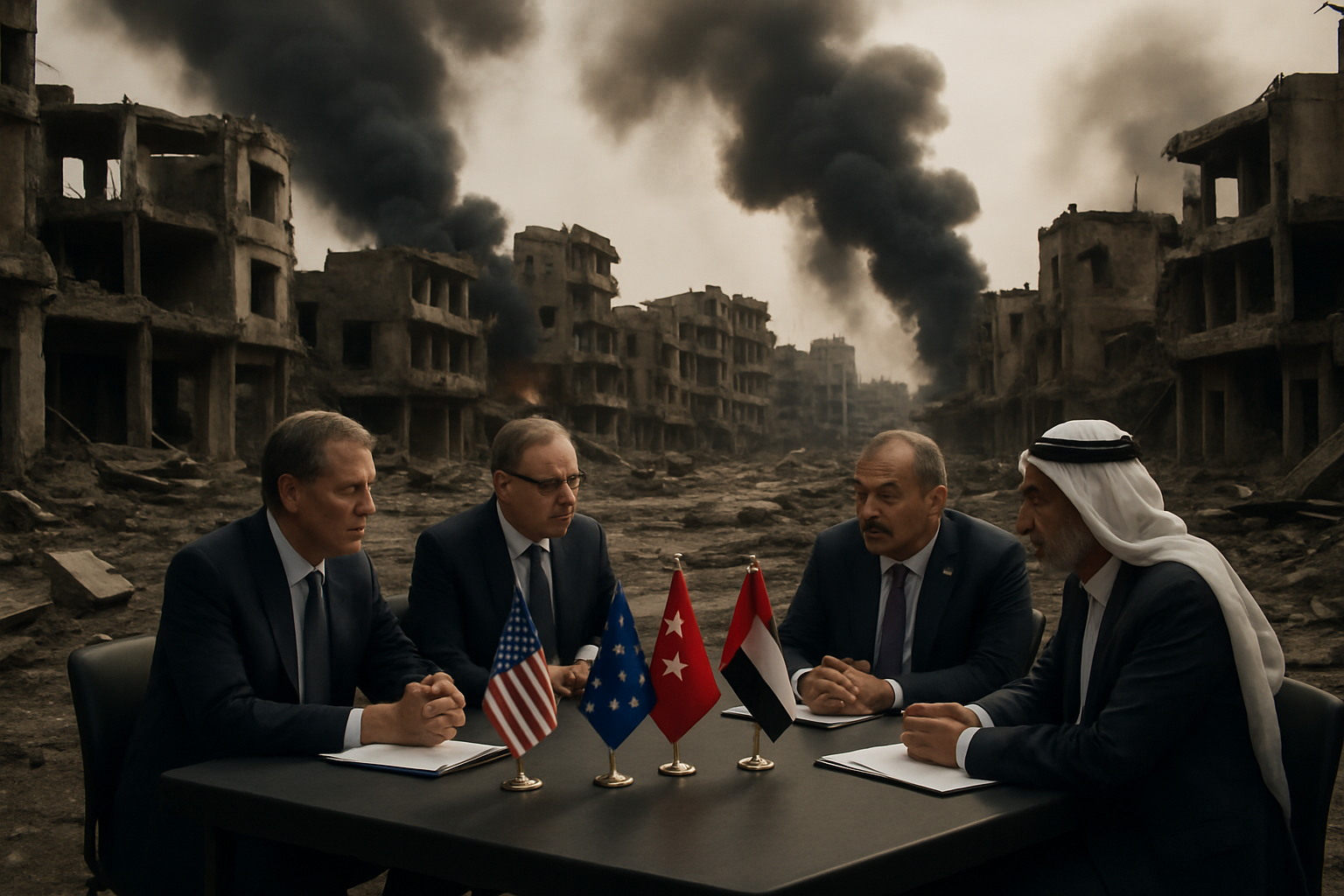
Israeli forces killed at least 15 people across Gaza and Lebanon on Sunday while the Israeli cabinet approved the most comprehensive West Bank land seizure since 1967, marking a dramatic escalation in multiple conflict zones that threatens to undermine international peace initiatives.
The deadly strikes occurred as Israeli Prime Minister Benjamin Netanyahu's government formalized unprecedented territorial control measures in the occupied West Bank, drawing fierce international condemnation and accusations of implementing "de-facto annexation" in violation of international law.
Gaza Strikes Continue Despite Ceasefire
Israeli airstrikes across the Gaza Strip killed at least 11 Palestinians on Sunday, including four people in a tent encampment housing displaced families in northern Gaza. The Israeli Defense Forces justified the operations as "precise strikes" responding to alleged Hamas ceasefire violations in Beit Hanoun, where militants reportedly emerged from tunnels east of the "yellow line" ceasefire demarcation.
The Gaza Government Media Office has documented over 1,600 systematic ceasefire violations since the October 10, 2025 truce began, resulting in 601 Palestinian deaths and 1,553 injuries during what was intended to be a peace period. The total Gaza death toll has reached 71,800.
"Where is the ceasefire?"
— Dr. Mohamed Abu Selmiya, Al-Shifa Hospital Director
The humanitarian crisis has deepened with Gaza's Civil Defense completely shut down due to fuel shortages, hampering emergency response capabilities. Only 27 Palestinians crossed the Rafah border with Egypt versus the agreed daily quota of 200, with Hamas condemning "systematic harassment" by Israeli security forces denying passage to 38 of 50 planned returnees. An estimated 20,000 Palestinians still await medical evacuation.
Lebanon Border Strike Kills Four
Simultaneously, Israeli forces conducted a targeted drone strike in eastern Lebanon near the Syrian border, killing four people identified as operatives of the Palestinian Islamic Jihad group. The strike occurred approximately 25 miles north of Lebanon's border with Israel, representing the most significant Israeli military action in Lebanon since recent ceasefire arrangements.
Despite a November 2024 truce intended to end over a year of Israel-Hezbollah hostilities, Israel has continued carrying out regular strikes in Lebanon, with Sunday's operation marking the first officially announced action against Islamic Jihad since the ceasefire.
Historic West Bank Land Seizure Approved
In the most significant development, the Israeli cabinet approved Finance Minister Bezalel Smotrich's proposal to restart registering "extensive" areas of West Bank land as "Israeli territory" for the first time since 1967 – representing the largest land seizure since the occupation began.
The decision allocates an initial 244 million shekels (approximately $67 million) for land registration from 2026-2030, with the process potentially taking 30 years to complete. The systematic approach targets hundreds of thousands of dunams, with particular focus on the strategically vital Jordan Valley.
"This represents a true revolution in settlement policy and a dramatic policy transformation removing bureaucratic obstacles to settlement expansion."
— Bezalel Smotrich, Israeli Finance Minister
Energy Minister Eli Cohen openly acknowledged the measures constitute "factual sovereignty" implementation, stating the steps will "establish reality on the ground that there will be no Palestinian state."
Unprecedented International Condemnation
Eight Arab and Muslim nations – Saudi Arabia, Jordan, Egypt, UAE, Qatar, Indonesia, Pakistan, and Turkey – issued a joint condemnation calling the Israeli measures violations of international law "aimed at imposing unlawful Israeli sovereignty" and undermining the two-state solution.
The European Union characterized the actions as a "step in the wrong direction," emphasizing that annexation remains illegal under international law. Britain demanded Israel reverse the moves, warning that any "unilateral attempt to alter the geographic or demographic makeup of Palestine is wholly unacceptable."
UN Secretary-General António Guterres expressed "grave concern," warning that the measures threaten the viability of a two-state solution through "dangerous escalation." Over 400 EU diplomats have called for increased pressure on Israeli authorities, while a European Left Coalition petition against EU-Israel partnerships has exceeded 400,000 signatures.
Palestinian Authority Response
Palestinian Authority President Mahmoud Abbas condemned the Israeli decisions as "dangerous" measures that systematically violate international law and undermine the possibility of a viable Palestinian state. Hamas described the land registration decision as "null and void" from an "illegitimate occupation authority."
Palestinian sources describe the land seizure as the largest confiscation operation since 1967, potentially affecting the livelihoods of hundreds of thousands of Palestinians and making a two-state solution technically unfeasible through systematic demographic and geographic landscape alteration.
International Peace Initiatives Under Threat
The escalating violence and territorial seizures threaten President Trump's Board of Peace initiative scheduled for February 19, which aims to secure over $1 billion in Gaza reconstruction commitments from 27 member nations. The initiative represents a "business approach" to conflict resolution, departing from traditional UN frameworks.
Hungarian Prime Minister Viktor Orbán has confirmed attendance at the Washington summit, but the continued ceasefire violations and West Bank annexation moves have created serious obstacles to meaningful peace negotiations.
Legal and Strategic Implications
International legal experts cite potential violations of UN Security Council resolutions and Geneva Conventions regarding occupied territories. The systematic extension of Israeli civilian law and administration into occupied territory meets international legal definitions of annexation regardless of formal declarations.
The measures effectively erode the Oslo Accords framework that has governed Israeli-Palestinian relations since the 1990s, with critics arguing they could make a two-state solution technically unfeasible through systematic territorial control.
Regional Diplomatic Response
The coordinated eight-nation response represents unusual diplomatic consensus, unifying regional opposition across traditional divisions. The Organization of Islamic Cooperation (OIC) separately condemned what it described as "continuing massacres," citing the recent casualties as evidence of dangerous escalation.
Egypt has maintained 150 hospitals on alert with 300 ambulances deployed for Gaza medical evacuations, while continuing diplomatic efforts to salvage the peace process despite the systematic violations.
Looking Forward
The current escalation represents a comprehensive challenge to Palestinian statehood, regional stability, and international law enforcement credibility. The pattern of systematic ceasefire violations combined with unprecedented territorial seizures suggests a fundamental departure from previous diplomatic frameworks toward aggressive sovereignty assertions.
Success or failure of the international opposition will likely influence territorial sovereignty disputes and conflict resolution mechanisms globally, setting significant precedents for how the international community responds to systematic violations of international law in occupied territories.
As diplomatic efforts continue, the international community faces mounting pressure to develop more effective enforcement mechanisms for ceasefire agreements and territorial dispute resolution, with the credibility of 21st-century global governance systems hanging in the balance.