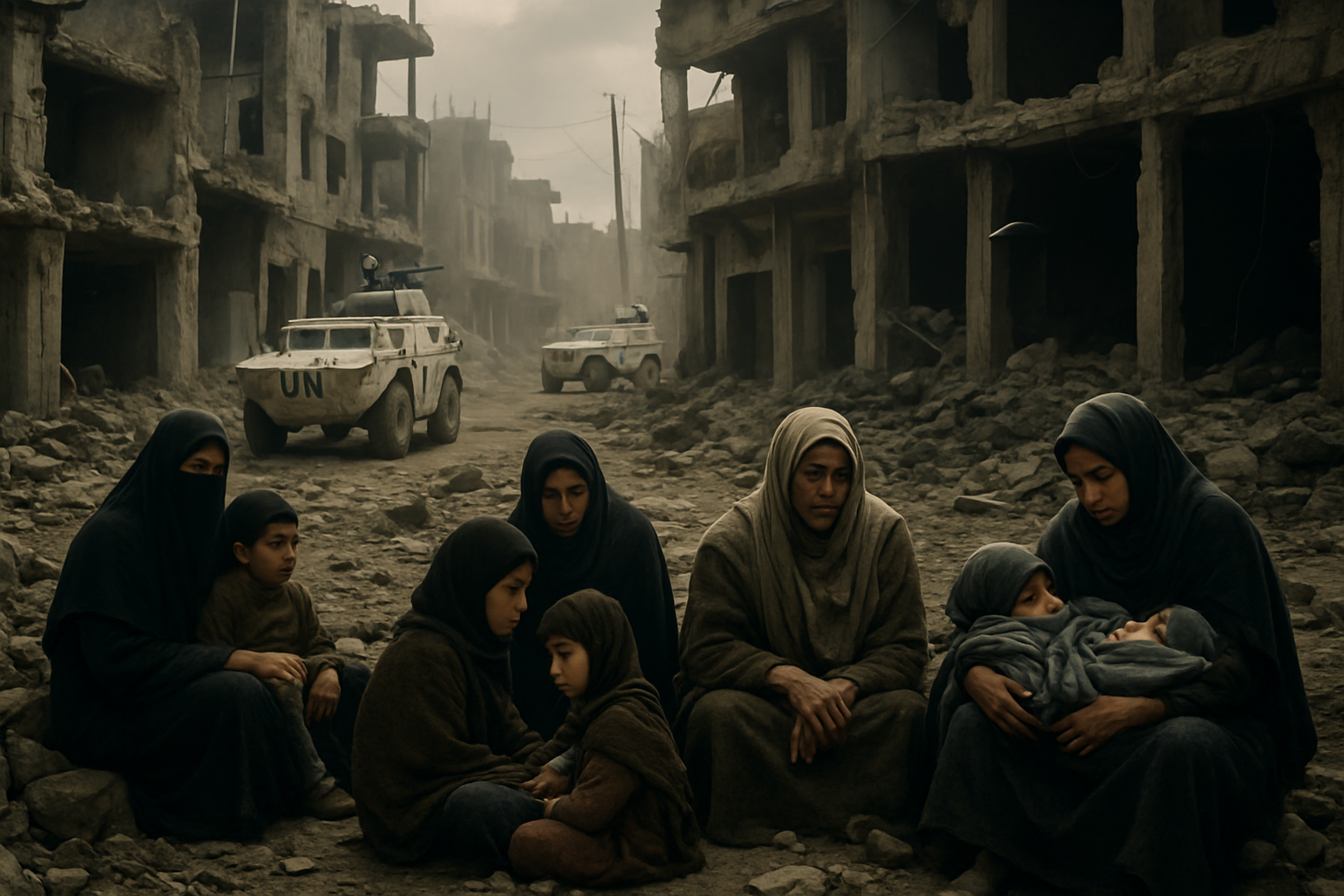
Historic diplomatic talks between Israeli and Lebanese ambassadors are scheduled for Tuesday, April 15, 2026, at the US State Department, marking the first formal engagement since the November 2024 ceasefire collapsed, as the Middle East faces its most dangerous crisis since the Cold War with over 1.2 million Lebanese displaced and systematic violations plaguing multiple conflict zones.
The unprecedented humanitarian catastrophe across multiple theaters has prompted urgent international intervention, with over 1,600 documented Gaza ceasefire violations since October 2025 resulting in 680+ Palestinian deaths during what was supposed to be a peace period. Meanwhile, Israeli ground operations in southern Lebanon have expanded beyond November 2024 ceasefire positions, creating new "security zones" amid systematic targeting of medical personnel.
Gaza Under Siege: Systematic Ceasefire Breakdown
The collapse of Gaza's ceasefire agreement has been described by international observers as one of the most systematically breached truces in recent history. Dr. Mohamed Abu Selmiya, Director of Al-Shifa Hospital, has repeatedly questioned "Where is the ceasefire?" as Israeli forces continue operations that have killed at least six Palestinians in Al-Maghazi refugee camp and other areas of central Gaza.
The humanitarian infrastructure has reached a breaking point. Gaza Civil Defense has completely shut down due to fuel shortages, compromising emergency response capabilities for 2.3 million residents. The Rafah crossing, Gaza's only non-Israeli controlled access point, has been severely restricted with only 27 people crossing daily versus the agreed 200-person quota—what Hamas condemns as "systematic harassment."
"Gaza is experiencing complete darkness. There is no electricity, no scheduled power hours, forcing residents to completely reshape their lives,"
— Palestinian Media Center Report
Over 20,000 Palestinians await medical evacuation, with Gaza Health Ministry Director Zaher al-Wahidi reporting that 6-10 critically ill patients are dying daily. Environmental concerns are mounting, with Palestinian NGO Network President Amjad al-Shawa warning of public health emergencies from waste accumulation and disease outbreak risks in overcrowded displacement camps.
West Bank: Unprecedented Territorial Expansion
Parallel to the Gaza crisis, Israeli authorities have announced the construction of over 30 new settlements in the occupied West Bank, drawing fierce condemnation from the European Union and 85 UN member states. The EU characterized the expansion as "illegal under international law" and a "major setback to peace efforts," while Finance Minister Bezalel Smotrich has openly declared policies designed to "kill the idea of a Palestinian state."
The Israeli government has approved the most comprehensive West Bank land registration since the 1967 occupation, targeting hundreds of thousands of dunams with strategic focus on the Jordan Valley. Energy Minister Eli Cohen acknowledged that these measures constitute "factual sovereignty" implementation, establishing "reality on the ground that there will be no Palestinian state."
Recent violence has escalated dramatically, with Palestinian sources reporting attacks by both Israeli forces and settlers in multiple areas including Nablus, where 25 Palestinians were wounded in coordinated assaults. Two Palestinian children were killed by unexploded Israeli military ordnance in Jiftlik, Jordan Valley, while 15 Bedouin families were forced to flee their homes due to settler violence.
Lebanon Crisis: Complete Ceasefire Collapse
The November 2024 US-French brokered ceasefire between Israel and Hezbollah, which had held for over a year, completely collapsed in March 2026. This breakdown followed the death of Iranian Supreme Leader Ali Khamenei on March 1, forcing Hezbollah into what officials described as an "impossible choice" between maintaining the ceasefire and responding to Iranian pressure for retaliation.
Lebanese casualties have reached catastrophic levels, with over 1,200 civilian deaths and 1.2 million displaced persons—representing 25% of Lebanon's population. Emergency shelters are overwhelmed, with thousands sleeping on Beirut streets. The systematic targeting of medical personnel has resulted in 26 paramedics killed and 51 wounded since March 2, including a devastating attack on the Burj Qalaouiyah healthcare center that killed 12 medical workers.
Israeli Defense Forces have expanded ground operations beyond the original ceasefire positions, with IDF Chief Eyal Zamir declaring that operations are "just beginning" with "several weeks" of continued ground operations planned. Netanyahu has ordered the destruction of strategic infrastructure, including the Qasmiyeh Bridge over the Litani River, and issued demolition orders for civilian homes near the border.
Regional Powers Under Pressure
The crisis has strained traditional regional alliances, with eight Arab nations—including countries that normalized relations with Israel such as the UAE and Saudi Arabia—issuing joint condemnations of what they term systematic violations of international law. Egyptian President Abdel Fattah el-Sisi has warned of "comprehensive chaos" spreading across the region as Iranian attacks have directly targeted "sisterly countries."
Morocco has witnessed solidarity protests supporting Palestinian prisoners, while Italy has seen silent marches in Rome for Gaza's victims. The international response has been unprecedented in scope, with over 400 EU diplomats demanding increased pressure on Israeli authorities and European Left Coalition petitions gathering more than 400,000 signatures against EU-Israel partnerships.
Nuclear and Diplomatic Breakdown
The broader regional context includes the complete collapse of nuclear diplomacy frameworks. The New START treaty expired in February 2026, marking the first time in over 50 years without US-Russia nuclear constraints. Iran continues uranium enrichment at 60% purity with over 400kg of weapons-grade material—sufficient for multiple nuclear weapons according to international experts.
The hereditary succession of Mojtaba Khamenei as Iran's Supreme Leader—the first in the Islamic Republic's 47-year history—has consolidated Revolutionary Guards control over governance during active warfare conditions. Trump administration demands for "unconditional surrender" and claims of the right to personally choose Iran's next Supreme Leader represent the most explicit regime change rhetoric since 1979.
Global Economic and Security Impact
The conflicts have triggered unprecedented global disruptions. Over 18,000 flights have been cancelled worldwide—reaching COVID-19 scale aviation crisis levels—with eight Middle Eastern countries maintaining simultaneous airspace closures. Oil prices have surged past $100 per barrel for the first time since 2014, with Iran's mining of the Strait of Hormuz effectively closing 40% of global oil transit.
The International Energy Agency has implemented its largest strategic reserve release in its 50-year history, deploying 400 million barrels to stabilize markets. Natural gas prices have surged 24% in Europe and 78% in the United States, while Qatar's LNG production—representing 20% of global exports—has been halted due to infrastructure damage.
Diplomatic Last Resort: Washington Talks
The scheduled April 15 talks between Israeli and Lebanese ambassadors represent what many diplomatic observers consider a last resort for preventing broader regional warfare. The negotiations will focus on establishing immediate ceasefire frameworks, force withdrawal from buffer zones, enhanced Lebanese army and UN peacekeeping deployment, and long-term security guarantees for both sides.
However, critical challenges remain. Netanyahu has explicitly excluded Lebanon from broader ceasefire frameworks, creating what diplomatic sources term a "dangerous loophole" that threatens any comprehensive agreement. Iran has indicated it may withdraw from broader regional talks unless comprehensive enforcement mechanisms are established across all fronts.
French President Emmanuel Macron has offered to host direct Israel-Lebanon talks in Paris—the first such negotiations since the ceasefire collapse. UN Secretary-General António Guterres has called the situation "the greatest test of multilateral cooperation in the modern era," while Turkey has warned Israel against committing "genocide under Hezbollah pretext."
International Law Under Strain
Legal experts cite extensive violations of UN Security Council resolutions and Geneva Conventions across multiple theaters. The systematic targeting of medical personnel in Lebanon, collective punishment policies in Gaza, and territorial expansion in the West Bank constitute what international observers term "comprehensive challenges to civilian protection frameworks."
The World Health Organization has launched a $30.3 million emergency appeal to support health systems in five Middle Eastern countries, warning that healthcare infrastructure is "under severe strain." WHO Director-General Tedros Adhanom Ghebreyesus emphasized that attacks on healthcare represent "attacks on humanity itself."
Template-Setting Crisis
The current Middle East crisis is being viewed by international relations experts as a template-setting moment for 21st-century conflict resolution. The success or failure of diplomatic interventions will establish precedents for territorial sovereignty disputes, nuclear governance credibility, and international law enforcement mechanisms with implications extending decades beyond current events.
Pakistan's emergence as a crucial mediator in broader US-Iran talks through the "Islamabad Accord" demonstrates innovative solutions possible when traditional great power mechanisms fail. The framework provides a precedent for multipolar world order approaches where middle powers bridge major adversary divides to prevent catastrophic conflict escalation.
As diplomatic efforts intensify ahead of Tuesday's Washington talks, the international community faces critical decisions about whether to prioritize immediate ceasefire arrangements or address underlying political and security issues driving the conflicts. The coming days will determine whether diplomatic innovation can prevent broader regional warfare affecting millions more civilians, or if the Middle East will descend into the most dangerous international crisis since the Cold War's end.
The stakes extend far beyond regional boundaries, affecting global energy architecture, nuclear proliferation prevention mechanisms, and the credibility of international law enforcement in an increasingly multipolar world. Success in containing these conflicts through diplomatic means could provide frameworks for managing similar crises globally, while failure may accelerate preferences for military solutions over negotiated settlements for decades to come.