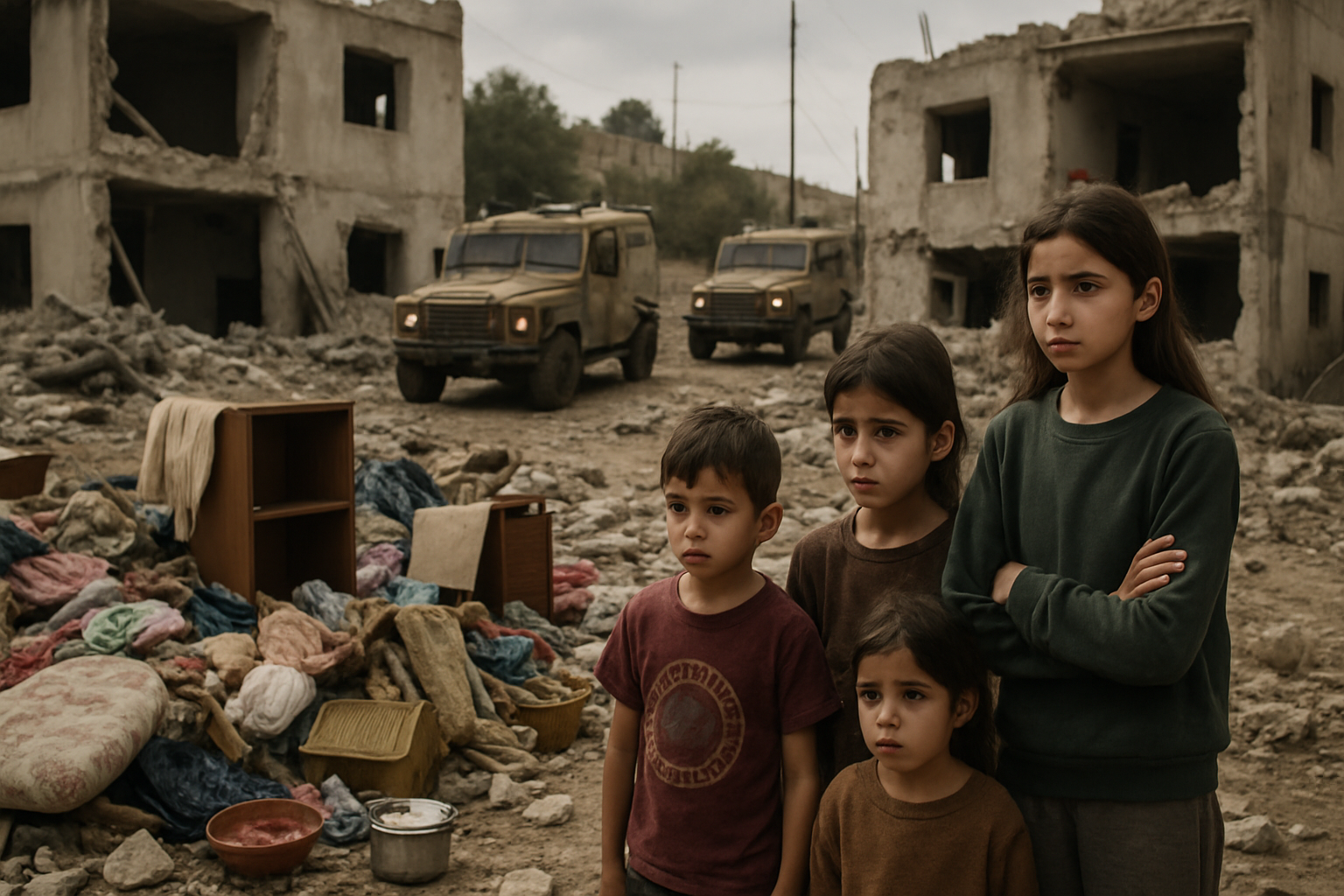
Violence erupted across the occupied Palestinian territories on Tuesday, February 17, 2026, as two Palestinian children were killed by unexploded Israeli military ordnance in the Jordan Valley while settler attacks forced 15 families to flee their homes in the northern West Bank.
The tragic incidents highlight the escalating crisis facing Palestinian civilians amid Israel's unprecedented territorial expansion policies and systematic violations of international law that have drawn widespread global condemnation.
Children Killed by Military Ordnance
Two Palestinian children died and three others were injured when unexploded Israeli military ordnance detonated in the village of Jiftlik in the central Jordan Valley, north of Jericho. According to Palestinian sources, five children from the village were playing in agricultural areas of the neighboring Farush Beit Dajan when the explosion occurred.
The Israeli military claimed the incident happened at a shooting range where "ammunition exploded as kids handled it," stating that Israeli troops treated two others injured in the incident. However, Palestinian officials described the deaths as resulting from military remnants left behind by Israeli forces in civilian areas.
Jiftlik Mayor Ahmed Ghawanem confirmed that the children were in their community's agricultural lands when the deadly explosion took place, underscoring the ongoing danger posed by military ordnance in areas where Palestinian families live and work.
Settler Violence Forces Mass Displacement
In a separate incident that same day, escalating attacks by Israeli settlers forced 15 Palestinian families to abandon their homes in the al-Burj Bedouin community in the northern Jordan Valley. The families were compelled to dismantle their own homes under pressure from settler violence, according to village leaders who spoke to Palestinian news agencies.
The forced displacement represents the latest wave of what Palestinian officials describe as systematic ethnic cleansing targeting Bedouin communities throughout the West Bank. These communities, often living in temporary structures, are particularly vulnerable to both settler attacks and Israeli military operations.
"Israeli settler attacks are driving Palestinian Bedouins from their homes in the occupied West Bank."
— Al Jazeera Report
The international community has long recognized such forced displacement as a violation of the Fourth Geneva Convention, which prohibits the forcible transfer of protected persons in occupied territory.
Gaza Violence Continues Despite Ceasefire
Meanwhile, Israeli forces killed another Palestinian child in northern Gaza after the child allegedly crossed what Israel calls the "yellow line" - a military demarcation zone established during the current ceasefire period. Portuguese media reported that the Israeli army announced the killing through its official channels, citing the boundary violation as justification.
This incident adds to the mounting casualties since the October 2025 ceasefire agreement, with Palestinian officials documenting over 1,600 systematic violations by Israeli forces resulting in more than 600 Palestinian deaths during what was supposed to be a peace period.
Historical Context of Escalating Tensions
Tuesday's violence occurs against the backdrop of Israel's most comprehensive territorial expansion policies since the 1967 occupation began. In recent weeks, the Israeli government has approved unprecedented measures to register extensive areas of West Bank land as "Israeli territory" for the first time since the occupation started.
Finance Minister Bezalel Smotrich has openly declared that these policies will "continue to kill the idea of a Palestinian state," describing them as a "dramatic policy transformation" removing bureaucratic obstacles to settlement expansion. Energy Minister Eli Cohen has acknowledged that the measures constitute "factual sovereignty" implementation, stating the steps will "establish reality on the ground that there will be no Palestinian state."
International Condemnation Mounts
The Israeli policies have drawn unprecedented international opposition, with eight Arab and Muslim nations - Saudi Arabia, Jordan, Egypt, UAE, Qatar, Indonesia, Pakistan, and Turkey - issuing joint condemnation calling the measures violations of international law "aimed at imposing unlawful Israeli sovereignty."
UN Secretary-General António Guterres has expressed "grave concern" over the measures, warning they threaten the viability of a two-state solution through what he termed a "dangerous escalation." The European Union has characterized Israel's actions as a "step in the wrong direction," emphasizing that annexation remains illegal under international law.
Over 400 EU diplomats have demanded increased pressure on Israeli authorities, while a European Left Coalition petition against EU-Israel partnerships has exceeded 400,000 signatures, demonstrating growing public opposition to Israel's policies.
Humanitarian Crisis Deepens
The latest violence exacerbates an already dire humanitarian situation. In Gaza, the Civil Defense services have been forced to shut down due to fuel shortages, hampering emergency response capabilities. The Rafah crossing with Egypt, which reopened earlier this month after nearly two years of closure, operates under severe restrictions with only 27 Palestinians crossing daily versus a promised quota of 200.
Hamas officials condemn what they describe as "systematic harassment" by Israeli security forces, noting that 38 of 50 planned Palestinian returnees were denied passage. Meanwhile, approximately 20,000 Palestinians await medical evacuation from Gaza, where the total death toll has reached 71,800.
Legal Implications and War Crimes Concerns
International legal experts cite potential violations of UN Security Council resolutions and the Geneva Conventions regarding occupied territories. The systematic extension of Israeli civilian law and administration into occupied territory meets international legal definitions of annexation regardless of formal declarations.
The targeting of children and forced displacement of families represent serious violations of international humanitarian law. The Geneva Center for Democracy and Human Rights has warned of what it describes as "serious compound violations" of international humanitarian law and human rights conventions.
Impact on Peace Initiatives
The escalating violence threatens international peace initiatives, including the Trump administration's planned Board of Peace summit scheduled for February 19, 2026, which aims to secure over $5 billion in Gaza reconstruction commitments from 27 nations.
The systematic violations also undermine the implementation of UN Resolution 2803 and Gaza ceasefire agreements, with international observers describing the situation as "systematic implementation failures" rather than isolated incidents.
Regional Implications
The crisis has broader implications for regional stability and international law enforcement. Success or failure of international opposition to Israel's territorial expansion will influence territorial sovereignty disputes and conflict resolution mechanisms globally, potentially setting precedents for territorial control assertions in other occupied territories worldwide.
Palestinian Authority President Mahmoud Abbas has condemned what he calls "dangerous decisions" that systematically violate international law and undermine the possibility of a viable Palestinian state. The measures effectively erode the Oslo Accords framework that has governed Israeli-Palestinian relations since the 1990s.
Looking Ahead
As the international community grapples with how to respond to the escalating crisis, the events of February 17 underscore the urgent need for effective enforcement mechanisms to protect Palestinian civilians and uphold international law. The deaths of children from military ordnance and the forced displacement of families represent the human cost of a conflict that continues to defy diplomatic resolution.
The coming weeks will be crucial in determining whether international pressure can halt Israel's territorial expansion and settler violence, or whether the situation will further deteriorate, potentially making a two-state solution technically unfeasible through systematic demographic and geographic landscape alteration.